For Onlinecourses55
|
2026-06-07
For Onlinecourses55
|
2026-06-07

Couples therapy for long distance relationships how to maintain the connection - couples therapy training
Are you facing unique challenges in your long-distance relationship? Our specialized course provides practical tools to enhance your emotional bond despite the distance.
Living in a relationship where the partners are in different places brings its own joys and challenges. Often the excitement of reunion is mixed with the frustration of daily absence. In this context, seeking professional support is not a sign of failure but a sign of care: therapy offers concrete tools and a safe space to reorganize expectations, improve communication and create routines that sustain the bond. Below you will find practical explanations, exercises and recommendations to get the most out of a therapeutic process designed for couples separated by distance.
Physical absence transforms many natural dynamics of living together: conflict resolution is complicated when there is no face-to-face contact, intimacy demands creativity and small daily gestures disappear. In addition, communication tends to become more dependent on brief messages and interpretations, which can increase misunderstandings. Emotional exhaustion appears when expectations about future visits, calls or decisions are not aligned. Therapy helps to clarify expectations, negotiate agreements and generate rituals that mitigate the sense of separation.
If any of these signs are repeated and affect your well-being, the intervention of a professional can facilitate new ways of relating and set healthy boundaries that allow you to move forward without losing the connection.
There is no single approach that works for all couples, but some approaches offer particularly valuable tools when the couple is physically apart:
Helps identify and express deep emotional needs that are often invisible behind the screen. Works on fear and avoidance patterns to rebuild affective security.
Focuses on modifying interpretations and behaviors that damage the relationship. It is useful to establish concrete agreements on communication and routines at a distance.
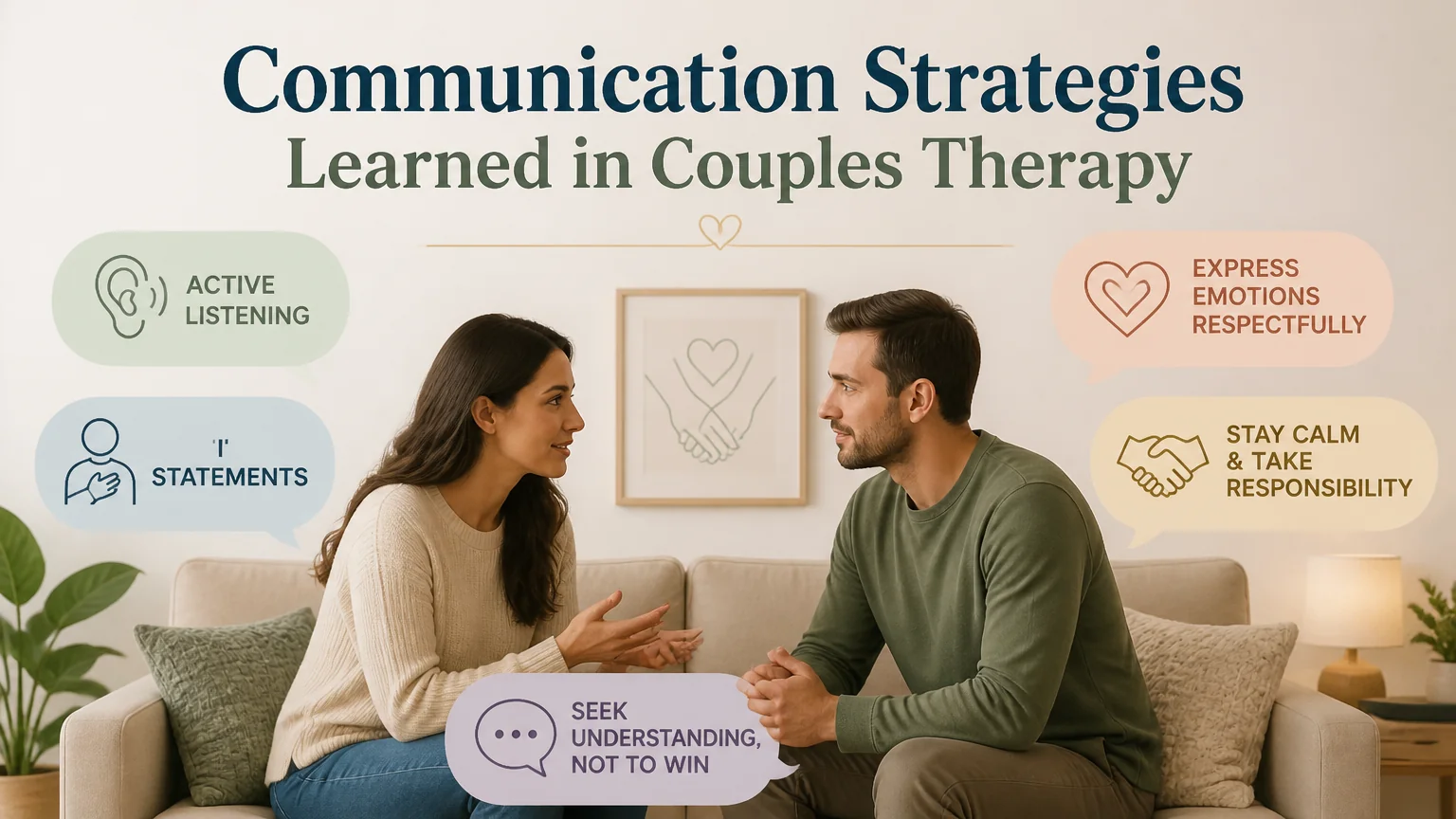
Include techniques to improve active listening, non-blaming expression of needs and step-by-step conflict resolution phases, very practical when contact time is limited.
These exercises can be incorporated gradually and adapted to the rhythms of each couple. The key is consistency and a willingness to experiment until you find what really strengthens the bond.
Before the first session, it is helpful for each partner to reflect on three things: what he or she hopes to achieve with therapy, what the complaints are, and what would be an acceptable solution. In the initial session the therapist will usually ask for a summary of the history of the relationship, the long-distance routines and the most conflicting moments. Bringing concrete examples of interactions (messages or situations) can speed up the work. It is important to agree with the professional on the modality (face-to-face, video call), frequency and rules about confidentiality and participation of each one.
A long-distance relationship depends to a large extent on the emotional health of each person. Taking care of one's support network, maintaining personal interests, getting good sleep and managing stress all help each partner come to the relationship from a stronger place. Individual therapy complements couple's work when there are personal wounds that interfere with the relationship. Remember that "being well on one's own" is not selfishness, but a basis for sustaining the shared bond.
No: many couples seek therapy to strengthen the relationship, improve communication or prepare for important decisions. In the context of distance, preventive therapy can prevent minor problems from becoming chronic.
Yes. Many therapists offer online sessions with good results: the key is to ensure privacy, a stable connection and a space where both feel safe to express themselves.
It is often the case that one person is more motivated than the other. In such cases it may be useful to start with individual therapy to work on one's own posture, and gradually invite the other to participate by showing concrete changes. If resistance persists, the therapist can help negotiate forms of communication and schedules to reduce tension.
Seeking professional help when distance weighs heavy does not imply weakness; it is a conscious decision to protect what you both value. With the right tools, consistent practice and the guidance of a therapist, many couples find renewed ways to stay close, build shared plans and face the future with greater confidence.
Search
Popular searches