For Onlinecourses55
|
2026-10-04
For Onlinecourses55
|
2026-10-04
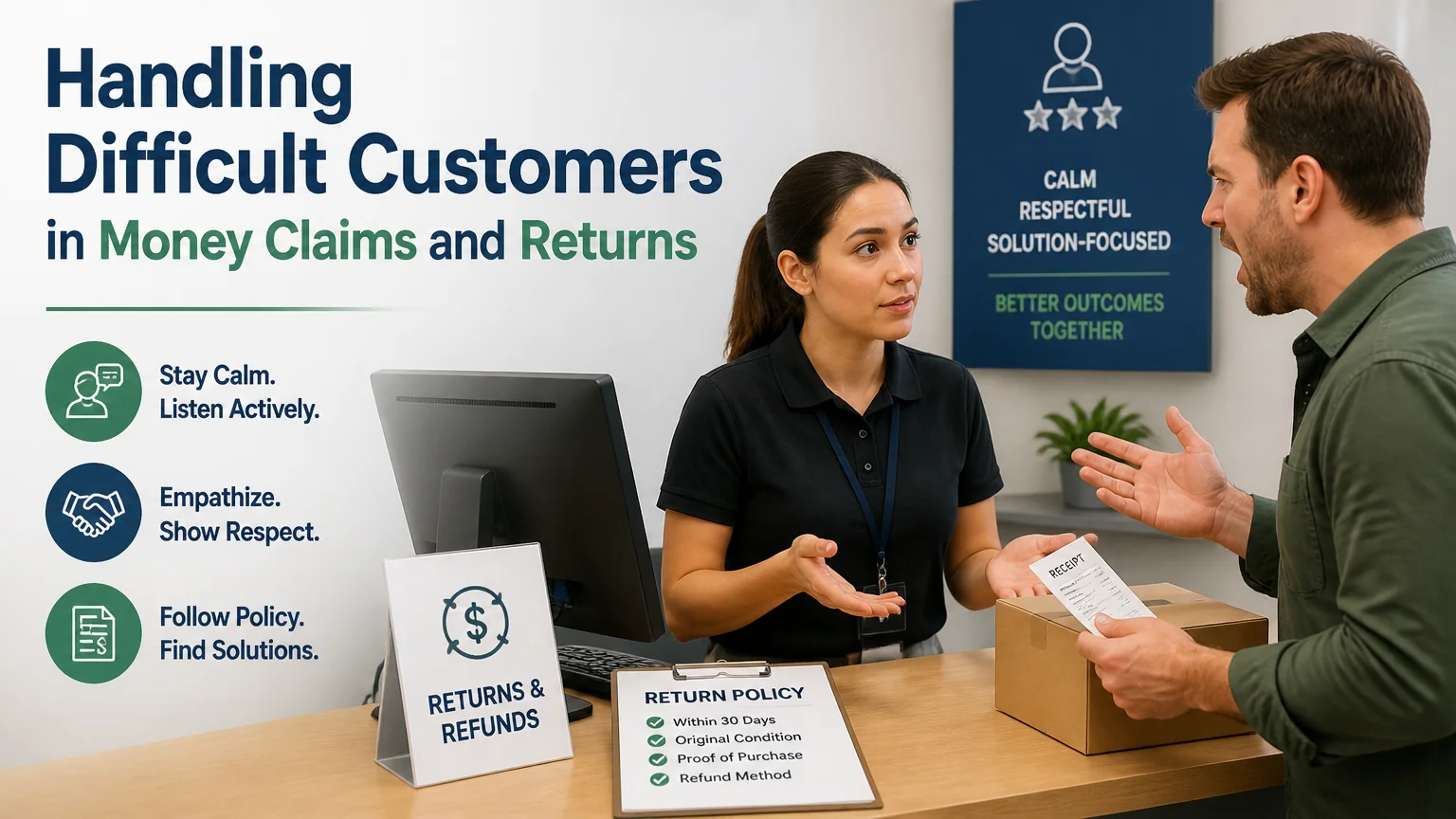
Handling difficult customers in money claims and returns - handling difficult customers
Learn to handle tricky refund requests with confidence by taking our course that trains you in customer service techniques, allowing you to respond with clarity and empathy.
The first step when dealing with a difficult customer regarding a refund or return is to pause and analyze what is really happening. Often, the customer’s frustration stems not from the amount involved, but from the feeling of not being heard, a confusing process, or unmet expectations. Before responding in the heat of the moment, gather the facts: date of purchase, payment method, product or service involved, prior communications, and any applicable policies. This information will provide context and allow you to respond with confidence and clarity.
Active listening quickly reduces tension. Let the customer explain their side of the story without interrupting, and show that you’re listening with short, empathetic phrases: “I understand,” “I can see why this would upset you,” “Thank you for explaining.” Avoid technical terms or phrases that sound evasive. Repeating what the customer said in your own words (“So, what you’re telling us is that…”) confirms that you’ve understood and shows respect for their time and experience.
Once you’ve listened, explain the available steps and estimated timelines in simple terms. Avoid making promises you can’t keep and don’t use excessive legal jargon; clarity builds trust. If there are mandatory procedures (product return, technical department review, payment verification), briefly outline them and provide realistic timelines. Letting the customer know what you’re going to do and when you’re going to do it prevents repeated calls and reduces the customer’s anxiety.
Staying calm is essential. If the customer raises their voice, don’t take it personally. Take a breath, maintain a neutral tone of voice, and use pauses to organize your response. If communicating in writing, proofread before sending and remove any words that might sound defensive. If the customer is angry, it’s appropriate to suggest a pause and propose resuming the conversation shortly: “If that’s okay with you, I can call you back in 30 minutes after speaking with the relevant department.”
Focusing on concrete solutions shortens the conflict. Present options whenever possible: full refund, replacement with another product, store credit, or repair. Allowing the customer to choose between alternatives gives them back some control and reduces resistance. If company policy prevents a full refund, explain why and, if appropriate, offer reasonable compensation (free shipping, a discount on a future purchase, an extended warranty) to preserve the relationship.
Record every interaction: date, time, advisor’s name, what the customer said, and the proposed solution. Documentation protects both parties and facilitates internal escalations if further review is required. Additionally, it allows you to identify patterns when a customer contacts you again about the same issue or when multiple customers report the same problem, which helps improve processes and reduce future complaints.
Clearly define and communicate limits: how much an agent can decide on their own and when it’s necessary to escalate to a supervisor. If you can’t resolve the complaint at your level, inform the customer of the next step, who will take over, and by when. It’s important that escalation isn’t used as an excuse to delay the response; it should be a quick and coordinated process to provide a definitive resolution.
The best way to reduce difficult customers is to anticipate issues. Simplify your return and complaint policies, make them visible and easy to understand, and communicate terms and conditions at the time of purchase. Send clear post-sale confirmations and user guides to minimize misunderstandings. When customers know what to expect, complaints tend to be less contentious and quicker to resolve.
An example for email or chat: "Hello [Name], thank you for contacting us. I’m sorry to hear about this. To help you, I’ll need your order number and a photo of the product. Once I receive them, I’ll assess the situation and get back to you with a solution within 72 hours.” For phone: “I’m very sorry about this; I’ll handle it right away and assign you a case number for follow-up. Can I confirm your order number?” These short scripts convey control and empathy.
Dealing with difficult customers regarding refund claims and returns requires patience, empathy, and clear processes. Active listening, offering concrete options, documenting every step, and maintaining transparent communication are key to turning a complaint into an opportunity to build loyalty. Additionally, continuously reviewing and improving policies and the post-sale experience reduces the recurrence of conflicts. With consistent practices, a customer who is initially upset can end up as a brand advocate.