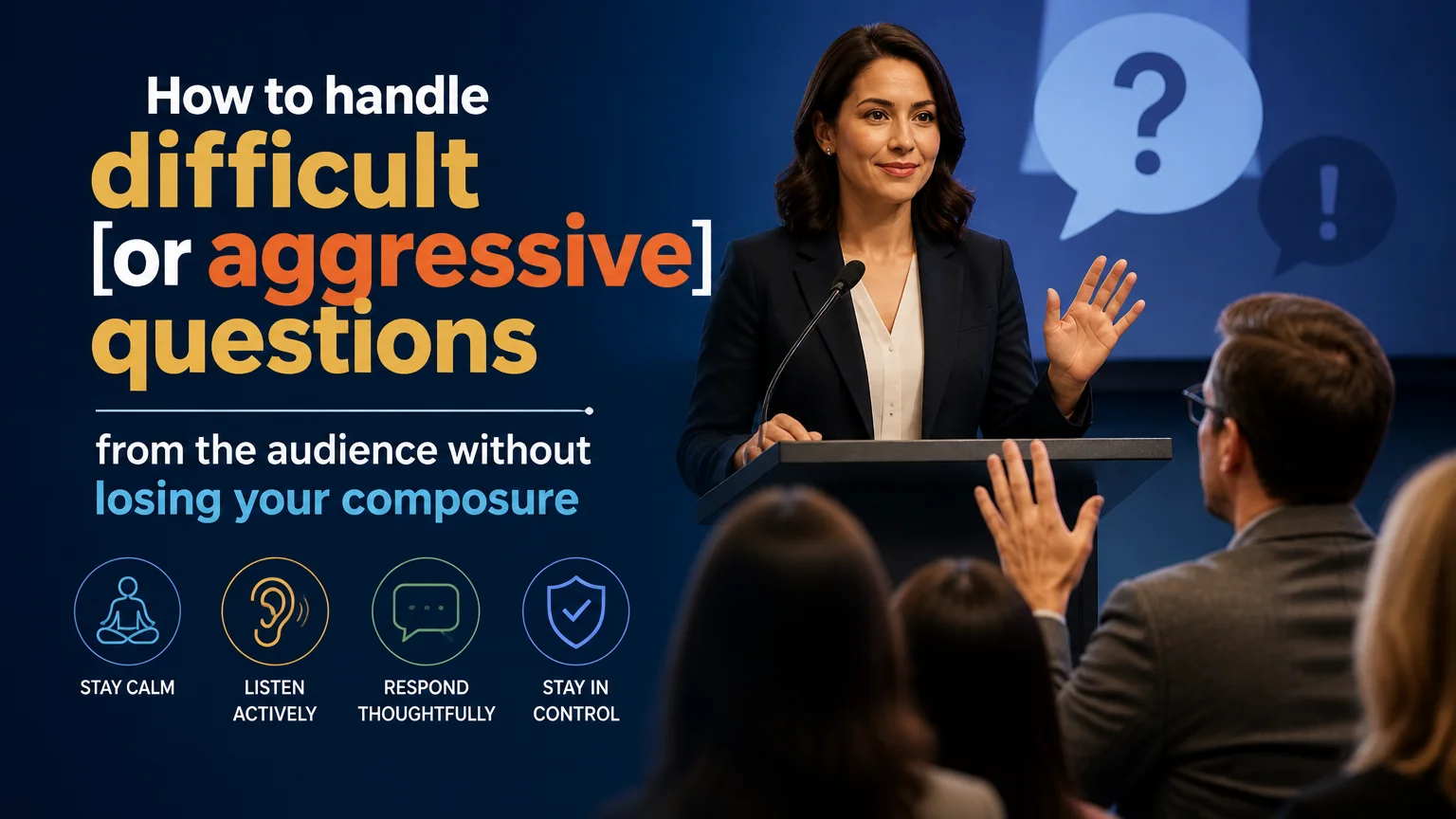
Answering demanding, loaded, or bad-vibe questions is a skill you can train. It’s not about winning a fight, but about guiding the conversation, protecting your message, and staying composed. With intentional preparation and a few simple techniques, you can turn that tense moment into an opportunity to reinforce your credibility.
Understanding the origin of tough questions
Before thinking about answers, it helps to understand why they arise. Not every intervention is an attack; sometimes they signal genuine interest, fear of change, or prior frustration. That initial read helps you avoid taking it personally and choose the right approach.
Common types of tricky questions
- Hostile: challenging tone, seek to discredit.
- Trap: include assumptions that harm you if you accept them.
- Long or rambling: take up time and confuse.
- Off-topic: steer the conversation away from the objective.
- Repetitive: already answered, but the listener wasn’t satisfied.
- Hyper-technical: exceed the intended level of detail.
Preparation: emotional and content shielding
Calm is cultivated before the event. Preparing critical scenarios, key messages, and operational boundaries saves you costly improvisation. Rehearse answers to uncomfortable questions, and decide in advance what you will not discuss.
Risk map and responses
- List of sensitive topics and critical data, with supporting evidence.
- Key messages of 2 to 3 ideas you can always come back to.
- Bridging phrases to steer the conversation without evasion.
- Clear boundaries: timing, confidentiality, out-of-scope topics.
Staying calm in the moment
Visible calm reduces perceived aggressiveness. If you control your breathing and your pace, you control the room’s pace. Pause, observe, and respond from intention, not impulse.
Strategic pause and breathing
- Listen without interrupting; take 2-3 seconds before responding.
- Inhale through your nose counting 4, exhale 4; lower physiological tension.
- If it gets very tense, take a sip of water or jot down a keyword; that gives you room.
Neutral body language
- Open posture, relaxed shoulders, hands visible.
- Calm tone and unhurried pace; avoid speeding up when you feel pressure.
- Brief, evenly distributed eye contact, not a fixed stare.
Techniques to respond with confidence
Content matters, but structure is what gives you control. Use simple frameworks to organize your answer without losing the thread.
Clarify and frame
- Repeat or paraphrase the question to confirm intent.
- Separate emotion from content: “I see there’s concern about…”
- Define the scope: “I can address A and B in this setting; C requires additional data.”
Bridges to the message
- “What matters here is…”
- “To answer usefully, let me start with…”
- “While that detail is valid, the central point is…”
Set boundaries kindly
- Acknowledge the concern, explain the boundary, and offer an alternative.
- “I can’t share confidential figures, but I can share the criteria we use.”
Handle according to the type of question
Hostile or accusatory
Don’t fight the tone; respond to the substance. Thank the candor, validate the concern without accepting unfair premises, and return to verifiable ground.
- “Thanks for raising it directly. On the substantive point…”
- “I don’t agree with that assumption; what is documented is…”
Trap or assumption-laden
Identify the embedded assumption and defuse it before answering. Redefine the question in neutral terms.
- “That wording assumes X; if we distinguish X from Y, I can explain…”
- “Allow me to separate two things so we don’t mix conclusions.”
Too long or off-topic
Summarize in one sentence, validate, and steer back. Protect the group’s time.
- “If I understand correctly, your point is A. On today’s topic, what’s relevant is…”
- “Let’s take this part now and leave the other in the parking lot.”
Repetitive or already answered
Restate briefly with a different example or evidence. If it persists, close gracefully and move on.
- “The key doesn’t change: X for Y reasons. To avoid repeating ourselves, I’ll move to the next one and we’ll come back if there’s time.”
Brief script: listen, acknowledge, synthesize, explore, respond
A practical framework is L-A-S-E-R: listen, acknowledge, synthesize, explore, respond. It gives you structure and conveys respect.
- Listen: without unnecessary interruptions.
- Acknowledge: “I see the interest/concern.”
- Synthesize: “In short, you’re asking about…”
- Explore: “Do you mean X or Y?”
- Respond: clear, brief, with a bridge to your message.
Useful phrases ready to use
- “Thanks for the question; it’s worth looking at it in parts.”
- “Before I answer, can you clarify what you mean by…?”
- “I don’t have that data right now; I can verify it and share it later.”
- “I don’t agree with that premise; what we can state is…”
- “Let’s return to the session’s objective so the group gets value.”
- “I’ll note your concern in the parking lot and we’ll revisit it at the end.”
- “I understand the concern, and that’s why we decided to…”
- “Let me summarize to make sure I understood you correctly…”
Manage time and involve the room
When an interaction gets tense, the group’s energy can help you. Involve them with a brief question or a show-of-hands vote to gauge the mood, and use a moderator if there is one.
- Set Q&A rules at the start: timing and turns.
- If someone monopolizes, set limits politely and give the floor to another voice.
- Use the “parking lot” for complex topics that require more time.
If you make a mistake or don’t know
Credibility doesn’t require omniscience. Clearly acknowledging limits and offering a next step makes you trustworthy.
- “I was wrong when citing that figure; the correct one is…”
- “I don’t have that data now. I’ll confirm it and write to you this afternoon.”
- “Outside my area of expertise; I can refer you to the person leading it.”
Signs it’s better to close
If the exchange becomes personal, repetitive, or unsafe, protect the space. Close with empathy and decisiveness, and propose an alternative channel.
- “To respect everyone’s time, let’s close here and continue one-on-one.”
- “Let’s not move into speculative territory; when we have data, we’ll share it.”
Close with authority and empathy
End your answers by summarizing a core idea and connecting it to the audience’s benefit. The close should sound like “direction,” not “defense.”
- “In short: we decided X for Y, because it maximizes Z for you.”
- “We’re taking these three actions and will share progress on…”
Training and habits that make the difference
Sustained practice turns techniques into reflexes. Rehearse with colleagues playing “devil’s advocate,” record yourself, watch your tone and your pauses. Improve one thing at a time: the pause, the synthesis, the bridging. Over time, tough questions stop being a risk and become the best part: the moment when your preparation and your calm speak for you.
 For Onlinecourses55
|
2026-10-18