What to do with your hands: the definitive guide to stop looking like a robot - overcoming stage fright
Mastering your hand gestures can vastly improve your communication, so learn how to use them effectively during presentations.
Why your hands make you look robotic
When you don’t know what to do with your hands, your body compensates with stiffness, repetitive movements, or exaggerated gestures. That translates into signals of nervousness, distrust, or a lack of naturalness. Your hands are an amplifier of what you say: they underline ideas, set the pace, and help people understand you. If you don’t use them, communication dims; if you use them poorly, you distract. The key is to give them a simple purpose and repeat patterns that feel comfortable.
Basic principles of hand gestures
- Gesture zone: imagine a box between your collarbones and navel. Keep your gestures within that zone most of the time.
- Visible palms: occasionally showing your palms conveys openness and reduces the perception of threat.
- Calibrated amplitude: shoulder-width gestures in normal conversation; a bit larger on stage, smaller in intimate spaces.
- Rhythm and pause: speak, pause, gesture. Don’t gesture without purpose; let the gesture underline a keyword or a number.
- Relaxed symmetry: alternate hands and avoid putting all the work on just one. Seek balance without stiffness.
Where to place your hands when standing
You need a neutral resting place. That way you avoid swaying or nervous gripping.
- Low bowl: gently bring your hands together at navel height, fingers relaxed, without interlacing them tightly.
- Thumb to thumb: touch only the tips of your thumbs, the rest of the fingers loose. A small anchor to release tension.
- Hand over hand on forearm: one hand rests on the opposite forearm, without squeezing. Brief posture, useful when listening.
- A neutral object: hold a slim notebook or a pen, without playing with it. Improves control if it’s hard to keep still.
Avoid keeping both hands in your pockets for long periods. A brief hand-in-pocket can help, but alternate and return to the neutral zone.
What to do with your hands when sitting
When seated, your reference points are the table and your thighs. Keep your elbows away from the edge so you don’t “anchor” yourself with stiffness.
- On the table: rest only the base of your palms or your fingers, with loose wrists. You feel out the terrain without seeming on guard.
- On your thighs: relaxed hands, palms down, fingers apart. Come up to the gesture box when you speak.
- Subtle cup hold: if there’s a drink, use it as an anchor, but set it aside when responding so you can gesture freely.
Gestures that work in any conversation
- Enumerate: count on your fingers 1-2-3 to organize responses.
- Fit ideas together: parallel hands coming closer to show synthesis or agreement.
- Contrast: one hand on each side for “before vs. after” or “A vs. B”.
- Precision: bring thumb and index finger together to signal “detail” or a “key point”.
- Openness: palms semi-open facing up when asking for opinions or inviting participation.
- Gentle direction: open hand with an oblique palm to guide without imposing.
Specific contexts
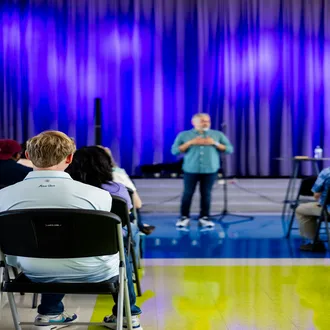
Presentations and public speaking
- Opening: hands in bowl, eye contact, first gesture when stating the central idea.
- Development: alternate enumerating, contrasting, and fitting; keep hands neutral during transitions.
- Closing: closing gesture with hands coming together and a pause. Don’t run from the final silence.
Meetings and job interviews
- Entry: visible hand, firm handshake without squeezing, palms return to the neutral zone.
- Responses: small, precise gestures, closer to the torso. Use enumerations for clarity.
- Dissent: visible palm, fingers together, a gesture of lowering the intensity when offering alternatives.
Video calls
- Framing: raise the camera so your hands are visible up to the chest.
- Slow gestures: reduce speed and amplitude to avoid blurring.
- Listening signal: lightly interlaced fingers in front of the chest or thumb to thumb while nodding.
Dates and social life
- Relaxation: hands visible on the table or on your thighs, without crossing your arms.
- Attunement: subtly mirror the other person’s gestural energy without imitating them.
- Emotional emphasis: brief open palms when sharing something personal.
Photos and camera
- Standing: a light hand in the pocket with the thumb out and the other relaxed, or low bowl.
- Sitting: one hand on your thigh and the other gently holding your forearm. Avoid tense fingers.
- Objects: cup, book, or jacket over the shoulder to give your hands context.
What to avoid without seeming stiff
- Touching your face, hair, or jewelry repeatedly.
- Pointing with your finger as if accusing; use an open hand.
- Cracking knuckles, banging on the table, or clicking a pen.
- Permanently hiding your hands: behind your back or under the table.
- Over-gesticulating: large, constant movements that compete with your words.
Don’t fight every tic: channel it. If you tend to move your fingers, switch to thumb to thumb; if you shake your wrists, move only a minimal flourish within the gesture box.
How to train your hands daily
- 1-minute routine: shake arms, loosen shoulders, open and close your hands 10 times, finish by showing your palms.
- Reading with gestures: take a paragraph and decide on three key gestures. Practice pauses before each gesture.
- Automatic counting: every time you enumerate, use your fingers. Return to neutral after point three.
- Video mirror: record yourself for 60 seconds; eliminate one excess per day (for example, touching your face).
- Breathe into your hands: on the inhale, release your fingers; on the exhale, rest in bowl. Physical anchor for calm.
Cultural signals and adaptation
- Distance and amplitude: the smaller the interpersonal distance, the smaller the amplitude of gestures.
- Pointing: prefer an open hand to a pointing finger, especially with strangers.
- Touch: ask for implicit permission with your gaze before touching a shoulder or arm.
- Local gestures: avoid gestures that change meaning by country; keep it simple and clear.
Mini scripts for typical situations
- Meeting someone: handshake, release, low bowl. When introducing yourself, brief open palm, then back to neutral.
- Answering a difficult question: pause, hands on thighs or bowl, look, enumerate with fingers and close by fitting ideas together.
- Disagreeing: visible palm, head nods slightly, open hand facing down when proposing an alternative.
- Telling a story: start with hands near the chest, medium amplitude at the climax, return to neutral at the close.
- Closing a sale: fitting gesture when summarizing benefits, open palm when asking for the next step.
Quick checklist before you go out
- Loose shoulders, free elbows, warm hands.
- A decided neutral place: bowl, thumb to thumb, or a discreet object.
- Three key gestures ready: enumerate, contrast, and fit.
- Box rule: collarbones to navel as the safe zone.
- Pause and look before gesturing.
- Plan B for nerves: switch to thumb to thumb or hold a notebook.
Practical close
Hands are not a problem to hide, but a tool to direct. Give them a clear resting point, choose a few high-impact gestures, and coordinate them with pauses and eye contact. Practice in short, repeatable segments until your body does it on autopilot. When your hands accompany what you say at the right moment, the feeling of artifice disappears and something better appears: presence.
 For Onlinecourses55
|
2026-04-06
For Onlinecourses55
|
2026-04-06