ForOnlinecourses55

How to sit in an interview to convey confidence and professionalism - communication non verbal businesses
Conveying confidence and professionalism begins long before the first question. The way you sit sets the tone of the conversation, projects confidence and speaks to your self-control. A consistent, open and stable posture makes your ideas come across more clearly. Below you will find a practical guide with concrete recommendations to prepare your presence, choose how to sit and maintain nonverbal communication aligned with your message throughout the interview, both in-person and virtual.
Before sitting down, prepare your body and mind to occupy the space naturally. Two or three minutes of diaphragmatic breathing help lower your heart rate and relax your shoulders and jaw. Practice your base posture: feet supported, long spine, relaxed shoulders and chin parallel to the floor. Visualize the first minute: entering, greeting, sitting down and adopting the initial position. If you can, rehearse in front of a mirror or record yourself: observe if you slouch, if you move your hands excessively or if you lean on the table. The goal is that your posture becomes the "default mode" from which you move and gesture, not a rigid pose that makes you look tense.
When entering, move your shoulders slightly back, walk at a calm pace and maintain friendly eye contact. Wait to be shown where to sit or ask naturally. Place your bag or briefcase to the side of the chair, not on the table. If you offer or receive a handshake, do it standing; then sit down with a controlled movement, without collapsing into the chair or dragging it noisily. As you settle, show a slight smile and relax your breathing. That first settling sets the pattern: seek stability and calm.
If the chair is adjustable, set the height so that your feet are fully supported and your knees are about 90–100 degrees. Bring the chair close enough to the table so you don't have to lean forward excessively when you speak. If there are armrests, use them lightly, without gripping. In one-on-one conversations, a slight torso orientation of 30–45 degrees relative to the table reduces the sense of confrontation and promotes connection. Avoid reclining too far; the backrest is a support, not a hammock.
Seat your sit bones (pelvic bones) well and feel the spine lengthen from the base to the crown. Imagine a string holding you up, without stiffening the neck. Draw the shoulders slightly back and down, opening the chest without exaggeration. Maintain a micro-forward lean of 5–10 degrees toward your interlocutor when you speak; it communicates interest and assertiveness. Avoid thoracic "collapse" and also military rigidity: the key is an active, relaxed tone.
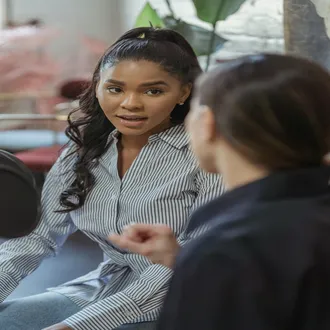
Keep the chin parallel to the floor and avoid constantly tilting your head to one side. Look people in the eyes in blocks of 3–5 seconds and alternate with natural pauses toward documents or notes. A steady gaze, accompanied by normal blinking and slight smiles, projects friendly confidence. If there are several people, distribute your gaze evenly and return your look to the person who asked the question when you finish your answer.
Hands tell a story about your control and openness. Keep your elbows close to your body, with forearms lightly supported on the table or on your thighs. Show your palms naturally when gesturing, avoiding pointing in an accusatory way. A soft steepling gesture or bringing fingers together and apart in moderation can help emphasize complex ideas. Avoid crossing your arms, clenching your fists, fidgeting with objects or touching your face repeatedly. If you carry a pen or notebook, place them aligned and use them with intention: taking brief notes reinforces your attention; doodling conveys nervousness. While listening, keep your hands still and visible; when speaking, use gestures that accompany the rhythm of your voice without invading the interviewer's space.
Place both feet on the floor, with the toes pointed toward the interlocutor. Keep your knees hip-width apart. You can cross your ankles briefly if it feels comfortable, but avoid crossing your legs at the knee for long periods: it closes the posture and complicates spinal alignment. Stop any repetitive movement (bouncing the knee, tapping the floor, swinging the foot). If you notice yourself doing it, breathe and "anchor" the soles of your feet to regain stillness.
Lean slightly forward, nod occasionally and keep an attentive gaze. Avoid interrupting with micro-gestures of impatience. Maintain comfortable silences, without filling them with noises (clicks, taps). An open and stable posture conveys that you understand and value what is being said to you.
Before you start, pause for a second, inhale and begin with a long spine. Accompany key ideas with measured gestures, lower your hand at the end of each sentence and avoid "over-explaining" with your body. If you are asked a difficult question, maintain the base posture, look at the interviewer, take a breath and answer calmly. Postural calm reinforces the perception of competence.
You can lightly mirror the interviewer's body language (rhythm, lean, amplitude of gestures). Do it naturally, never as a literal copy. Moderate synchrony creates rapport without losing your own style.
Organize your workspace on the table: resume at hand, discreet pen and notebook. Place the water bottle out of the visual axis. Keep your phone off and put away. If you are offered coffee or water, accept only if it does not compromise your comfort while speaking. Avoid invading the interviewer's area with your objects. When you want to show a portfolio, turn it toward them while keeping your elbows close to your body so you don't reach too far across the table.
In remote format, the camera becomes your interlocutor. Adjust the chair so that your upper torso and hands fit in the frame; your gaze should align with the webcam. Sit slightly forward in the chair to avoid reclining. Illuminate your face from the front and place the camera at eye level. Gesture a little more slowly so movements appear clear on screen and look at the camera when you close key ideas. Avoid swivel or wheeled chairs if you move a lot: they add distractions. Plant your feet and avoid placing one leg over the other, which can misalign you and take you out of frame.
Posture is trained like any skill. Spend a few minutes each day sitting in your base posture and answering practice questions out loud. Practice in front of a real table, with a chair similar to an office chair. Record short sessions and correct only one aspect at a time (hands visible, feet anchored, moderate lean). With repetition, these supports become automatic and you can focus your energy on the content of your answers, letting your physical presence support your professionalism.
Sitting well is not about appearing to be someone you're not, but about removing noise and showing your best version clearly. With a stable foundation, an open attitude and coherent body communication, your message travels farther and your confidence is perceived effortlessly.