For Onlinecourses55
|
2026-04-14
For Onlinecourses55
|
2026-04-14
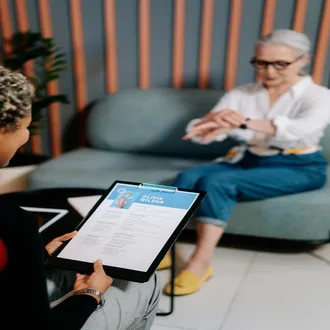
Power postures: how to project confidence and authority instantly - communication non verbal businesses
Use your body language to your advantage by implementing practical strategies that project confidence and clarity without coming across as stiff.
There are times when you want your presence to speak before your words. That initial impression depends not only on what you say, but on how you position yourself, breathe and occupy space. The good news: you can train it. With some conscious body adjustments, it is possible to convey calm, determination and clarity without falling into stiffness or arrogance. What follows is a practical guide to using your posture to your advantage, naturally and sustainably.
Postures that project confidence are not theatrical poses or masks. They are simple body configurations that send coherent signals: openness, stability and direction. It is not about "acting" confident, but about creating the physical conditions for your mind and voice to organize.
They are also not a universal trick that works the same everywhere. Cultural context, environment and your own disposition matter. Think of these guidelines as a flexible framework. Adapt it to your style and the situation, always with authenticity: authority is not hardness; it is calm clarity.
The way you position yourself influences how you think and feel. A stable posture facilitates deeper breathing and a slower speaking rhythm. The opposite also happens: if you slouch, you reduce the space to breathe and your voice can become shaky or rushed.
We will work on three axes: verticality (elongated spine), openness (chest and shoulder openness) and grounding (firm feet and distributed weight). When those axes are aligned, the body conveys calm, and your audience's attention gravitates toward you naturally.
Visible hands increase the perception of openness and competence. Gesture from the center of the body outward, not from the shoulders, and avoid pointing at people. Use gestures that "contain" ideas: open to enumerate, close to conclude.
The gaze holds the conversation. Distribute it in cycles: 3 to 5 seconds per person in small groups; in auditoriums, divide the room into zones and alternate. When you listen, tilt your head slightly and soften your gaze to show receptivity without losing postural firmness.
This sequence signals the body that you are ready to lead the interaction. Repeat before presentations, calls or difficult conversations.
The most persuasive combination is not hardness, it is competence with closeness. Translate this into three gestures: stable posture (competence), friendly facial expression (warmth) and visible listening (validation).
In formal or hierarchical environments, reduce the amplitude of gestures and increase precision. In creative contexts, broader gestures can be read as energy and initiative. Observe first: calibrate your posture to the "average" of the room and raise your presence by 10% from there.
People of different heights or builds can adjust openness to avoid oversizing their presence. If you are often perceived as distant, prioritize signals of warmth (smile, nod). If you are perceived as scattered, reinforce pauses and the grounding of your feet.
To measure, record yourself or ask someone to observe three aspects: stability, clarity and closeness. Define a personal cue (for example, touching thumb to index) to remind you to straighten your posture without anyone noticing.
Projecting confidence and authority is, in essence, ordering your body so your message arrives clear. Start with the fundamentals: feet on the ground, slow breathing, gentle openness. With consistent practice and small corrections, your presence will stop being an accident and become a conscious choice.
Search
Popular searches