For Onlinecourses55
|
2026-03-05
For Onlinecourses55
|
2026-03-05
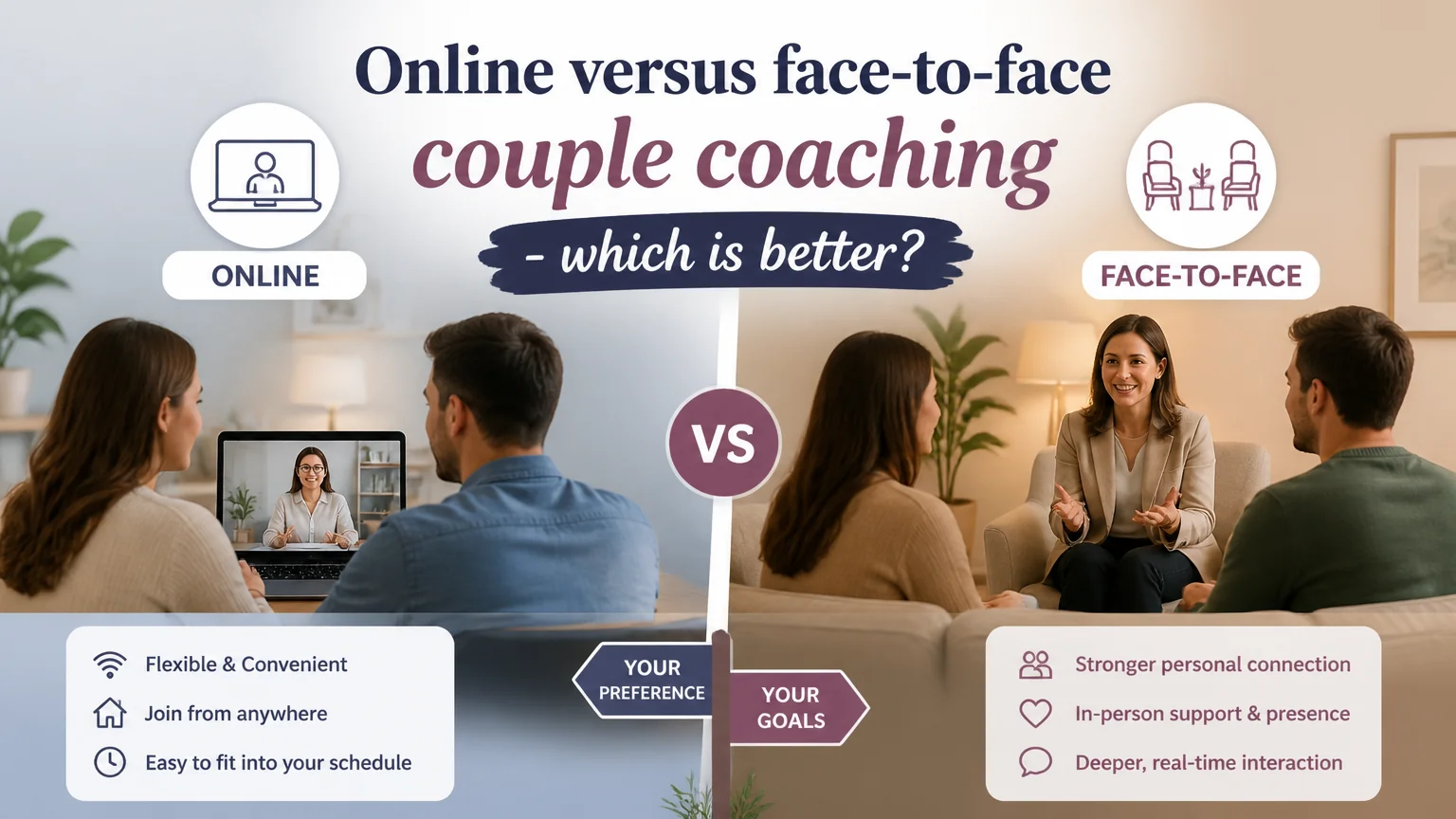
Online versus face-to-face couple coaching - which is better? - couples coach
Deciding between distance or face-to-face coaching can influence your experience and outcomes. Understanding the benefits of each can empower you to choose the best fit for your relationship. Delve into the essential differences and discover how relationship coaching formats tailor to your specific needs.
When a couple decides to work on their relationship, they are looking for clarity, practical tools and a safe space to explore emotional dynamics. Today there are two main ways to receive professional accompaniment: distance sessions and face-to-face sessions. Each format has different characteristics that influence the experience, communication and results. The key differences, advantages and limitations of each modality are discussed below to help decide which may be best suited to a particular situation.
Remote coaching is usually done through video calls, phone calls or even email messages and exercises. Before the first session, the practitioner and the couple agree on the platform to be used, the duration of the sessions and certain confidentiality agreements. In many cases, questionnaires are sent beforehand to identify priorities and digital resources are shared between sessions.
Face-to-face sessions are conducted face-to-face in a dedicated space, which allows for direct interaction and the possibility of observing body language, tones and micro-expressions with greater fidelity. The professional can propose dynamics in the same room, body expression exercises, or activities that require travel. There is also usually a greater formality in the schedules and duration of the sessions.
The distance modality offers a flexibility that many couples value. It facilitates access to professionals who are not in the same city, reduces travel time and often allows for longer schedules. For couples with tight schedules, family responsibilities or mobility difficulties, the online option may be the most practical.
Physical presence generates a sense of closeness that can facilitate trust and depth of work. The shared space creates a specific framework for the session, which helps to separate daily life from the therapeutic process. In addition, observing body language and dynamics in situ can provide valuable information that is not always evident on a screen.
Each format also presents challenges. In the online modality, there may be technical problems, difficulties in creating intimacy through the screen, or interruptions from the home environment. In the face-to-face format, limitations include travel, higher costs and possible difficulties in coordinating schedules.
There is no single answer; the choice depends on objectives, context and preferences. As a guideline, certain situations tend to benefit more from one modality or the other.
In order to make a decision, it is useful to evaluate specific aspects before choosing a modality. Ask about availability, budget, goals of the process and comfort level with the technology. It is also important to assess the experience and training of the professional, beyond the format offered.
Regardless of the format chosen, there are practices that increase the effectiveness of the process. Establish clear agreements, maintain consistency and practice the tasks proposed by the professional. A willingness to be open and experiment with new ways of communicating is key to moving forward.
The choice between distance and face-to-face accompaniment depends more on the concrete needs of the couple than on the supposed superiority of one modality over the other. Both can be highly effective if the professional has good training, the couple is committed to the process and the conditions are adjusted to favor trust and continuity. Assessing objectives, logistics and emotional preferences will help to make an informed decision and design a work plan that enhances the expected results.
Search
Popular searches