For Onlinecourses55
|
2026-10-03
For Onlinecourses55
|
2026-10-03
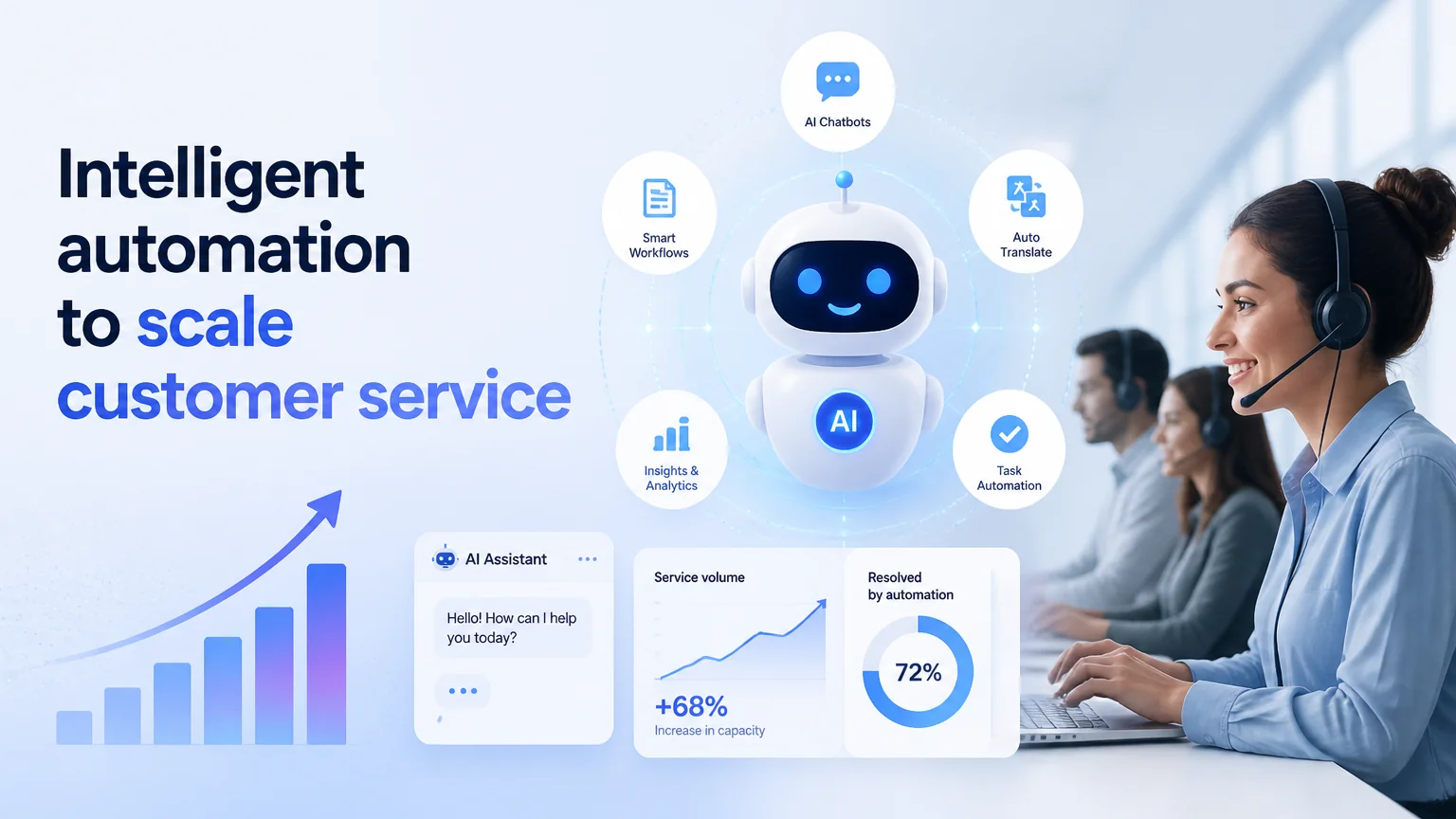
Intelligent automation to scale customer service - customer service
Leverage intelligent automation to improve service interactions by understanding its components through our detailed training that's practical and insightful.
Intelligent automation combines automated rules, artificial intelligence, and customer data to manage service interactions without compromising quality. It’s not just about replacing human tasks with machines, but about designing workflows that enable fast, consistent, and personalized responses whenever possible, and transferring to a human agent when necessary. This approach seeks to balance operational efficiency and customer experience through context-based decisions and continuous learning.
Adopting intelligent automation in customer service has measurable impacts on response time, cost, and service perception. It allows for handling a higher volume of interactions without proportionally increasing the workforce, reduces wait times through instant responses, and frees up agents to focus on complex cases that truly require human judgment. Additionally, by leveraging historical data and patterns, it improves the consistency of responses and facilitates the early detection of recurring issues.
Intelligent automation applies to a wide variety of scenarios within customer service. Some typical examples include managing frequently asked questions, tracking shipments, processing refunds, scheduling appointments, identity verification, and initial technical support. Each case can be designed with different levels of automation depending on the complexity and risk associated with the automated decision.
Effective implementation relies on a clear roadmap that minimizes risks and maximizes adoption. Starting with low-risk, high-volume cases allows you to validate hypotheses, measure impact, and make adjustments without compromising customer satisfaction. Collaboration between business, technology, and operations teams is essential to ensure that automated workflows reflect real-world processes and handle exceptions correctly.
The market offers a variety of solutions: chatbot platforms with NLP, RPA tools, CRM systems with native integration, orchestration engines, and conversational analytics. The choice depends on the size of the company, the complexity of processes, and the desired level of customization. It is advisable to prioritize solutions that allow for open integrations and scaling without completely replacing the existing infrastructure.
Accurate measurement is key to scaling with confidence. Defining clear KPIs from the start will allow you to assess whether automation is delivering value. Among the most useful metrics are automatic resolution rate, average handling time, transfer-to-agent rate, customer satisfaction, and cost per interaction. Feedback from agents and customers helps identify gaps in automated responses to improve models and rules.
Automation is not without its challenges. Poor design can lead to frustration if customers feel forced into an automated loop without access to human assistance. Additionally, managing sensitive data requires strict controls. Another common challenge is ensuring that systems learn correctly and do not reproduce biases or errors that affect service quality. Overcoming these challenges requires constant testing, governance, and a clear scaling strategy.
Successful scaling involves more than just technology: it requires a customer-centric culture, flexible processes, and metrics aligned with business objectives. Starting small, measuring results, learning, and expanding progressively minimizes risks. Maintaining transparency with customers about when they are interacting with automated systems and always ensuring a satisfactory human experience in complex cases are principles that underpin sustainable growth.
With a customer-centric strategy, intelligent automation can transform customer service, making it possible to handle more inquiries faster and at a lower cost, without sacrificing empathy or effective problem-solving. When implemented carefully and monitored constantly, it becomes a powerful lever for scaling operations and improving service perception.