For Onlinecourses55
|
2026-03-05
For Onlinecourses55
|
2026-03-05
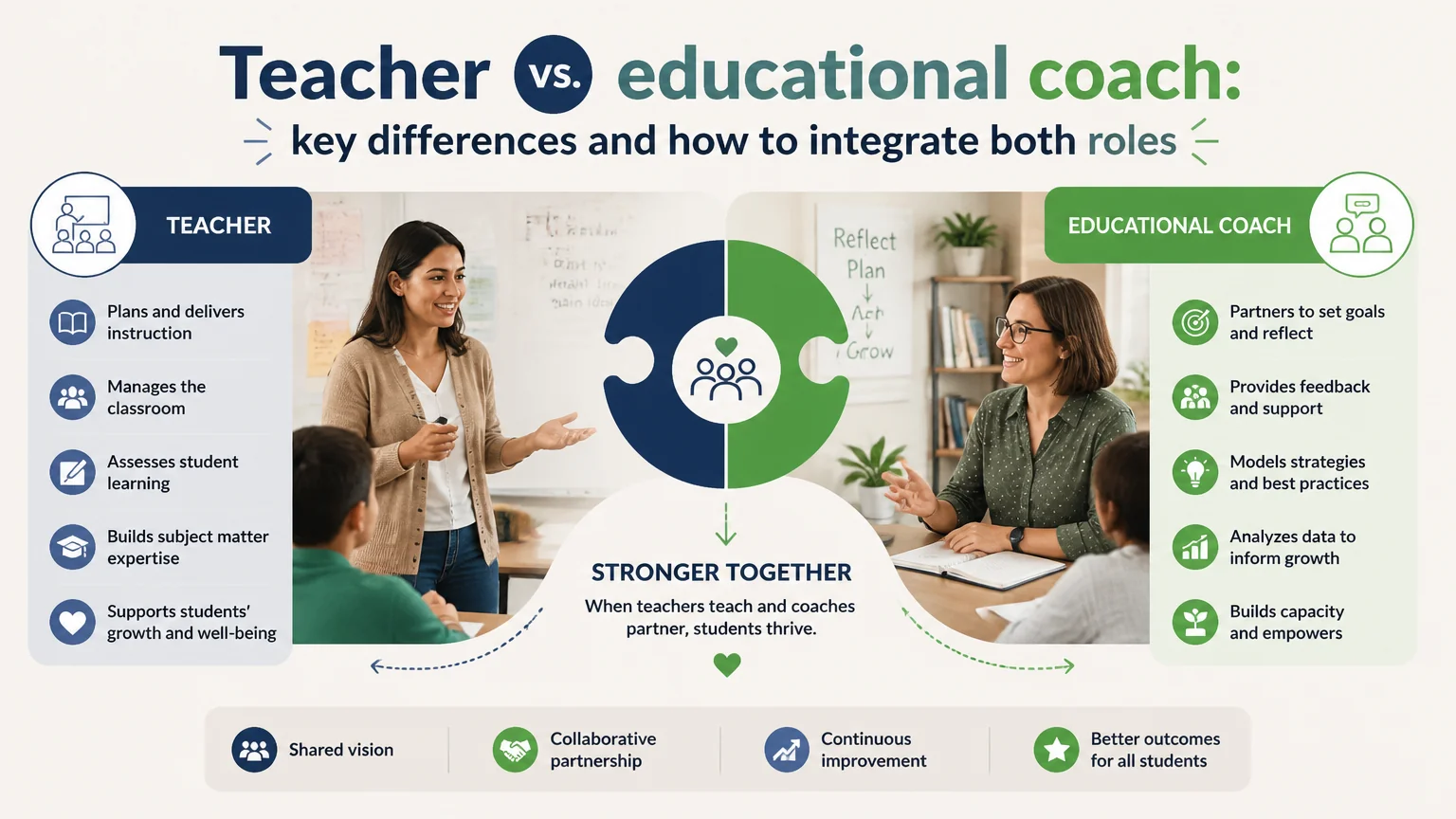
Teacher vs. educational coach: key differences and how to integrate both roles - educational coach
Understanding the relationship between teaching and coaching roles fosters growth; a course on integrating coaching in educational settings can refine your approach, enhancing both teaching and learning.
In education, two roles often intertwine with distinct but complementary purposes: the person who teaches content and manages learning in the classroom, and the person who supports professional development to improve practice. Understanding their differences and, above all, how to integrate them harmoniously allows for raising learning outcomes and building healthier school cultures. Below are clear frameworks, examples, and practical steps to combine both approaches sustainably.
Teaching is aimed at ensuring student learning: it plans, teaches, assesses, and adjusts instruction so that curriculum objectives are met. Formative coaching focuses on the professional's growth: it helps clarify goals, observe practice, reflect, and design improvements. One prioritizes immediate learning outcomes; the other, the development of capacities in the medium and long term.
In the classroom, the relationship is usually asymmetrical: the teacher guides, structures, and makes pedagogical decisions. In coaching, the relationship tends to be more horizontal: trust is built, questions are asked, and strategies are co-designed. Authority in teaching stems from the instructional role; in coaching, from credibility, listening, and shared evidence.
Teaching practice uses lesson sequences, scaffolding, formative assessment, time and group management, materials, and resources. Coaching relies on observation protocols, specific measurable goals, open questions, evidence analysis, and feedback cycles. Both can use data, but with different focuses: student performance versus improvement of practice.
In the classroom, assessment verifies the achievement of learning and guides reteaching. In coaching, evidence is used to raise awareness and guide professional change, not to grade. Therefore, it is key to agree in advance which data will be collected, for what purpose, and how confidentiality will be protected to sustain a safe improvement culture.
A team seeks to improve academic participation in discussions. They set the goal that 80 percent of students will make at least two evidence-based contributions in each class. A mini-lesson is designed that models how to cite sources and build arguments. Turn-taking cards and sentence stems are incorporated. Over three sessions, interventions per student and their quality are recorded. After observation, the sequence is adjusted: more individual preparation time and peer-check pairs. At the end of the cycle, the data show an increase in frequency and quality, and the team decides to scale the practice to more groups.
Yes, but not at the same time and not under the same rules. It is advisable to make explicit when one is teaching and when one is coaching, with different purposes, evidence, and confidentiality agreements. Separating hats avoids confusion and protects trust.
The key is clarity: coaching uses data to learn and improve; summative assessment judges the level achieved. Keeping differentiated spaces, with transparent criteria, and prioritizing short improvement cycles reduces tensions and enhances results.
Integrating both perspectives does not mean diluting them, but orchestrating them intentionally: teach with clarity and rigor, and coach with questions, evidence, and follow-up. When goals, practices, and data are aligned, student learning improves and the profession is strengthened. The first step is small and concrete: choose a focus, observe it honestly, and start a brief shared improvement cycle.
Search
Popular searches