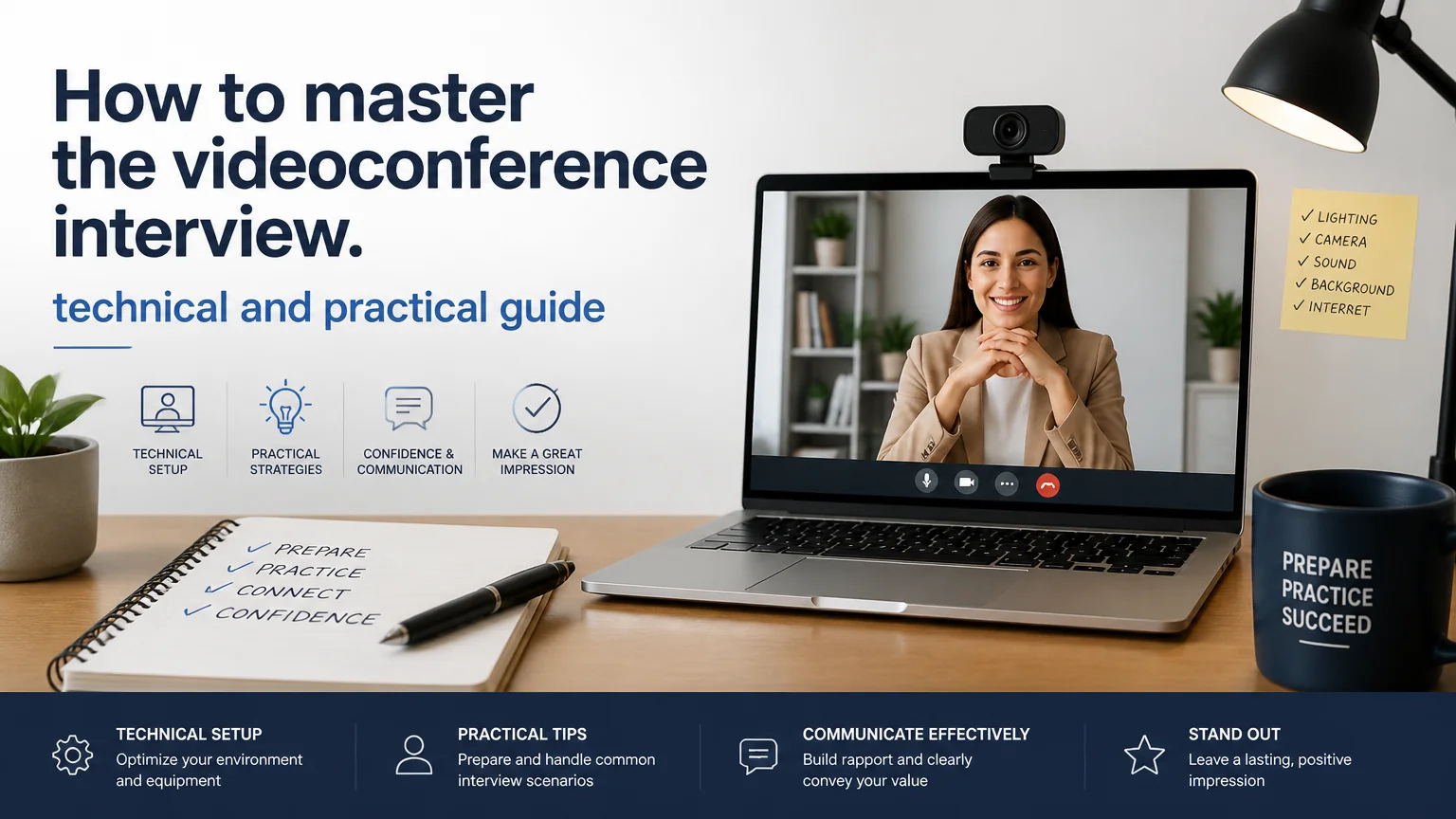
How to master the videoconference interview. technical and practical guide - job interview
Get ready for virtual interviews by mastering your online presence with our videoconference preparation guide that ensures a polished appearance and smooth communication.
How to Master the Videoconference Interview: Technical Guide to Not Failing on Zoom
The world has changed and selection processes have too. The videoconference interview (Zoom, Teams, Skype) is no longer an exception, it's the norm, especially in the early screening phases. However, many candidates treat it with less formality than an in-person one, making technical and etiquette mistakes that cost them the job. In this article we teach you how to prepare your recording "set" and your attitude to get through the screen.
1. Technical Preparation: Your New "Suit"
In a virtual interview, your internet connection and image quality are part of your professional image. If the call drops or you appear pixelated, the perception of your digital competence decreases.
- Hardware Check:Test before going live: Don't wait until 5 minutes before. Check camera, microphone and speakers the day before. [cite_start]Make a test call with a friend [cite: 1171, 1174-1175].
- Connection:Wired vs Wifi: If possible, connect via Ethernet. [cite_start]It's much more stable than Wi‑Fi and you'll avoid freezes at the key moment of your answer [cite: 1172-1173].
- Platform:Familiarity: Do they use Teams, Zoom or Meet? [cite_start]Download the app, update it and make sure your username is professional (no childhood nicknames)[cite: 1174].
2. The Setting: Mind the Environment
Your home becomes your office. What is visible behind you communicates as much as you do.
- Background:Neutral and Tidy: A plain wall, a tidy bookshelf or a professional virtual background are ideal. [cite_start]Avoid showing an unmade bed, a dirty kitchen or hallways with people passing by [cite: 1182-1183].
- Lighting:Front Light: Never sit with your back to a window (backlight), you'll appear as a silhouette. The light should hit your face. [cite_start]A lamp behind your laptop works wonders [cite: 1184-1185].
- No Distractions:Shielding: Tell your family or roommates. Close the door. Secure the pets. [cite_start]Silence your phone and computer notifications (Slack, Whatsapp Web, Email) [cite: 1186-1188].
3. Personal Image Remotely
The classic mistake: "Dressing only from the waist up".
- Full Outfit:Psychology and Safety: Dress as if you were going to the office, pants and shoes included. This puts you in "work mindset". [cite_start]Also, if you have to get up for an emergency, you don't want to be seen in pajamas [cite: 1190-1192].
- Makeup and Shine:HD Camera: Webcams accentuate skin shine. [cite_start]A bit of mattifying powder (even for men) helps give a more polished, less sweaty appearance under the lights [cite: 1204-1205].
4. Eye Contact and Digital Body Language
The rules change in front of a webcam. This is where most people lose the emotional connection.
- The Gaze Trick:Look at the camera, not the screen: When you speak, you instinctively look at the other person's face on the screen. [cite_start]But for them to feel like you're looking them in the eye, you must look at the little black dot of the camera[cite: 1196]. Practice this — it's unnatural but very effective.
- Framing:Medium shot: Don't get too close to the camera (the "giant head" effect) nor sit too far away. Shoulders and head should be visible with a bit of space above.
- Extra Energy:Compensation: The screen "eats" energy. [cite_start]You need to project your voice a bit more, smile a bit more and gesture slightly more noticeably so your enthusiasm comes through the fiber-optic connection[cite: 1201].
5. The "Invisible" Cheat Sheet
A big advantage of the online interview is that you can have notes.
- Strategic Post-its:Visual support: Stick post-its around the screen with keywords, figures of your achievements, or questions you want to ask. [cite_start]Being close to the camera, it will look like you're looking at the interviewer while you consult your notes [cite: 1139-1140].
Mastering the online interview demonstrates technological adaptability, one of the most in-demand competencies today. Treat it with the same seriousness as an in-person meeting with the CEO.
 For Onlinecourses55
|
2025-12-15
For Onlinecourses55
|
2025-12-15