For Onlinecourses55
|
2026-09-27
For Onlinecourses55
|
2026-09-27
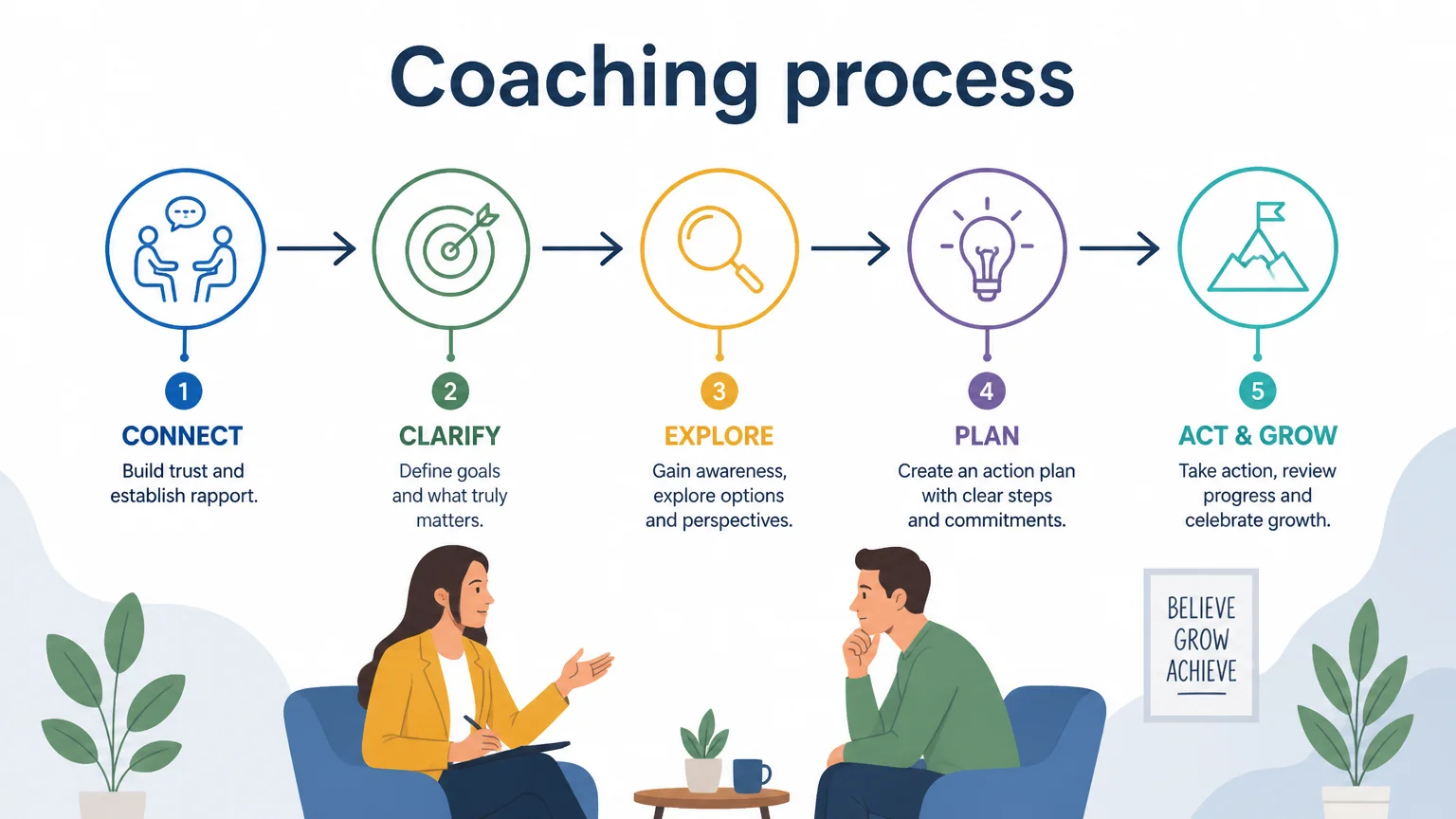
Coaching process - life coaching
Have you ever felt stuck, as if you were going around in circles without making progress? Do you dream of achieving great things, but don’‘t know where to start? If the answer is yes, then coaching could be the tool you need to unlock your potential and transform your life.
Coaching is not therapy, nor consulting, nor mentoring. It is a personalized support process that helps you identify your objectives, overcome your obstacles, and develop the necessary skills to reach your goals. Imagine it as having a strategic partner who pushes you to be the best version of yourself.
In this article, we will explore the coaching process in depth, from its fundamentals to its benefits and the different stages that compose it. Get ready to discover how coaching can be the catalyst you need to achieve success in all areas of your life.
Before diving into the stages of the process, it is crucial to understand what coaching is and what it is not.
What Coaching IS:
A process of personal discovery that helps you become aware of your strengths, weaknesses, values, and beliefs.
A collaborative relationship between the coach and the coachee (the person receiving coaching).
A focus on the present and the future, rather than focusing on the past.
A tool for setting clear goals and developing an action plan to achieve them.
A catalyst for personal and professional change and growth.
What Coaching is NOT:
Therapy: Coaching does not focus on healing deep traumas or emotional problems. If you need therapeutic help, it is important to seek a mental health professional.
Consulting: A consultant gives you solutions and tells you what to do. A coach helps you find your own solutions and make your own decisions.
Mentoring: A mentor shares their experience and gives you advice. A coach helps you discover your own path and develop your own skills.
A magic bullet: Coaching requires commitment, effort, and a willingness to step out of your comfort zone.
Coaching offers a wide range of benefits that can transform your life in multiple areas. Here are some of the most notable ones:
Greater Self-Awareness: Coaching helps you understand your thought patterns, emotions, and behaviors, allowing you to make more conscious decisions aligned with your values.
Better Time Management and Productivity: You will learn to prioritize tasks, set boundaries, and optimize your time to achieve your goals more efficiently.
Increased Confidence and Self-Esteem: Coaching helps you recognize your achievements, overcome your fears, and develop greater confidence in your abilities.
Improved Communication and Interpersonal Relationships: You will learn to communicate more effectively, express your needs, and build stronger, more meaningful relationships.
Greater Clarity and Focus: Coaching helps you define your goals, identify your priorities, and stay focused on what truly matters.
Reduced Stress and Anxiety: You will learn to manage stress, control your emotions, and develop greater resilience in the face of challenges.
The coaching process is generally divided into several key stages that guide you from the starting point to the achievement of your goals. While each coach may have their own approach, these are the most common stages:
This first stage is fundamental to building a solid foundation for the coaching process. The coach is dedicated to establishing a relationship of trust, respect, and empathy with the coachee. Expectations are explored, roles are defined, and the ground rules are set. The goal is to create a safe space where the coachee feels comfortable opening up and being vulnerable.
In this stage, the coach helps the coachee assess their current situation, identify their strengths and weaknesses, and define their short, medium, and long-term goals. Assessment tools, such as questionnaires, interviews, and reflection exercises, are used to gain a deep understanding of the coachee’‘s needs and aspirations. Goals must be SMART: Specific, Measurable, Achievable, Relevant, and Time-bound.
Once the goals have been defined, the coach helps the coachee explore different options and strategies to achieve them. Creativity, brainstorming, and the search for innovative solutions are encouraged. The coach acts as a facilitator, guiding the coachee to discover their own answers and make informed decisions.
In this stage, a detailed action plan is developed, with concrete steps, deadlines, and responsibilities. The coachee commits to carrying out the necessary actions to achieve their goals. The coach provides support, motivation, and follow-up to ensure the coachee stays focused and sticks to their plan.
Throughout the process, the coach constantly monitors the coachee’‘s progress. Results are evaluated, obstacles are identified, and necessary adjustments are made to the action plan. The coach celebrates achievements and provides constructive feedback to help the coachee continue to grow and advance.
Once the goals have been achieved or the coaching process has been completed, a formal closure takes place. Achievements are reviewed, learnings are consolidated, and strategies are established to maintain progress in the long term. The coach and coachee part ways with gratitude and mutual recognition.
The coach is not an expert who tells you what to do, but a facilitator who helps you discover your own answers. Their main role is to:
Listen actively: Pay attention to what you say and what you don’‘t say, to understand your needs and perspectives.
Ask powerful questions: Formulate questions that make you reflect and challenge your limiting beliefs.
Provide honest feedback: Offer constructive comments to help you improve and grow.
Create a safe space: Provide an environment of trust and respect where you feel comfortable being vulnerable and authentic.
Support your growth: Celebrate your achievements, motivate you to overcome your challenges, and accompany you on your path to success.
Empower you: Give you the tools and knowledge you need to take control of your life and achieve your goals.
Choosing the right coach is a personal decision that requires research and reflection. Here are some tips for finding the coach that best suits your needs:
Define your goals: What do you want to achieve with coaching? In what area of your life do you need help?
Research different coaches: Look for coaches who have experience in your area of interest and who align with your values.
Read reviews and testimonials: Find out what other clients say about the coach.
Schedule an initial session: Most coaches offer a free session to get to know you and explain their approach.
Trust your intuition: Choose a coach with whom you feel comfortable, safe, and connected.
Coaches use a variety of tools and techniques to help their clients achieve their goals. Some of the most common include:
Powerful questions: Open-ended questions that invite reflection and self-discovery.
Visualization: Imagining success and creating a clear mental picture of your goals.
SMART goal setting: Defining specific, measurable, achievable, relevant, and time-bound goals.
SWOT analysis: Identifying your Strengths, Weaknesses, Opportunities, and Threats.
Wheel of Life: Evaluating your level of satisfaction in different areas of your life.
NLP (Neuro-Linguistic Programming): Techniques to change patterns of thought and behavior.
Mindfulness: Practicing full attention to reduce stress and improve concentration.
To make the most of the coaching process, it is important to avoid these common mistakes:
Not being committed: Coaching requires effort and dedication. If you are not willing to invest time and energy, you are unlikely to see results.
Having unrealistic expectations: Coaching is not a magic bullet. It takes time and patience to see significant results.
Not being honest with your coach: Honesty is fundamental to building a trusting relationship and getting the most benefit from coaching.
Resisting change: Coaching will challenge you to step out of your comfort zone and adopt new perspectives.
Not implementing the action plan: Coaching is not just about talking and reflecting. It is important to take action and put what you learn into practice.
There are different types of coaching, each focused on a specific area of life. Two of the most common are:
Life Coaching: Focuses on helping you improve your overall well-being, achieve your personal goals, and live a fuller, more meaningful life.
Executive Coaching: Focuses on helping you improve your professional performance, develop your leadership skills, and achieve your career goals.
The choice between life coaching and executive coaching will depend on your specific needs and goals.
There are many myths about coaching that can create confusion and unrealistic expectations. Here are some of the most common:
Myth: Coaching is only for people who have problems. Truth: Coaching is for anyone who wants to improve their life and reach their full potential.
Myth: Coaching is a waste of time and money. Truth: Coaching can be a valuable investment if you find the right coach and commit to the process.
Myth: Anyone can be a coach. Truth: Coaching requires training, experience, and specific skills.
Myth: Coaching is the same as therapy. Truth: Coaching and therapy are two different disciplines with different approaches and goals.
Coaching is constantly evolving and adapting to the new needs of the market. In the future, coaching is expected to be even more accessible, personalized, and technological. Artificial intelligence and virtual reality could play an important role in the future of coaching, offering new tools and experiences for personal and professional development.
The coaching process is a powerful tool to transform your life and achieve your goals. It is not a magic bullet, but a path of self-discovery, growth, and empowerment. If you are willing to invest in yourself, step out of your comfort zone, and commit to the process, coaching can be the catalyst you need to unlock your potential and live the life you truly desire. Dare to take the first step and begin your transformation journey today!