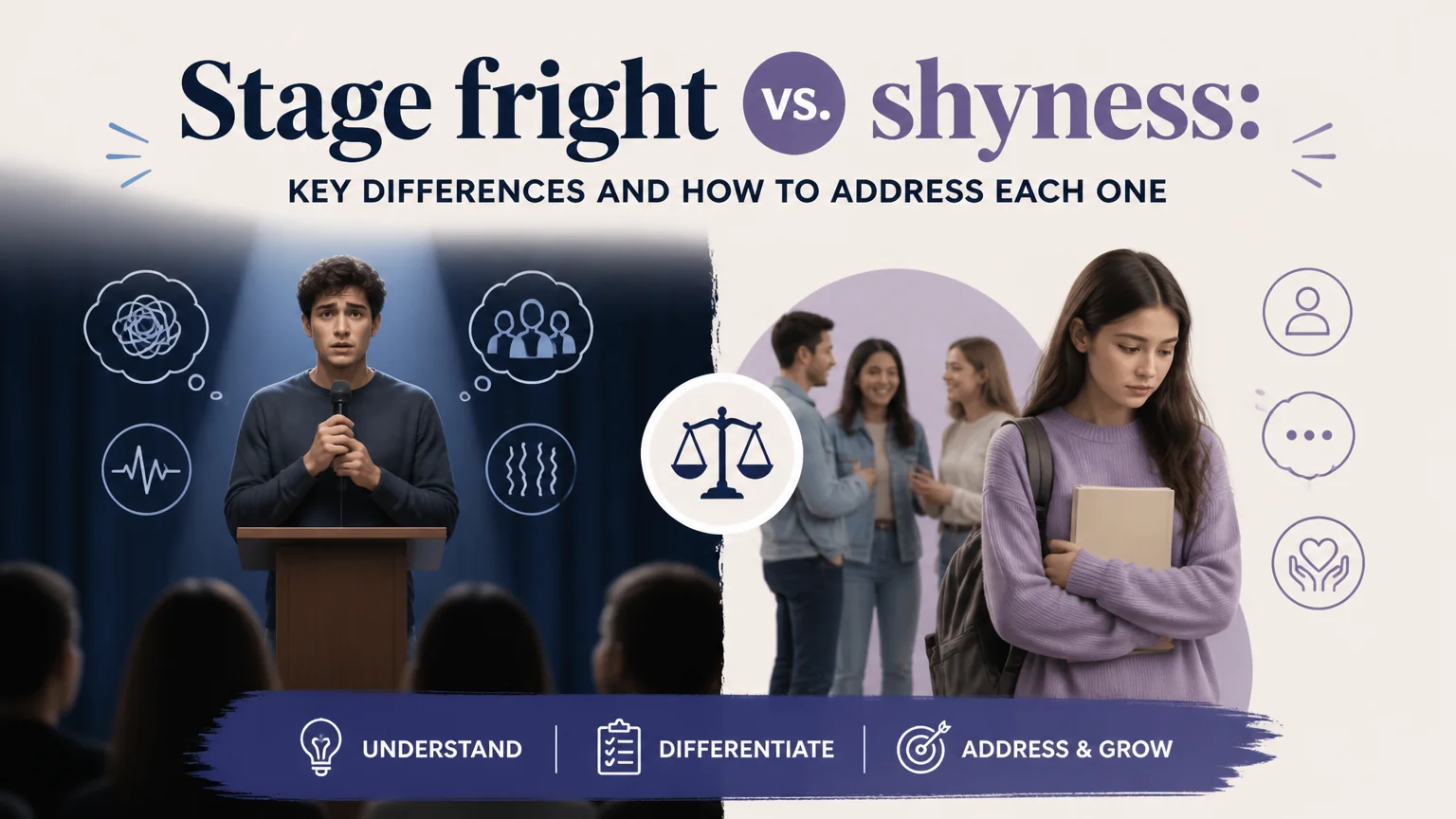
Stage fright vs. shyness: key differences and how to address each one - overcoming stage fright
Differentiating between stage fright and shyness can guide you towards effective strategies for public speaking success.
Public speaking, performing on stage, or even introducing yourself in a meeting can stir intense sensations. Sometimes it’s a spike of nerves that appears only when you’re on display. Other times, it’s a stable form of withdrawal that colors everyday life. Distinguishing between stage fright and shyness is key to choosing effective strategies and moving forward with confidence. Below you’ll find a clear guide to understand their differences and address them in practical ways.
What is stage fright
Stage fright is an anxiety reaction that arises in situations where performance is observed: giving a talk, taking an oral exam, acting, playing an instrument, leading a meeting, or recording yourself on camera. It appears even when you master the subject, because the focus is not the content but the exposure and others’ evaluation. It often manifests as heart palpitations, sweaty hands, a shaky voice, rapid breathing, and racing thoughts. What’s distinctive is its situational nature: off stage, the person may feel sociable, confident, and at ease.
What is shyness
Shyness is a stable tendency toward social inhibition. It involves discomfort or nerves in everyday interactions: starting conversations, joining groups, asking for help, meeting new people, or sharing opinions. It isn’t limited to public performance; it affects day-to-day life. Although it doesn’t always reach the level of social anxiety disorder, it can reduce opportunities for connection and growth. Shyness is accompanied by heightened self-consciousness, fear of judgment, and a preference to observe before participating.
Key differences
- Context: stage fright shows up when you’re exposed; shyness permeates ordinary interactions.
- Persistence: stage fright is episodic; shyness is a more constant trait.
- Preparation: practice and rehearsal help a lot with stage fright; with shyness, preparation helps but doesn’t remove the baseline discomfort.
- Attentional focus: in stage fright it centers on performance; in shyness, on one’s own worth and social acceptance.
- Impact: stage fright affects specific events; shyness can limit your social network and initiative-taking.
- Recovery: after the exposure, stage fright drops quickly; shyness may persist during and after the social encounter.
How to address stage fright
Smart preparation and rehearsal
- Set a clear structure: opening, key points, examples, and a memorable close.
- Rehearse under similar conditions: standing, with a timer, and if possible in front of one or two trusted people.
- Use “failure rehearsals”: deliberately practice with small mistakes to train your recovery and tolerate imperfection.
- Design minimalist visuals: aids that guide you, not that read the content for you.
Physiological regulation
- 4-6 breathing: inhale for 4 seconds, exhale for 6 for 2 to 3 minutes to activate the calming response.
- Tension release: micro-stretches of neck, shoulders, and jaw before going on stage.
- Pre-performance rituals: a short walk, shaking out your arms, drinking water; consistency reduces uncertainty.
Cognitive management
- Define controllable metrics: clarity, pace, and connection—not perfection or applause.
- Reframe arousal: interpret activation as useful energy to perform better.
- Safety scripts: have transition phrases ready for when you go blank.
During the presentation
- Strategic pause: breathe and look at the audience before starting; set the pace.
- Brief, varied eye contacts to create connection without overwhelming yourself.
- Conversational pace: speak as you would explain to one person, not as if reciting.
- Accept micro-failures: correct and move on; the audience is usually kinder than you imagine.
How to address shyness
Gradual and consistent exposure
- Personal hierarchy: list situations from least to most uncomfortable and progress step by step.
- The 2-minute rule: start short interactions, closing with a friendly phrase; increase the duration with practice.
- Weekly goals: for example, start two new conversations or participate once in a meeting.
Social skills and self-affirmation
- Open questions: what, how, why? foster natural dialogues.
- Active listening: briefly paraphrase and validate; it reduces self-consciousness.
- Behavioral self-affirmations: upright posture, smiling, and brief eye contact.
- Clear boundaries: practicing saying no politely reduces fear of conflict.
Mindset and self-compassion
- Normalize discomfort: feeling nervous doesn’t mean incapacity.
- Kind self-talk: speak to yourself as you would to a friend; it reduces rumination.
- Errors as data: each attempt teaches you what to adjust next time.
Helpful environments
- Structured spaces: public speaking clubs, study groups, or volunteer work with defined roles.
- Micro-communities: small, regular activities to make repetition easier.
- Support: practice with someone who encourages you and offers concrete feedback.
Signs that it’s advisable to seek professional help
- You persistently avoid key study or work situations.
- Your physical symptoms are so intense that they frequently shut you down.
- Your social network shrinks and you feel isolated or low in mood.
- Intense rumination and self-criticism that don’t ease with basic strategies.
Cognitive-behavioral therapy, social skills training, and in some cases medical interventions can make a big difference. Asking for help is a form of courage and efficiency.
Common myths and truths
- Myth: only the inexperienced feel nervous. Truth: expert artists and speakers feel it too; they learn to use it.
- Myth: the only way out is “to be extroverted.” Truth: you can keep your style and communicate with impact.
- Myth: if your voice shakes, you failed. Truth: the audience values content and authenticity more than perfection.
- Myth: avoiding protects you. Truth: avoidance reinforces fear; gradual exposure reduces it.
Practical 4-week plan
Week 1: physiological base and clarity
- Practice 4-6 breathing daily for 5 minutes.
- Write down your triggers and symptoms; identify patterns.
- Set a low-risk social or exposure micro-goal.
Week 2: skills and rehearsal
- Learn an opening and a close for common presentations.
- Rehearse twice with a timer and record yourself to observe yourself kindly.
- Start three brief conversations in everyday contexts.
Week 3: exposure with feedback
- Share an idea in a meeting in 60 seconds.
- Ask someone you trust for feedback with two questions: what worked and what to improve.
- Increase the difficulty of one situation in your hierarchy.
Week 4: consolidation and flexibility
- Give a short presentation or participate in a structured group.
- Refine your pre-ritual: breathing, focus phrase, and first minute.
- Plan the next month with realistic, measurable goals.
Quick questions to self-assess
- Do my nerves appear only when presenting or also in everyday interactions?
- What avoidance behaviors do I use, and how much do they cost me in the long run?
- Which bodily signals do I recognize first, and how do I regulate them?
- What controllable metric will I use in my next interaction?
- What small action can I repeat three times this week to gain ease?
Addressing stage fright and shyness isn’t about eliminating sensations, but about learning to act with them. Deliberate practice, physiological regulation, and a growth mindset turn nerves into information and useful energy. With gradual, consistent steps, you’ll be able to express yourself more freely, connect better with others, and seize opportunities that today seem distant.
 For Onlinecourses55
|
2026-02-14
For Onlinecourses55
|
2026-02-14