ForOnlinecourses55
The best exercises your personal trainer will recommend for toning - personal trainer
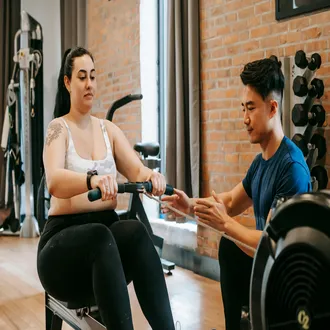
If you’re looking to improve muscle firmness and definition, there are exercises that a personal trainer typically recommends for their effectiveness and safety. Below you’ll find a practical guide, with explanations of why they work, how to perform them correctly, and how to integrate them into a routine. It’s written in a straightforward and helpful way, as if someone were explaining it to you right beside you at the gym.
Before diving into specific exercises, it’s important to understand what “toning” really means: it’s not just about doing lots of reps, but about improving relative strength and body composition. Toning involves building muscle and reducing body fat percentage so that your muscles become more visible. To achieve this, your trainer will explain the relationship between progressive resistance, training volume, and diet control.
Movement control and the sensation of muscle contraction are key. It’s not just about moving weight, but about feeling the muscle work, maintaining tension during the eccentric phase (lowering), and avoiding jerky movements that shift the load onto the joints.
Working a muscle group twice a week is usually more effective than a single intense session. Additionally, recovery—sleep, nutrition, and rest days—is just as important as the workout itself for seeing progress.
Compound exercises involve multiple joints and muscle groups at once: they’re efficient, burn more calories, and build functional strength. Here are the most common ones and how to do them correctly.
From bodyweight to a weighted barbell, the squat works your quads, glutes, and core. Keep your back neutral, knees aligned with your feet, and lower yourself as far as your flexibility allows. If you’re a beginner, start without weight and focus on form.
Lunges are excellent for balance and unilateral development. Take a wide step and lower yourself until your back knee is close to the ground, keeping your chest up. You can do them forward, backward, or while walking.
The bench press works your chest, shoulders, and triceps. If you can’t do full push-ups, modify by resting on your knees or doing dumbbell bench presses. Control and wrist-to-shoulder alignment are essential.
Strengthens the upper back, lats, and biceps. Keep your core stable and pull with your shoulder blades, not your arms. It’s a great exercise for improving posture.
A key exercise for the glutes, hamstrings, and posterior chain. Keep your back straight, hips back, and push through your legs as you rise. Master the technique with light weights before increasing the intensity.
Excellent for isolating and strengthening the glutes. Lift your hips by squeezing your glutes at the end of the movement and avoid hyperextending your back.
In addition to compound exercises, isolation exercises help target specific areas and address weaknesses.
These work the deltoids to shape the shoulders. Use moderate weight and control the range of motion.
For more defined arms. Perform controlled movements and avoid swinging your body.
They define the calves. You can do them on a step for a greater range of motion.
Essential for a strong core. Incorporate front, side, and moving planks for an added challenge.
A well-organized session balances compound and isolation exercises and follows the principles of progression.
5–10 minutes of mobility and activation: joint rotations, unloaded squats, and light sets of the first exercise.
Heavy compound exercises first, then the accessory exercises. This way, you use your maximum strength on the movements that need it most.
For toning, mix up the ranges: 3–4 sets of 6–12 reps for compound exercises targeting strength and hypertrophy, and 12–20 reps for isolation exercises targeting muscular endurance.
1–2 minutes between strength sets and 30–60 seconds for endurance exercises or supersets.
To continue improving, you must gradually increase the demand: more weight, more reps, more sets, shorter rest periods, or exercise variations (unilateral, with bands, on an unstable surface). Changing the stimulus every 4–8 weeks prevents plateaus.
It’s better to use less weight with good form than to lift heavy and get injured. A trainer usually corrects posture and range of motion.
Exhale during the effort and inhale on the return. Keep your core engaged to protect your spine.
Distinguish between fatigue and acute pain. If something hurts sharply, stop and consult a professional.
Don’t expect results from exercise alone. Adequate protein intake (around 1.4–2.0 g/kg depending on goals and activity level), calorie intake adjusted to your goals, and proper hydration are essential. Rest and sleep allow muscle fibers to repair and grow; 7–9 hours is a common guideline.
A repetitive routine without progression leads to a plateau. Introduce variations and new loads.
Overtraining slows progress. Plan for active recovery days and deload weeks.
A weak posterior chain or an unstable core limits performance in other exercises.
A simple, balanced session you could do 3 times a week: 1) Squats 3x8–10, 2) Incline press or push-ups 3x8–12, 3) Dumbbell row 3x8–12, 4) Glute bridge 3x12–15, 5) Plank 3x30–60s, 6) Lateral raises 3x12–15. Adjust weights so that the last reps are challenging but controlled.
With consistency, proper technique, and a healthy diet, these exercises and principles will deliver visible results in a matter of weeks. A personal trainer will tailor the details to your mobility, history, and goals, but the foundation outlined here is the same one many professionals recommend for safe and effective toning.