For Onlinecourses55
|
2026-09-10
For Onlinecourses55
|
2026-09-10

Therapeutic strategies in personality disorders - psychology disorder personality
To develop a comprehensive approach to personality disorders, you need structured and compassionate guidance. By participating in our course that offers foundational knowledge and practical skills, you will enhance your ability to create meaningful, therapeutic relationships.
The clinical approach to personality disorders requires a comprehensive, sustained, and evidence-based strategy. The focus is not to "change personality" but to reduce suffering, improve functioning, and increase the capacity for self-regulation, mentalization, and healthy relationships. Below are pillars and practical tools to guide an effective intervention in the short, medium, and long term.
A useful treatment plan combines an individualized formulation, realistic goals, and structured techniques. Continuity of the therapeutic relationship and a clear therapeutic frame support the process, while psychoeducation reduces stigma and aligns expectations. A dimensional approach (traits, not rigid labels) favors precise and measurable interventions.
Assessment should be multimodal, context-sensitive, and focused on resources. Beyond diagnosis, it is important to understand relational patterns, triggers, core schemas, and symptom-maintaining circuits. The formulation guides priorities and technical choices.
Explaining the working model, goals, and the person's active role reduces the sense of loss of control. Agreeing on rules of the therapeutic frame (attendance, between-session contact, crisis management) reduces misunderstandings and facilitates adherence. Motivational interviewing helps navigate ambivalence about change.
Designed for problems of emotional dysregulation, it combines validation and behavioral strategies. It integrates individual psychotherapy, skills group, brief coaching between sessions, and therapist team work. Key modules include mindfulness, distress tolerance, emotion regulation, and interpersonal effectiveness. A hierarchy of targets is prioritized, beginning with life-threatening behaviors.
Strengthens the capacity to understand one's own and others' mental states, especially under stress. In session the work is on the "here and now," slowing the process to explore intentions, emotions, and relational misunderstandings. The goal is to stabilize mentalization when it collapses, reducing impulsivity and conflicts.
Organized around relational patterns that emerge with the therapist and outside of session. Clarification, confrontation, and elaboration of splits and split-off representations help integrate a more complex view of oneself and others, decreasing emotional extremes and maladaptive behaviors.
Combines cognitive, behavioral, experiential, and relational techniques to modify core schemas and dysfunctional modes. It includes limited reparenting, dialoguing with modes (vulnerable child, detached protector, internal critic), and building corrective experiences that consolidate healthy modes.
Specific protocols incorporate functional analysis, relapse prevention, and skills training. Chain analyses identify triggers, automatic thoughts, and alternatives, providing clarity and agency for change.
Medications do not change personality traits but can relieve specific symptoms or comorbidities. Indication should be cautious, time-limited when possible, and coordinated with structured psychotherapy. Avoid unnecessary polypharmacy and periodically review risks/benefits.
The relationship is a central tool. Validation reduces shame and defensiveness; clear boundaries provide security. Alliance ruptures are to be expected and their deliberate repair prevents dropout and symptom escalation. Supervision and team work support the therapist.
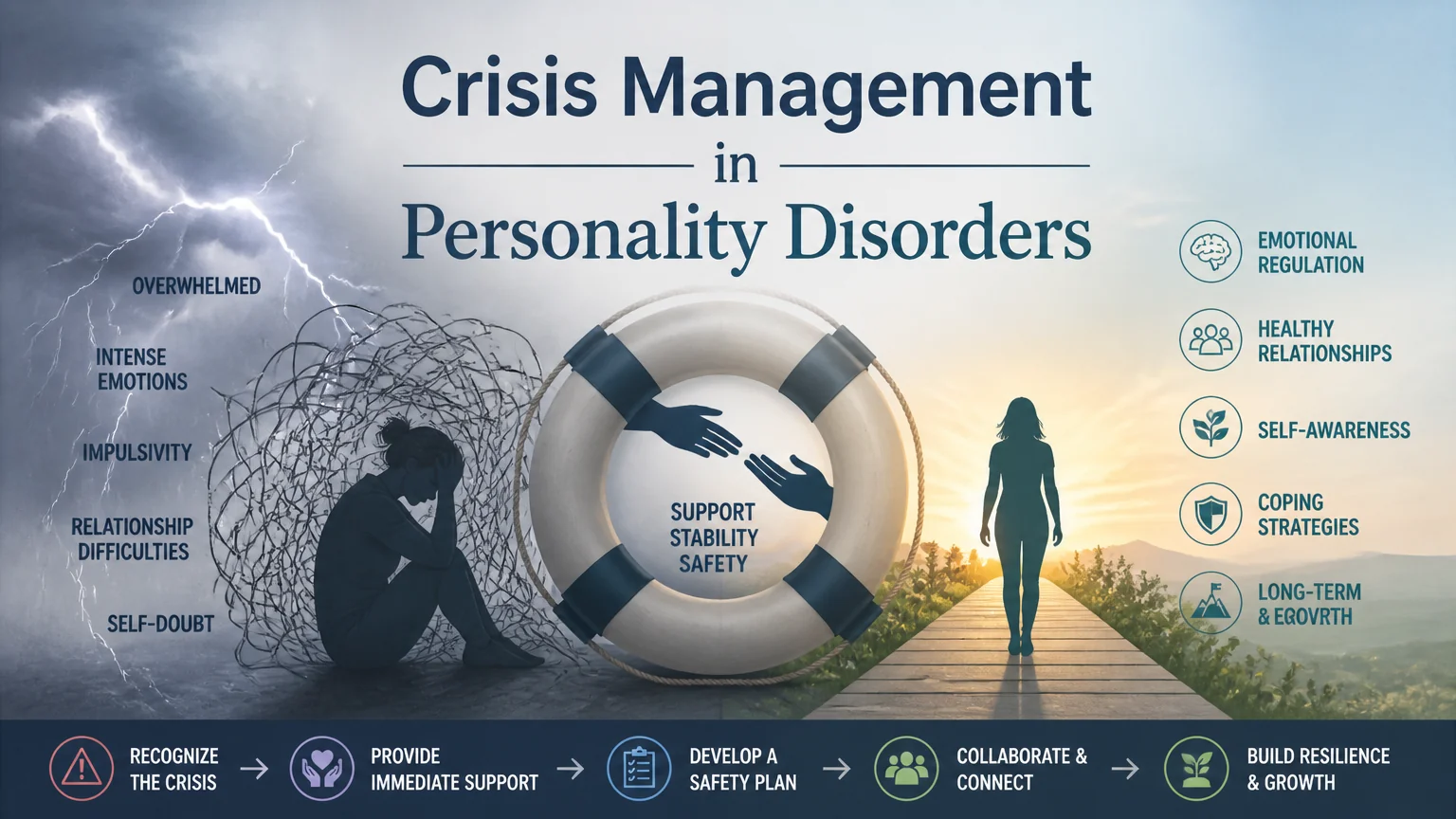
A co-created safety plan defines early warning signs, coping strategies, and steps to follow. Systematic risk assessment, coordination with support networks, and calibrated use of emergency resources reduce harm and promote progressive autonomy.
Psychoeducation for family members improves understanding of patterns, reduces criticism, and promotes consistent responses. Training in validation and boundaries, and aligning expectations across the relational system, reduces relapse and conflict. When appropriate, couple or family therapy provides a containing framework.
Comorbidities are the norm, not the exception. Use of alcohol or other substances complicates the course and increases risk. It is advisable to coordinate integrated and sequenced plans, prioritizing safety and stabilization first, with goals coordinated across teams.
The level of care is adjusted to risk and functioning: standard outpatient, intensive programs, brief hospitalization for acute risk, and intermediate services. Continuity (warm handoffs, discharge plans, follow-up) protects gains and prevents harmful discontinuities. Teletherapy can be effective with a clear frame.
Measuring outcomes guides decisions. Monitoring symptoms, target behaviors, and functional goals allows timely adjustments. Relapse prevention includes identifying early warning signs, rehearsing coping plans, and consolidating support networks.
Cultural context and trauma experiences shape symptom expression and help-seeking expectations. A trauma-sensitive approach prioritizes safety, choice, and collaboration, avoiding re-traumatization. Cultural humility and inclusive language strengthen the alliance and the relevance of interventions.
Working with high emotional intensity requires healthy boundaries, supervision, and burnout prevention. Reflection on countertransference, appropriate transparency, and respect for the person's autonomy support an ethical and effective practice.
Effective treatment rests on a clear formulation, a robust therapeutic relationship, and evidence-based methods tailored to each person's uniqueness. With structure, patience, and interprofessional collaboration, it is possible to reduce suffering, improve functioning, and build more stable and meaningful life trajectories.
Search
Popular searches