We all try to feel better. The problem appears when we do it by fleeing from what we feel. Postponing an uncomfortable conversation, burying stress at work, numbing yourself with your phone or with food: in the short term it seems like a relief, but in the long run life becomes narrower. This phenomenon has a name and clear consequences: we try to control internal emotions by avoiding situations, sensations and memories we don't like, and that strategy, paradoxically, makes them more persistent and moves us away from what matters.
What experiential avoidance is
It is the tendency to escape, suppress or control unpleasant internal experiences (thoughts, emotions, memories, bodily sensations) even if that effort costs us dearly. It's not that "feeling bad" is a problem in itself; what's problematic is turning life into an emotional control project. When our compass stops being what is valuable and becomes "not feeling this," life is reduced to a minefield where everything that could trigger emotions is avoided.
Difference between taking care of yourself and avoiding yourself
- Healthy care: resting after a hard day, asking for support, practicing breathing to regulate yourself, choosing not to argue when you're at the limit.
- Avoidance: not answering emails for fear of criticism, using alcohol to cover anxiety, overloading yourself with tasks to avoid thinking, saying "yes" to everything to avoid feeling guilt.
How it shows up in everyday life
- Procrastination: you postpone projects because you anticipate discomfort, uncertainty or fear of making mistakes.
- Compulsive distractions: endlessly scrolling through social media, binge-watching shows, playing games to avoid being alone with your thoughts.
- Rigid perfectionism: you try to make it flawless to avoid feeling shame, frustration or criticism.
- Control and safety: you ask for guarantees, check things a thousand times, avoid decisions for fear of regretting them.
- Avoiding conversations: you say "I'm fine" even when you're not, you accumulate resentment to avoid the discomfort of talking.
- Self-numbing: eating, shopping, drinking or overworking to soothe anxiety or sadness.
- Intellectualizing: you stay in your head analyzing and ruminating to avoid getting in touch with the body and the emotion.
The high cost of running away
In the short term, avoiding hurts less. In the long term, it comes at a price. What you avoid today accrues interest tomorrow.
- More intense emotions: what is suppressed rebounds. unexposed fear grows, unfelt anxiety amplifies.
- Shrunken life: you start by giving up a situation, you end up giving up places, people, dreams.
- Superficial relationships: you avoid vulnerability, you disconnect, you accumulate unresolved issues.
- Fatigue and chronic stress: sustaining constant control is exhausting; the mind never rests.
- Decisions dictated by fear: you choose the safe, not the valuable; you lose opportunities.
- Increased rumination: the more you try not to think something, the more it comes back.
- Risk of addictions and health problems: emotional anesthesia can become a habit and affect the body.
The cycle of avoidance
Understanding the loop helps deactivate it. It usually happens like this:
- Trigger: a situation, memory or physical sensation.
- Internal emotion: anxiety, shame, guilt, sadness.
- Control impulse: "I don't want to feel this."
- Avoidance behavior: distracting yourself, postponing, escaping.
- Immediate relief: the discomfort drops for a few minutes or hours.
- Pattern reinforcement: your brain learns "avoidance works," and next time you'll avoid sooner.
- Consequences: unresolved problems, more fear, less life.
Breaking the cycle doesn't mean eliminating emotions, but relating to them in a different way so you can choose according to your values, not according to fear.
Warning signs
- Your schedule is organized to avoid feeling: you avoid routes, people, topics.
- You make key decisions to "not feel bad," even if they contradict what matters to you.
- You need constant distraction when silence or a pause appears.
- You use "when I feel better" as a requirement to act, and that day never comes.
- Anxiety takes over: your life becomes smaller so that the emotion will be smaller too.
Making space instead of running away: practical alternatives
Active acceptance (not resignation)
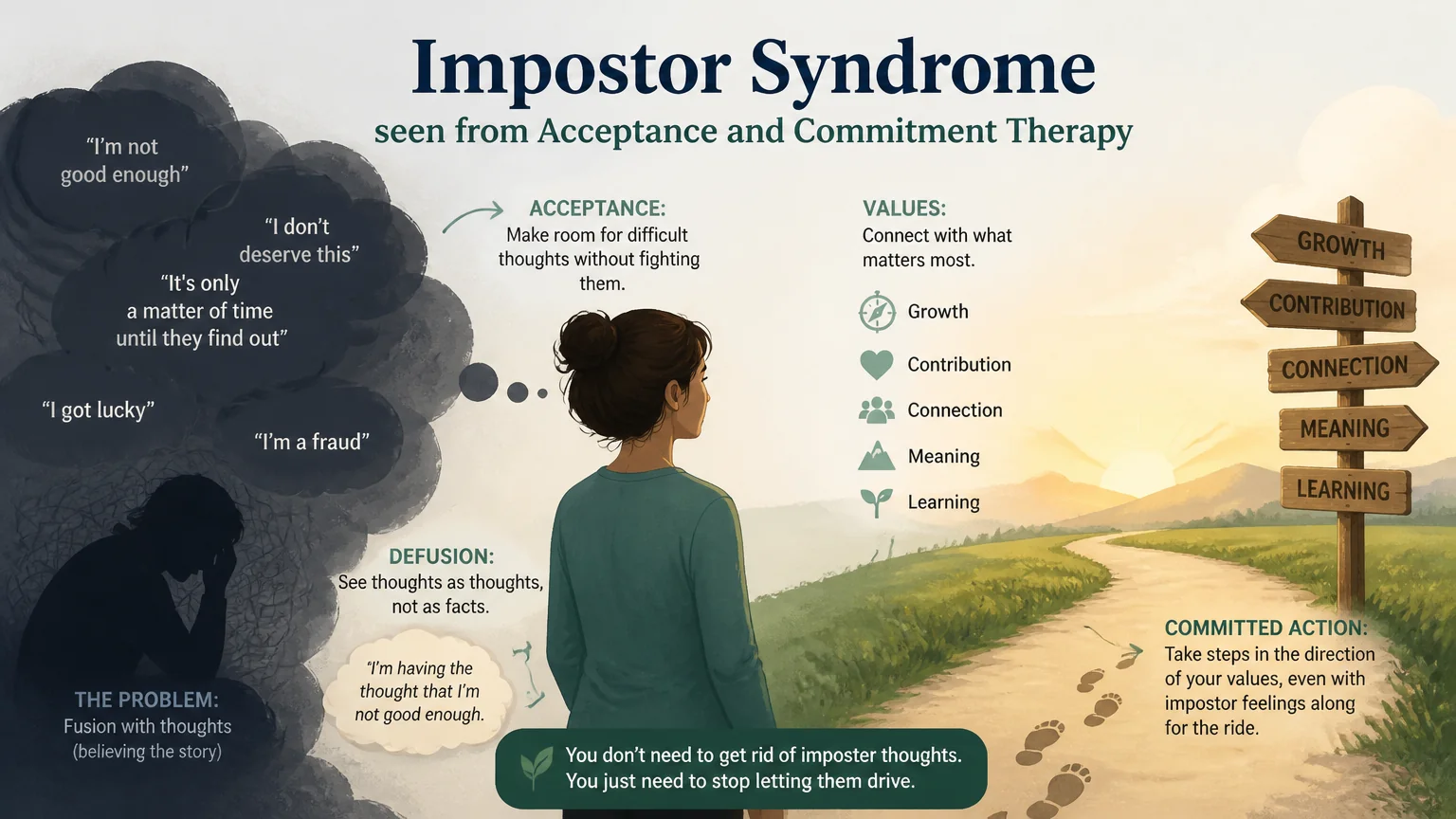
Acceptance is making space for the internal experience as it is, while you move in the direction of what matters. It's not "I like it," it's "it can be here." Practice it this way:
- Name and allow: "there is anxiety in my chest," "I notice warmth in my face," without adding a story. Breathe with it for 60-90 seconds.
- Widen the focus: feel your feet, hands, back; let the emotion be a part, not the whole.
- Leaves-on-a-river metaphor: imagine each thought as a leaf passing by. Don't chase it or sink it, observe it floating.
Clarify values (your compass)
If you don't choose by values, you choose by fear. Clarify what matters to you to have a "why" bigger than the discomfort.
- Write 5 roles (partner, friendships, work, health, community).
- For each role, note 3 values (e.g., care, learning, honesty).
- Define a 10-15 minute action aligned today with each value, even with discomfort present.
Gentle and gradual exposure
Instead of avoiding, approach gradually what is feared to teach your body that you can tolerate it.
- Create a hierarchy: list situations from 0 to 10 according to discomfort.
- Start at levels 3-4: stay long enough for the peak to go down a bit (don't flee at the peak).
- Repeat several times a week; move up a level when the previous one is more manageable.
- Record progress: note intensity before, during and after; celebrate small improvements.
Mindfulness and compassion
- Pause S.T.O.P.: Stop, Take a breath, Observe (body, emotion, thought), Proceed (act according to values).
- Compassionate gesture: hand on your chest, a kind posture, a supportive phrase: "This is hard and I can take one step."
- Realistic self-talk: change "I shouldn't feel this" to "It's human to feel this, and I can choose my next step."
A brief 7-day plan
- Day 1: identify your most common avoidances and the concrete cost you pay.
- Day 2: write your 5 main values and a small action for each.
- Day 3: practice 5 minutes of mindful breathing when you notice discomfort.
- Day 4: choose an avoided task and do just 10 minutes (timer).
- Day 5: start a conversation you've been avoiding using a brief honest phrase.
- Day 6: mild exposure to a feared situation (level 3-4) with breathing support.
- Day 7: review what you've learned, adjust your hierarchy and plan the next week.
Common myths that sustain the problem
- "Accepting is giving up": acceptance is stopping the fight with your inner experience to regain energy and act outwardly.
- "If I let myself feel, I'll be overwhelmed": emotions, if allowed with grounding, tend to rise and fall like waves.
- "I must think positively": more than forcing thoughts, it works to notice, let go and return to what matters.
- "When I control my fear, I'll act": actually, by acting with fear present, fear loses power.
When to seek help
If the distress seriously interferes with your life, if there is trauma, intense symptoms or you use substances to cope, seek professional support. You don't have to do it alone. And if there are thoughts of harming yourself or not wanting to live, seek immediate help from emergency services or contact a crisis resource in your country.
Small steps, big changes
You don't need to transform everything at once. It's enough to choose one situation, notice the emotion, give it space and take a step toward your values. Repeat. Over time, life stops revolving around avoiding feeling and begins to orient toward what matters to you. It's not about no longer having difficult emotions, but about them not ruling you. Your courage is not the absence of fear; it's your ability to move with it at your side.
 For Onlinecourses55
|
2026-03-11
For Onlinecourses55
|
2026-03-11




![Addictions and act: the urge surfing technique [urge surfing]](/images/postDuplicados/onlinecourses55-addictions-and-act-the-urge-surfing-technique-urge-surfing.webp)