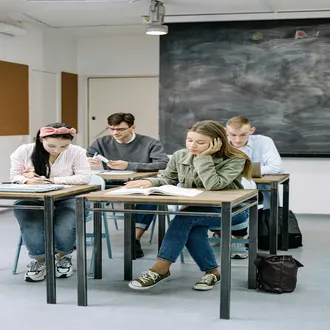
Learning is not just memorizing facts: it is a living process in which attention, emotion and practice intertwine. Understanding how the student's brain works and supporting them with coaching tools can transform the classroom experience, increase motivation and consolidate lasting learning. Below is a practical guide to bringing these principles into educational reality with concrete and applicable strategies.
What neuroeducation is and what it brings to the classroom
Neuroeducation integrates findings about brain functioning with pedagogical practices. It's not about turning the classroom into a laboratory, but about making informed teaching decisions: how to present information, when to practice, what type of feedback to give and how to sustain motivation. Its focus is on creating learning experiences that respect students' cognitive and emotional rhythms.
Applying it doesn't require extraordinary resources, but coherence: alternating moments of focus and rest, linking content with prior experiences, favoring active retrieval instead of passive re-reading and designing formative assessments that guide the next step.
Key principles of learning
- Plasticity: the brain changes with practice; repeating with purpose and varying contexts strengthens neural networks.
- Limited attention: it is optimized with clear goals, visual cues and short blocks with active breaks.
- Emotion and relevance: we learn better what matters to us; connecting with goals and familiar examples enhances memory.
- Memory and retrieval: recalling without looking at notes (retrieval practice) consolidates more than re-reading.
Educational coaching as a catalyst
Coaching in education centers the conversation on the student: their goals, resources and obstacles. Rather than giving answers, it guides with questions that activate metacognition: What do you already know?, What worked for you before?, What will you do differently now? This approach fosters autonomy, responsibility and a sense of progress, key factors for sustaining the cognitive effort required to truly learn.
Competencies of the teacher-coach
- Active listening and presence: capturing students' explicit and implicit needs without judgments.
- Powerful questions: invite reflection on processes, not just results.
- Clarity of objectives: translating vague intentions into concrete and measurable goals.
- Feedback that drives: specific, timely and oriented to the next action.
How the brain learns: from stimulus to consolidation
Learning begins with attention: without focus, there is no encoding. Then the brain transforms information into representations connected with prior knowledge. Deliberate practice reinforces those links, and rest —especially sleep— facilitates consolidation. Error, far from being an enemy, is a useful signal to adjust strategies when there is a climate of psychological safety.
From focus to lasting memory
- Selective attention: visible goals and brief tasks reduce extraneous load.
- Elaborative encoding: explaining in your own words and creating your own examples improves retention.
- Retrieval practice: trying to recall before looking at the answer strengthens memory traces.
- Spacing and interleaving: distributing study over time and mixing types of problems prevents the illusion of mastery.
- Sleep and breaks: consolidate what has been learned and prevent cognitive fatigue.
Evidence-based practical strategies
To bring these principles to the classroom, it's advisable to combine activation, practice and reflection activities. The key is to make the student's thinking visible and provide timely feedback, promoting a continuous cycle of trial, error and adjustment.
Concrete techniques
- Retrieval practice: low-stakes mini-quizzes, flashcards and summaries from scratch.
- Spacing and interleaving: plan brief reviews at 1, 3 and 7 days; alternate problems of different types.
- Own explanation: ask "teach it to me as if I didn't know" to detect and close gaps.
- Dual coding: combine words with diagrams, charts or timelines to anchor concepts.
- Gradual scaffolding: model, practice with guidance and withdraw supports until autonomy.
Emotion and motivation in the service of learning
Motivation flourishes when the student perceives autonomy, competence and belonging. Translated to the classroom: offer real choices (which problem to solve first), attainable challenges with support, and a climate where error is valued as part of the process. Connecting content to personal purposes activates the curiosity and persistence necessary to face the desirable difficulty of deep learning.
Coaching tools to motivate
- Process SMART goals: "I will do three retrieval attempts each week".
- Check-in: scales from 1 to 10 for energy, clarity or progress and decide the next step.
- Learning contracts: brief and visible commitments that are reviewed at the close.
Common myths that hinder
- "Rigid 'learning styles'": adapting only to visual/auditory does not improve results; it's better to use multiple representations.
- "We use 10% of the brain": the brain functions as a network; what's effective is optimizing attention and practice.
- "Left/right brain" for subjects: both networks collaborate; what matters is the type of task and the level of practice.
- Useful multitasking: alternating complex tasks degrades performance; better to use single-focus blocks.
- Music always helps: it can distract on tasks with a high verbal load; evaluate case by case.
Four-week implementation plan
- Week 1: define 2-3 process goals per group; introduce 5-minute retrieval mini-quizzes.
- Week 2: plan spaced reviews; create shared flashcards and brief review sessions.
- Week 3: incorporate interleaving in practice and model self-explanations with guided examples.
- Week 4: establish quick and specific feedback; close with metacognitive reflection and goal adjustment.
Conclusion
Understanding how the brain learns and accompanying it with coaching is not a trend: it is a more humane and effective way to teach. With small decisions —retrieve instead of re-reading, space instead of cramming, ask instead of lecturing— clarity, motivation and results multiply. Start with one technique, measure it and adjust it; sustained progress comes when the process becomes a habit.