For Onlinecourses55
|
2026-09-30
For Onlinecourses55
|
2026-09-30
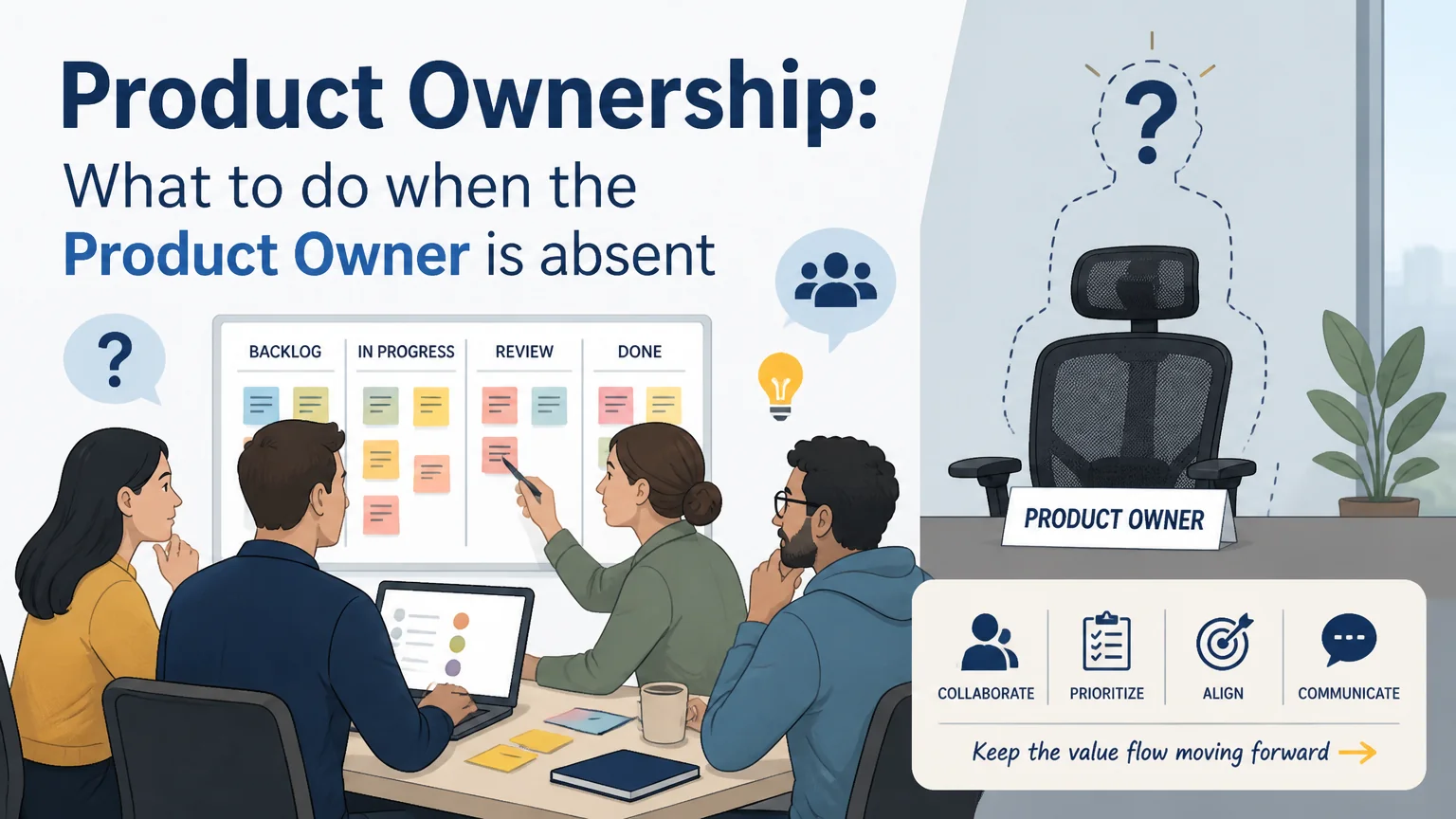
Product ownership: what to do when the product owner is absent - professional agile coach
To ensure continuity in product ownership during absences, exploring the tailored agile coaching program will equip you with essential strategies.
The role of the Product Owner (PO) is fundamental in the Scrum methodology. They are responsible for maximizing the value of the product resulting from the development team's work. But what happens when the PO is absent? This situation, although unexpected, can create uncertainty and delays if not handled properly. In this article, we will explore strategies and solutions to maintain product ownership and ensure project continuity during the Product Owner's absence.
Product ownership, in essence, refers to the responsibility and authority to make decisions about the direction and development of a product. The Product Owner is the main guardian of this ownership. Their knowledge of the market, of the users and of the product vision is essential to guide the team. Maintaining product ownership, even in the PO's absence, ensures that:
Product Owner absences can be unplanned or scheduled. Some of the most common causes include:
The key to managing the Product Owner's absence lies in planning and preparation. Here we present some effective strategies:
Best practice is to designate a team member who can act as a backup Product Owner in case of absence. This backup should:
Ideally, the backup should be someone from the development team who has worked closely with the PO and who understands the product's priorities and strategy. This person should be prepared and trained to assume the PO's responsibilities temporarily.
A well-documented product backlog is essential to ensure project continuity. The backlog should include:
The more detailed and up-to-date the backlog is, the easier it will be for the development team to understand the product's needs and objectives, even in the PO's absence.
Communication is essential to keep everyone informed and aligned. Before the PO's absence, it is important to clearly communicate:
During the absence, the team should maintain regular communication with the backup and with the PO, if possible. This will help resolve any questions or issues that arise.
Backlog refinement meetings are an excellent opportunity to clarify doubts and ensure that all team members understand the user stories. During the PO's absence, these meetings are even more important.
The backup Product Owner should lead these meetings and ensure that all user stories are well defined and prioritized.
In the absence of the Product Owner, it is important to empower the development team to make decisions. This means:
An empowered development team is more proactive and capable of solving problems independently.
In addition to the backup Product Owner, other key roles can help maintain continuity during the PO's absence: