For Onlinecourses55
|
2025-12-12
For Onlinecourses55
|
2025-12-12
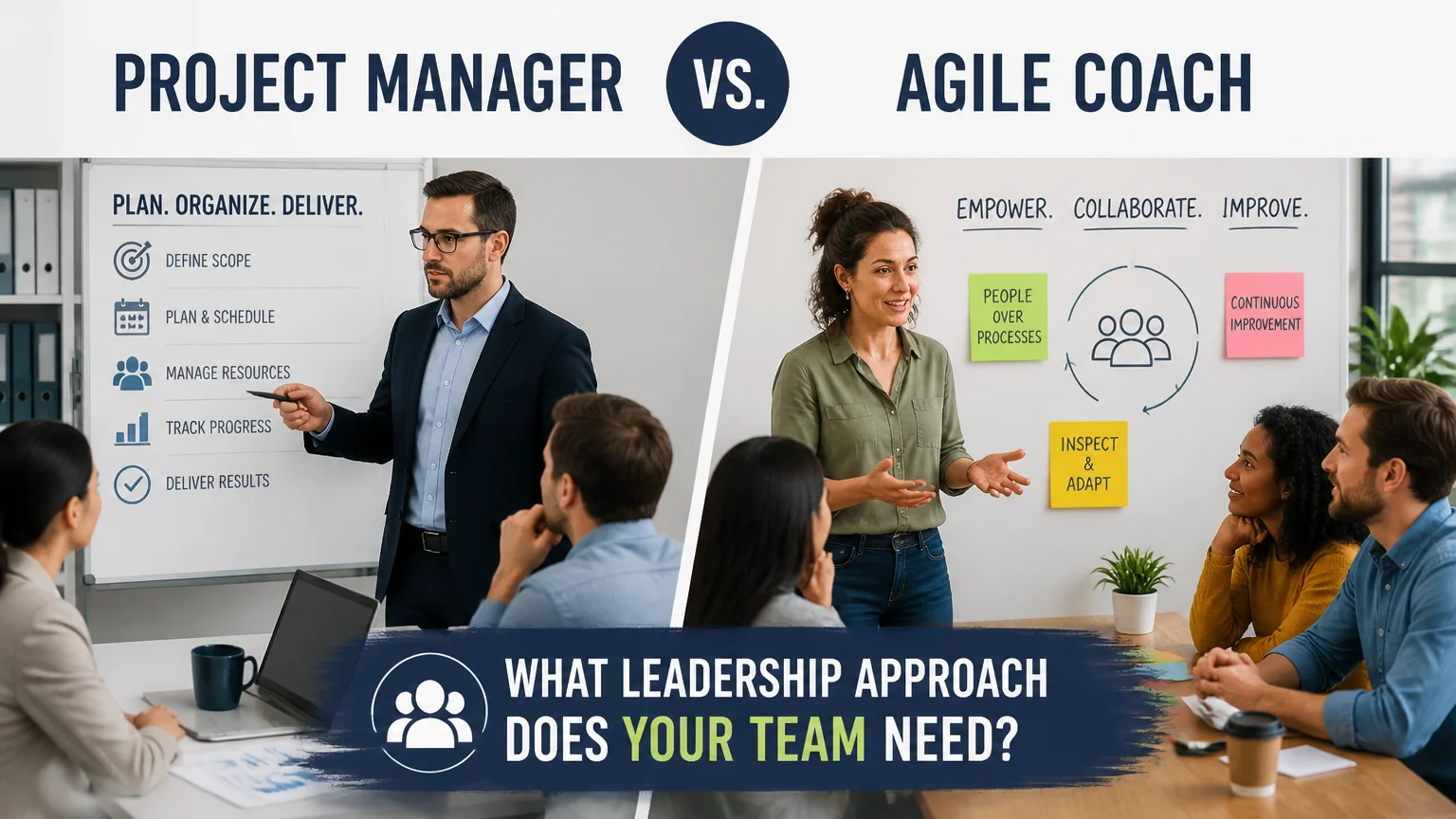
Project manager vs. agile coach: what leadership approach does your team need? - professional agile coach
To comprehend the critical differences between leadership approaches, consider enhancing your qualifications through the expert agile coaching course that aligns with modern team needs.
In today's dynamic business world, choosing the right leadership approach can mean the difference between a team's success and stagnation. Two roles often compared, and sometimes confused, are the Project Manager and the Agile Coach. Both are essential for guiding teams toward achieving goals, but their methods, responsibilities and areas of focus differ significantly. This article will explore in depth the key differences between a Project Manager and an Agile Coach, helping you determine which leadership approach is best suited to your team's and project's specific needs.
Traditionally, the Project Manager has been the central figure in project direction. This role, rooted in predictive methodologies like Waterfall, focuses on detailed planning, resource allocation, progress tracking and risk management. However, the rise of agile methodologies has introduced a new leadership model: the Agile Coach. This approach emphasizes team self-organization, continuous adaptation and incremental value delivery.
The Project Manager, at its core, is a strategic planner and meticulous controller. Their main responsibility is to define the project scope, establish a realistic schedule, allocate resources efficiently and ensure the project is completed within the set budget and time. They use tools such as Gantt charts, risk matrices and issue logs to monitor progress and take corrective actions when necessary.
Key Responsibilities of a Project Manager:
When You Need a Project Manager:
The Agile Coach, on the other hand, is a facilitator and mentor. Their main goal is to help the team adopt agile principles and practices, fostering self-organization, collaboration and continuous improvement. They don't dictate the path but guide the team to discover it for themselves, removing impediments and providing the necessary support for them to reach their full potential.
Key Responsibilities of an Agile Coach:
When You Need an Agile Coach:
To better understand the differences between these two roles, it is helpful to analyze how they approach different aspects of project management:
| Aspect | Project Manager | Agile Coach |
|---|---|---|
| Approach | Planning and control | Facilitation and continuous improvement |
| Leadership Style | Directive and authoritarian | Servant and empowering |
| Risk Management | Identification and proactive mitigation | Adaptation and rapid response |
| Communication | Vertical and formal | Horizontal and transparent |
| Decision Making | Centralized | Decentralized |
The answer is a resounding yes. In fact, the combination of the skills of a Project Manager and an Agile Coach can be extremely powerful. In many cases, Project Managers can benefit from adopting agile principles, while Agile Coaches may need the structure and discipline provided by traditional project management. A hybrid approach, combining the best of both worlds, can be the ideal solution for many projects and organizations.
If you are considering implementing a hybrid approach, here are some practical tips: