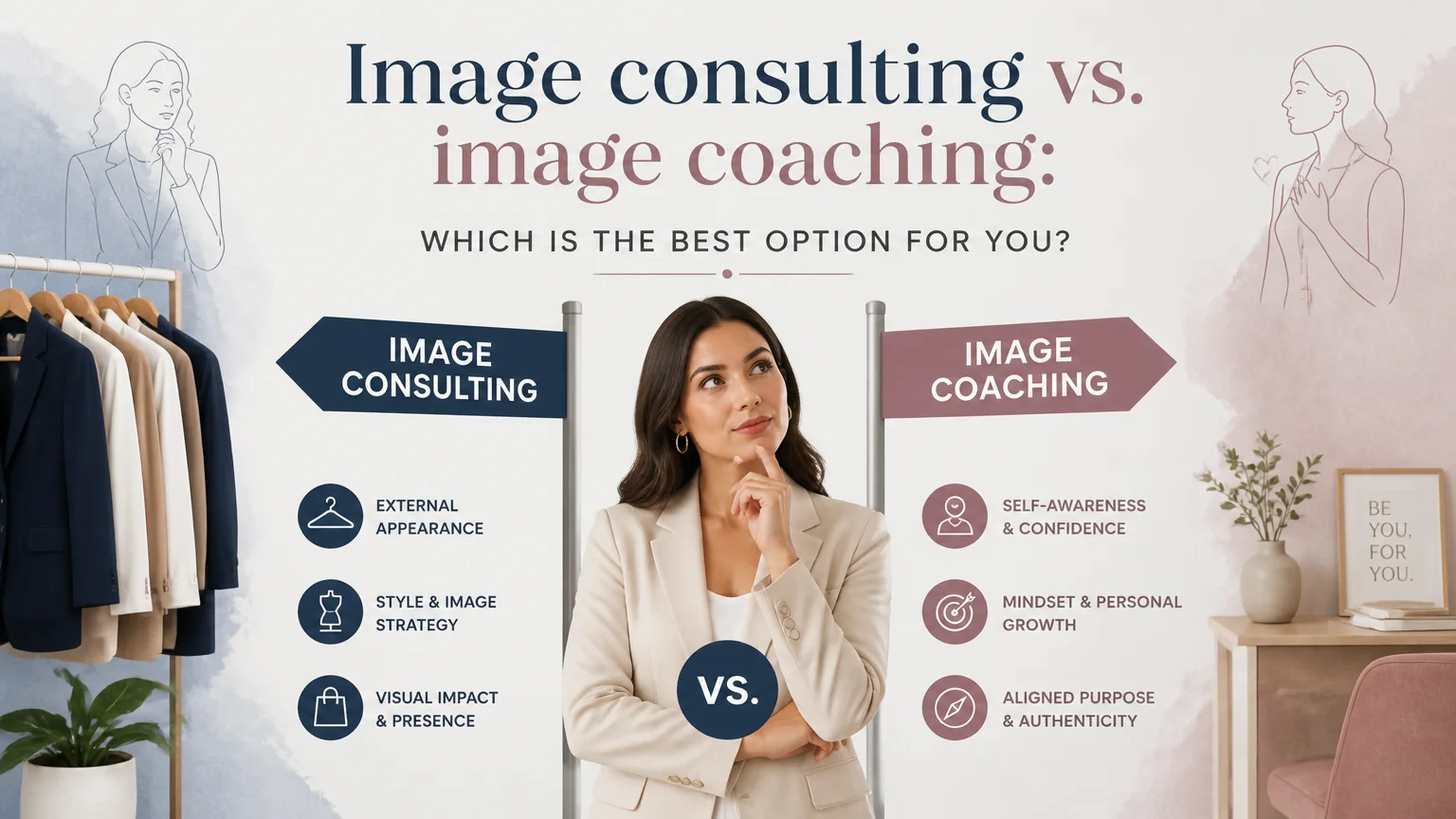
The way you dress, communicate, and present yourself to the world is not just aesthetics: it affects your confidence, your credibility, and the opportunities that open up to you. When it’s time to step up, two paths usually appear: receive clear recommendations on what to wear and how to project yourself, or work more deeply on your identity, beliefs, and goals so your image is built from the inside out. Here you’ll find a complete guide to distinguish both approaches, know what to expect from each, and choose the alternative that best fits your current moment.
What is image consulting
It’s a practical service focused on visible results in a short time. The approach is to analyze your features, lifestyle, and goals to propose concrete decisions about wardrobe, colors, hairstyles, makeup, accessories, and dress codes suitable for different personal and professional contexts.
What it typically covers
- Color analysis to identify palettes that brighten your face and balance your features.
- Silhouette and proportion analysis to choose cuts, lengths, and fabrics that flatter.
- Definition of personal style and versatile wardrobe capsules.
- Outfits for interviews, presentations, events, or daily life.
- Wardrobe organization and a strategic shopping plan.
- Protocol and dress codes by industry, company, or occasion.
How it usually works
It starts with a diagnostic interview, a wardrobe review, and, in many cases, a guided shopping session. You receive guides, suggested combinations, and practical rules. The professional takes a directive role: observes, assesses, and recommends.
What is image coaching
It’s a support process that helps you align your inner identity with how you present yourself. Rather than telling you what to wear, it focuses on your beliefs, fears, aspirations, and values to build an authentic image that’s sustainable over time. The goal is for you to make conscious, confident decisions about your appearance and communication.
Common tools
- Powerful questions and self-knowledge exercises.
- Exploration of values, purpose, and personal narrative.
- Work on limiting beliefs about the body, age, or “what’s expected.”
- Definition of image goals consistent with life and career goals.
- Progressive action plan with experiments and feedback.
What the process feels like
It usually unfolds over several sessions, with tasks between meetings and guided reflections. The professional doesn’t impose, but facilitates your discovering your own answers and gaining autonomy. Changes in the wardrobe do come, but as a consequence of a new understanding of yourself.
Key differences between both approaches
- Objective: consulting seeks immediate, tangible results; coaching pursues inner transformation that’s reflected in your image.
- Role of the professional: in consulting, an expert who prescribes; in coaching, a companion who facilitates discoveries.
- Methodology: consulting with rules, guides, and shopping; coaching with questions, dynamics, and evolving objectives.
- Duration: consulting is short or one-off; coaching is more progressive and deep.
- Delivery: in consulting you receive the “what” and the “how”; in coaching you build the “why” and the “what for,” and then choose the “what.”
¿Who is each one for?
Profiles that usually benefit from consulting
- People with little time who need clear, quick solutions.
- Those facing an important event or an immediate job change.
- Professionals who want to optimize their wardrobe without overthinking.
- People who already know themselves well and only need to fine-tune technical details.
Profiles that usually benefit from coaching
- Those going through life transitions and wanting to redefine their identity.
- People who don’t recognize themselves in their wardrobe or feel “costumed.”
- Leaders seeking coherence between their message, presence, and values.
- Those carrying beliefs that make it hard to show up with confidence.
Benefits and limits of each option
Benefits of consulting
- Visible results in a short time.
- Savings on purchases and better use of your wardrobe.
- Clarity on codes and combinations that work.
Benefits of coaching
- Authenticity and meaning: your image stems from who you are and projects coherence.
- Sustainable confidence: you learn to decide without relying on external rules.
- Holistic changes that impact communication, leadership, and well-being.
Common limits
- Consulting can feel rigid if it doesn’t consider your story and values.
- Coaching demands more time and commitment; it’s not the fastest route for an immediate event.
- Both approaches depend on your active participation to sustain results.
Practical examples
Ana was moving into a director role. She needed executive presence for a meeting in two weeks. She chose consulting: they defined combinations, adjusted tailoring, and chose powerful colors. She achieved an immediate impact. Months later, she did an image coaching process to consolidate her leadership style and feel more authentic.
Marcos had lost motivation with his wardrobe after a move. He tried guided shopping, but nothing represented him. He began image coaching: he worked on his change narrative, values of simplicity and creativity, and then built a matching capsule. This time, he did recognize himself in the mirror.
Signs to choose with confidence
- You need a solution for a specific date: prioritize consulting.
- You want to feel more yourself and understand what’s behind your image: prioritize coaching.
- Your wardrobe isn’t working and getting dressed frustrates you: consulting to organize, coaching if you feel disconnected from your identity.
- You have rules but lack confidence to break them: coaching.
- You prefer clear instructions and shopping lists: consulting.
Useful questions for the professional
- What their process is like and what deliverables you’ll receive.
- What expectations are realistic given your goal and time.
- How they integrate your lifestyle, values, and professional context.
- What indicators they’ll use to measure progress.
- Experience with cases similar to yours.
Costs, timing, and expectations
Formats vary depending on the city and the professional’s experience, but you can be guided by the logic of the service. Consulting is usually organized into short packages (diagnostic, wardrobe, shopping) and shows quick changes; coaching tends to be scheduled in cycles of several sessions, with tasks between meetings and evolving objectives. The important thing is to align budget, availability, and goals with the type of transformation you’re seeking.
- Consulting: concentrated results, per-package investment, high immediate impact.
- Coaching: sequential process, distributed investment, deep and lasting impact.
¿Can they be combined?
Yes, and it’s often a great idea. You can start with coaching to clarify who you are and what you want to project, and then translate it into concrete decisions with consulting. Or the other way around: first address practical urgencies with consulting and then work on coherence and confidence with coaching.
- Route 1: self-knowledge first, decisions afterward.
- Route 2: solve the immediate and then go deeper.
How to choose the right professional
- Review testimonials and before-and-after cases, but also process stories.
- Ask for methodological clarity and examples of deliverables.
- Assess the chemistry in an initial call: they should listen to and understand you.
- Look for certifications or training that support their approach.
- Make sure they respect your identity, culture, and work context.
First steps to move forward today
- Define your main objective (for example: credibility, warmth, creativity, authority).
- Choose three words you want your presence to communicate.
- Do a quick audit of your wardrobe: which pieces do represent you and which don’t.
- Decide on a time horizon: an immediate solution or a progressive transformation.
- Schedule an exploratory consultation to compare options and budgets.
Practical conclusion
If you’re looking for clarity and visible results in a short time, a process centered on technical recommendations can give you the boost you need. If what drives you is building an authentic, confident presence from the inside, a deep coaching process will offer tools to decide for yourself consistently. There isn’t a single right answer: the best option is the one that fits your moment, your goals, and your way of learning. What’s essential is to choose with intention, track your progress, and allow your image to evolve with you.
 For Onlinecourses55
|
2026-02-08
For Onlinecourses55
|
2026-02-08