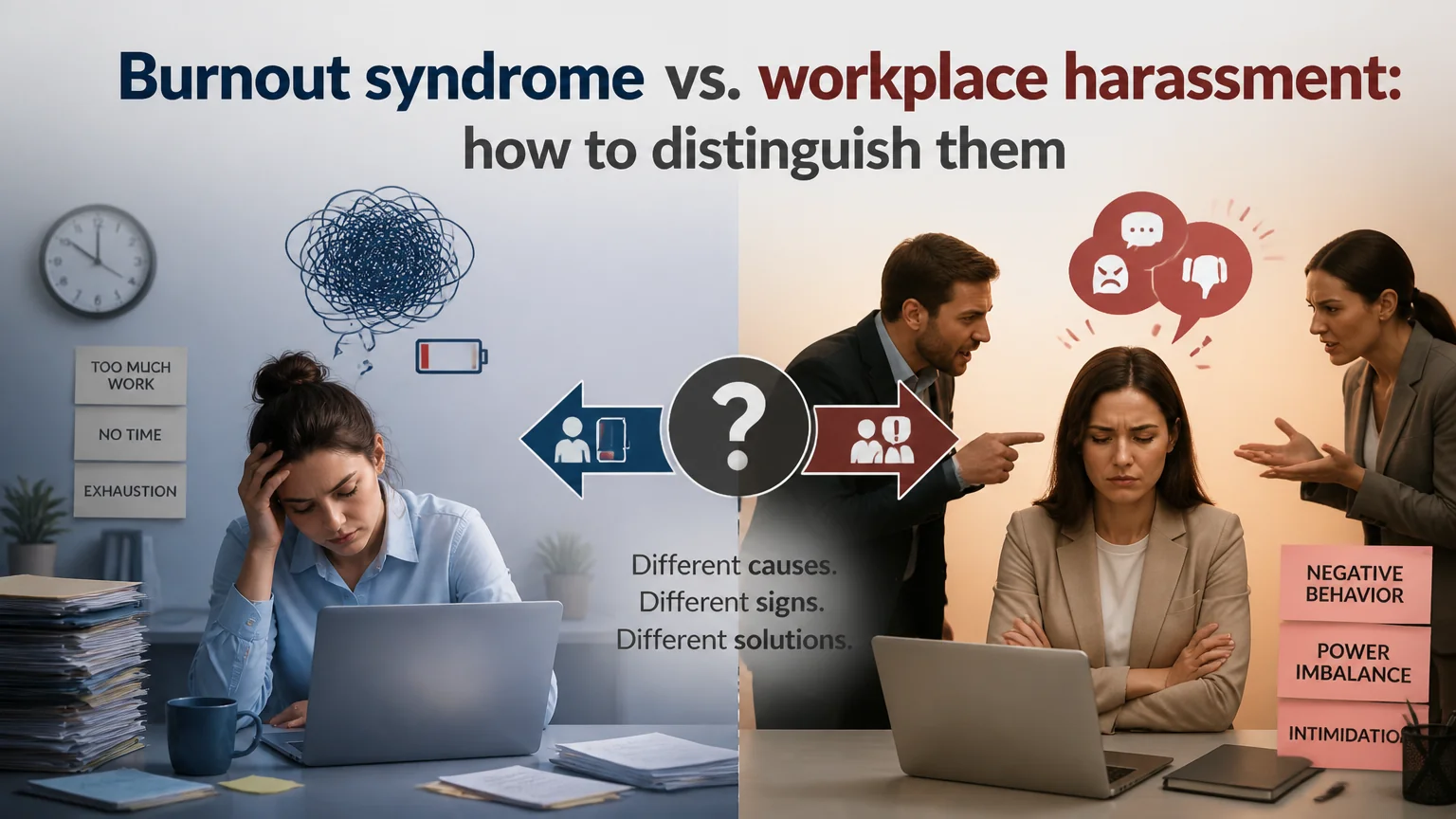
Burnout syndrome vs. workplace harassment: how to distinguish them - workplace harassment
Distinguishing between burnout and workplace bullying is critical for mental health. For nuanced insight and support, our course on understanding workplace challenges provides essential guidance.
The work environment, at times, can become a breeding ground for situations that compromise the mental health and well-being of employees. Two of these problems, although often confused, are the burnout syndrome (burnout) and workplace bullying (mobbing). It is essential to know how to distinguish them in order to address them effectively and protect our rights.
What is Burnout Syndrome (Burnout)?
The burnout syndrome, also known as occupational exhaustion, is a state of physical, emotional and mental exhaustion caused by chronic work-related stress that has not been properly managed. It is characterized by three main dimensions:
- Emotional exhaustion: A feeling of being drained, empty and without energy to meet work demands.
- Depersonalization: A cynical and distant attitude toward work and colleagues, with a loss of idealism and motivation.
- Reduced personal accomplishment: A sense of incompetence, lack of productivity and failure at work.
Common Causes of Burnout
Burnout does not arise out of nowhere. Generally, it is the result of a combination of factors related to the work environment and the individual's personal characteristics:
- Work overload: Excessive tasks, tight deadlines and constant pressure.
- Lack of control: Little autonomy in decision-making and organizing work.
- Insufficient rewards: A feeling of not being valued or recognized for the effort made.
- Lack of social support: Isolation and difficulty connecting with colleagues.
- Injustice: Perception of favoritism, unequal treatment and lack of fairness.
- Conflicting values: Disagreement between personal values and the company's values.
Symptoms of Burnout: How to Recognize It?
Symptoms of burnout can manifest in various ways, both physically and psychologically:
- Chronic fatigue: Persistent feeling of tiredness, even after resting.
- Sleep problems: Insomnia, difficulty falling asleep or interrupted sleep.
- Headaches and muscle pain: Tension and contractures caused by stress.
- Gastrointestinal problems: Stomach discomfort, heartburn and other digestive disorders.
- Irritability and mood changes: Greater susceptibility to frustration and anger.
- Difficulty concentrating: Problems with attention and memory.
- Social withdrawal: Withdrawal and avoidance of social interactions.
- Feelings of hopelessness and depression: Loss of interest in activities that were previously enjoyable.
What is Workplace Bullying (Mobbing)?
Workplace bullying, also known as mobbing, is a form of systematic and repeated psychological violence exercised against a worker in the workplace. It is characterized by a series of hostile and degrading behaviors that aim to humiliate, intimidate and destabilize the victim, with the ultimate goal of forcing them to leave their job.
Key Characteristics of Workplace Bullying
- Systematic nature: It is not an isolated incident, but a series of repeated and persistent attacks over time.
- Intentionality: The bully deliberately seeks to harm the victim.
- Power asymmetry: There is a power difference between the bully and the victim, which can be hierarchical, social or even numerical.
- Psychological harm: Workplace bullying has a significant impact on the victim's mental and emotional health.
Types of Workplace Bullying Behaviors
Workplace bullying can manifest in a variety of ways, including:
- Social isolation: Exclusion, ignoring and prohibition from participating in social activities.
- Attacks on reputation: Spreading rumors, constant criticism and public humiliation.
- Obstruction of work: Assignment of meaningless tasks, denial of resources and sabotage of projects.
- Verbal violence: Shouting, insults, threats and derogatory comments.
- Attacks on private life: Intrusion into personal life, disclosure of confidential information and telephone or digital harassment.
Consequences of Workplace Bullying
Workplace bullying has devastating consequences for the victim's health and well-being:
- Mental health problems: Anxiety, depression, post-traumatic stress and sleep disorders.
- Physical health problems: Headaches, gastrointestinal problems, hypertension and cardiovascular diseases.
- Social problems: Isolation, difficulty maintaining personal relationships and loss of confidence.
- Work-related problems: Decreased performance, absenteeism, sick leave and dismissal.
Key Differences between Burnout and Workplace Bullying
Although both problems can coexist and share some symptoms, it is important to distinguish the fundamental differences:
- Main cause: Burnout is mainly due to chronic work-related stress, while workplace bullying is caused by psychological violence exerted by one or more people.
- Intentionality: Burnout does not necessarily imply malicious intent, whereas workplace bullying is always intentional.
- Objective: Burnout generally does not have a specific target, while workplace bullying aims to harm and destabilize the victim.
- Aggressor: Burnout does not have a direct aggressor, while workplace bullying always involves a bully.
What to Do If You Suffer from Burnout or Workplace Bullying?
It is crucial to take action if you believe you are experiencing burnout or workplace bullying:
- Seek support: Talk to friends, family, coworkers or a mental health professional.
- Document everything: Keep a detailed record of incidents, dates, times, witnesses and any other relevant information.
- Report it to the company: If you feel safe, file a formal complaint with your supervisor or the human resources department.
- Consult a lawyer: An employment lawyer can advise you on your rights and legal options.
- Prioritize your well-being: Practice activities that help reduce stress and take care of your mental and physical health.
 For Onlinecourses55
|
2025-12-16
For Onlinecourses55
|
2025-12-16