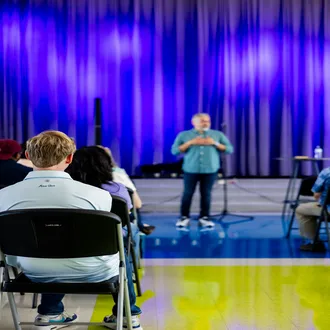
The stage and its types: how to use space to your advantage
The Theater Type Stage: Maximum Visibility and Attention
The ideal stage for a public intervention is one that guarantees the best possible visibility for the entire audience, and the one that best fulfills this function is the theater-type stage.
When facing a large audience in an auditorium, the most strategic position is to stand in the center of the stage.
This location makes you the natural focus of attention, facilitates eye contact with all sections of the audience and allows you to attract their interest more easily.
If you are sharing the stage with a table and other speakers, the best option is to stand at the side, diagonally to the audience and to the people seated at the table.
This way, you avoid turning your back on anyone, maintaining a visual connection with everyone present.
The Stage with Projection: Managing the Spotlight
When your presentation is supported by a projection (slides, videos, etc.), it should be placed at the center of the stage so that it is visible to everyone.
However, you should be aware that, in this configuration, the audience's natural focus of attention will shift to the screen, not to you.
If your goal is to bring attention back to you quickly, you must design your visual aids strategically: use powerful images, simple graphics and, above all, very little text.
The idea is that the audience can grasp the visual information in a second or two and look back to you for the verbal explanation, rather than just reading the screen.
The Tabletop Stage: Small Group Proximity
For smaller audiences (between 4 and 15 people), it is common for the intervention to take place around a table.
If a projector is used, the most recommended position for the speaker is on one of the short sides of the table, next to the projection screen.
This location allows you to easily point out the elements of the presentation without turning your back to anyone and maintaining eye contact with all attendees.
An alternative you should avoid is to stand behind the projector, as you would be completely giving up your prominence and forcing the audience to constantly turn around if they wanted to look at you, which is very uncomfortable and ineffective.
The Circular Stage and the Importance of Preparation
The circular table stage is not advisable for a formal presentation in which a speaker addresses an audience.
Its main characteristic is that there is no predominant position; all participants are at the same level, which makes the task of capturing and maintaining attention extremely difficult.
This type of setting is much more suitable for a colloquium, a debate or group work, where the aim is to encourage the equal par
the stage and its types how to use space to your advantage