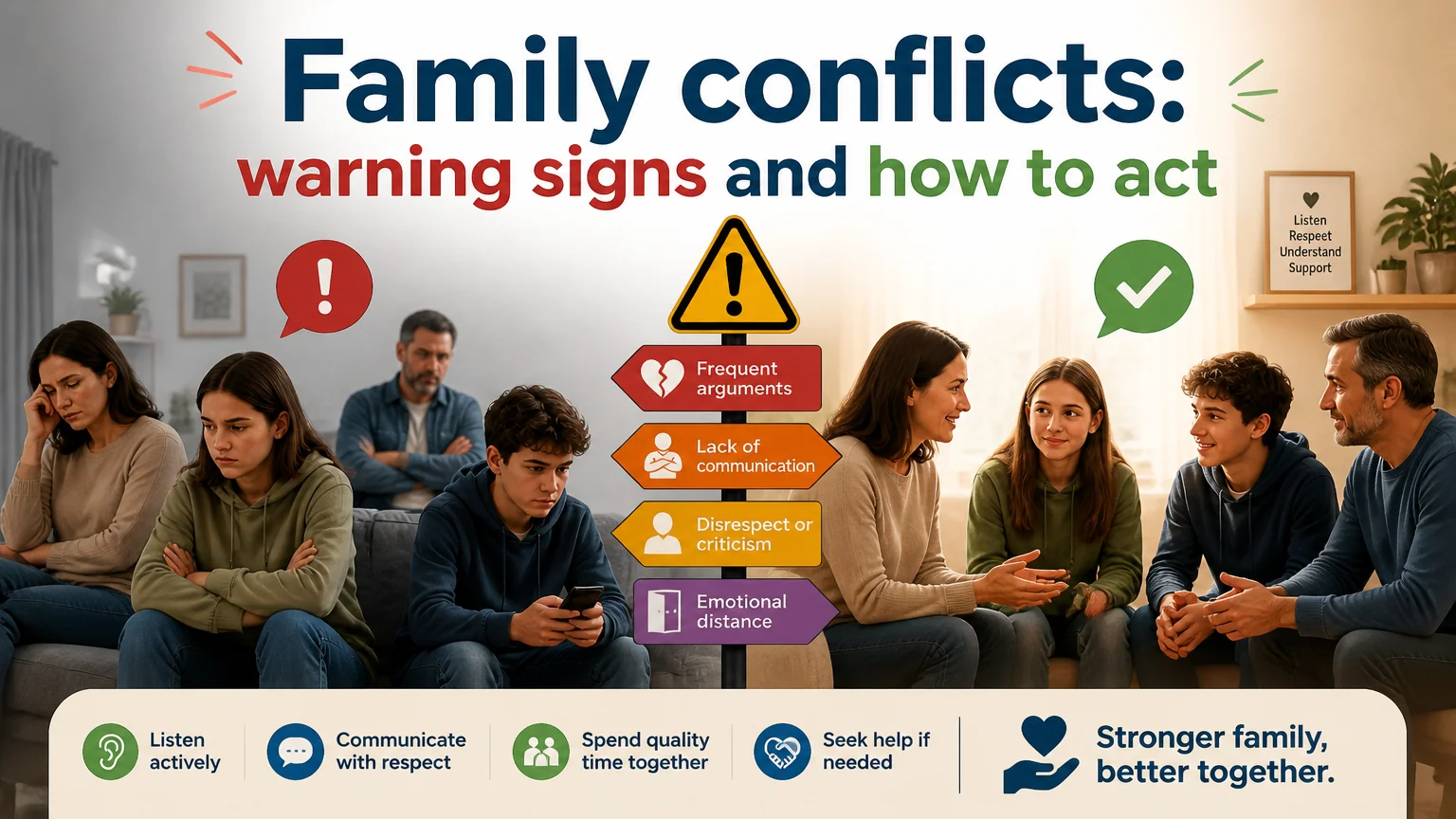
Implementing collaborative decision-making in your home can be enlightening; take advantage of a comprehensive course focused on navigating family disputes to foster stronger connections and mutual respect.
Why negotiating as a family transforms the home environment
A peaceful home is sustained not only by affection, but also by how decisions are made and disagreements are resolved. Negotiating as a family is not “haggling” nor always giving in; it is learning to identify interests, generate options, and build sustainable agreements that respect everyone’s needs. When practiced daily, it reduces tension, prevents repeated arguments, and teaches emotional and social skills for life.
Foundations of collaborative negotiation
Interests over positions
A position is what each person asks for (“I want this”), while the interest is the why (“I need it because…”). When we understand interests, creative solutions appear. For example, if someone wants silence at night and another person wants to watch shows, the interest might be to rest and relax; the solution may not be “all or nothing,” but rather headphones, schedules, or an alternate space.
Respect and dignity as non-negotiable rules
The quality of the agreement depends on the quality of how we treat each other. No mockery, no labels, no threats. The goal is not to win an argument, but to strengthen the relationship while we resolve the issue.
- Separate people from the problem: the conflict lies in the situation, not in the worth of the person who thinks differently.
- Seek win-win solutions: avoid short-term victories that erode trust.
- Clear commitments: what is agreed should be understood the same way by all parties.
Preparation: emotions, time, and place
Negotiating well begins before speaking. Choosing the right moment and setting the stage reduces friction and multiplies empathy.
- Regulate emotions: if there is intense anger, take a break; breathing, walking, or drinking water helps restore self-control.
- Choose the moment: avoid important conversations when someone is hungry, in a hurry, or very tired.
- Define the topic: “let’s talk about dishwashing turns and nighttime routines,” not “let’s talk about everything.”
- Bring data: observable facts such as schedules, frequency, or expenses, to avoid arguments based on assumptions.
Conversation techniques that work
Active listening and open-ended questions
Someone who listens with genuine curiosity deactivates defenses. Asking open-ended questions allows better understanding and shows a willingness to build.
- Reflection and validation: “I understand that it frustrates you to come home and see the kitchen messy; it weighs on me when I feel there isn’t enough time.”
- Exploratory questions: “What would be a good outcome for you?”, “What would you be willing to try this week?”
- Useful silence: leaving space to think prevents interruption and allows for nuance.
Language that reduces defensiveness
Form matters as much as content. Language that promotes responsibility without blame paves the way to agreement.
- First-person messages: “I need…” instead of “You never…”.
- Describe behaviors, not identities: “The trash wasn’t taken out,” not “You’re irresponsible.”
- Set clear and kind boundaries: “I can talk now for 20 minutes, then I need to get back to work.”
- Offer options: two or three realistic proposals invite choosing rather than fighting.
Steps to reach sustainable agreements
- Define the common goal: “We want a quiet night and a clean house without anyone burning out.”
- Generate options without judging: a brief brainstorming in which everything is written down first and evaluated later.
- Evaluate with criteria: available time, cost, impact on well-being, and fairness.
- Specify the agreement: who, what, when, how, and with what resources. The clearer, the better.
- Review plan: agree on a date to evaluate and adjust. Review is not failure; it’s maintenance.
Negotiating with children and adolescents
Adapt the process according to age
- Ages 3 to 6: simple, visible agreements. Use pictograms or charts with tasks and symbolic rewards.
- Ages 7 to 12: involve them in brainstorming. Offer limited options and explain the reasons behind the rules.
- Ages 13 to 17: more autonomy and shared responsibility. Link privileges to commitments and encourage self-regulation.
At all ages, adult consistency is key. If the agreement is that there are no screens at the table, it applies to adults and kids alike.
Money and household chores: a practical example
Let’s imagine there’s tension over the monthly shopping and the cleaning. A practical approach would be to agree on a visible budget and a division of tasks by time blocks.
- Budget: set an amount for basic purchases and a flexible fund for treats. Whoever wants an extra proposes where it will come from or what will be adjusted.
- Rotating roles: separate tasks by category (kitchen, bathrooms, trash, floors) and rotate them weekly to distribute the unpleasant and the light.
- Concrete supports: a short playlist to accompany cleaning, 20-minute timers, and a “pleasant finish” with shared downtime.
A mini script could be: “I see that spending on snacks went up. I’m concerned we won’t have enough for fruits and vegetables. How about setting aside a fixed amount for basics and leaving 15% for treats? We can review it every Friday.”
Handling disagreements and impasses
- Name the impasse: “I think we’re repeating ourselves; let’s try another route.”
- Go to the interests: “What is most important to you in all this?”
- Look for an experiment: “Let’s try this option for a week and evaluate with data.”
- Involve a neutral third person if the topic is very sensitive.
If the conversation heats up
- Agreed time-out: a 10- to 20-minute pause to self-regulate; return at the agreed time.
- Reframing: “Same team, shared problem.”
- Quick repair: a concrete apology for tone or a hurtful phrase makes it easier to get back on track.
Formalize, follow up, and celebrate
- Write down what was agreed in a visible, concise place, with a start date and review date.
- Shared board or list for tasks, with visible check marks to see progress.
- 15-minute weekly ritual: what worked, what to change, what to appreciate.
- Celebrate achievements: small acknowledgments keep motivation and good spirits up.
Common mistakes and how to avoid them
- Negotiating when someone is upset: better to pause and resume when calm.
- Vague agreements: “behave well” is not measurable; “turn off screens at 21:00 from Monday to Thursday” is.
- Imposing without listening: it may work once, but it erodes the relationship and increases resistance.
- Forgetting the review: without follow-up, even good agreements fade.
- Piling up topics: addressing one or two per conversation prevents exhaustion and confusion.
Mini conversation scripts
Screens and schedules
“I want us to rest better and for mornings to be less chaotic. How about we turn off screens at 21:00 from Monday to Thursday and allow an exception on Fridays? If we stick to it, on Saturday we’ll choose a movie together.”
Schoolwork and leisure
“I see you do your homework late and end up stressed. I’m concerned you’re not sleeping well. Shall we try 25-minute blocks with short breaks and a wrap-up at the end of the day? Leisure stays intact once we finish the study block.”
Guests and personal space
“I like it when your friends come over, and I need silence for my meetings. I propose that visits be from 17:00 to 20:00 and that you let me know a day in advance. In exchange, I’ll reserve the living room for you on weekend afternoons.”
Daily habits that sustain coexistence
- Brief morning check-in: each person shares a goal and a need.
- Screen-free meals at least once a day to reinforce connection.
- Weekly family meeting with an agenda and limited duration.
- Gratitude practice: name a specific action by another person that helped during the week.
- Learn to apologize: repair with actions, not just words.
A closing to get started
Negotiating at home doesn’t require perfect speeches, but clear intention and constant practice. With emotional preparation, genuine listening, and specific agreements, living together becomes lighter and fairer. Start with a small topic, try it for a week, and celebrate every improvement. Over time, you’ll see trust grow, conflicts resolve faster, and relationships strengthen, because every voice finds its place and decisions are made as a team.
 For Onlinecourses55
|
2026-05-22
For Onlinecourses55
|
2026-05-22