For Onlinecourses55
|
2026-04-07
For Onlinecourses55
|
2026-04-07

How to manage family conflicts between parents and children - family conflict resolution
Transform family quarrels into moments of growth with the right approach; consider a comprehensive course focusing on conflict resolution and healthy communication strategies that can benefit everyone involved.
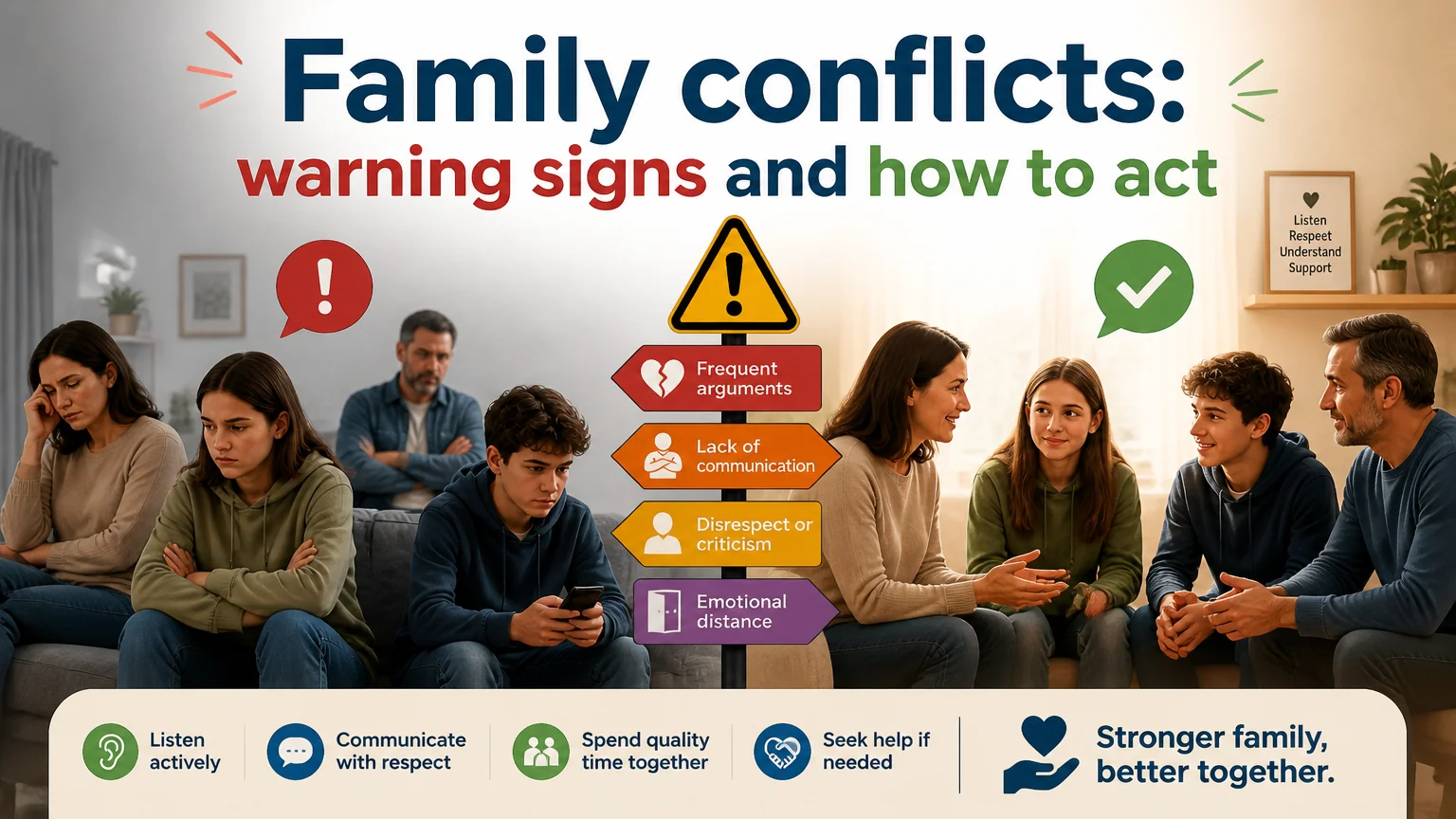
Disagreements between mothers, fathers, and children are not a sign of failure, but a natural part of living with people who learn, change, and seek their place. The key is not to avoid them, but to handle them in ways that strengthen the bond. Below is a practical guide that combines emotional understanding, clear communication, and realistic agreements to transform everyday clashes into opportunities for mutual growth.
Before trying to resolve, it’s helpful to ask what need is not being met. Many arguments are not about “what happened,” but about what that situation represents to each person: respect, autonomy, safety, belonging, or justice.
Identifying the underlying need helps shift the focus: from “who is right” to “what each person needs to feel safe and respected.”
Not all conversations have to happen “right now.” If someone is very upset, it’s wise to pause and resume with a cooler head. A private, distraction-free space makes it easier for everyone to express themselves.
These rules prevent the conversation from turning into a “fight to win” and steer it toward mutual understanding.
Listening is not waiting for your turn to reply, but trying to understand. Paraphrasing (“what I understand is that…”) shows interest and reduces defensiveness.
Instead of “you always do” or “you never follow through,” use “I feel / I need / I’m concerned,” which reduces attack and makes it easier for the other person to listen.
The goal is not to impose, but to co-create solutions everyone can sustain.
When the body is on alert, the ability to reason goes down. That’s why managing activation is part of handling conflict.
Modeling this self-regulation teaches children that feeling intensely is valid and that it’s also possible to return to agreement.
An effective boundary isn’t a lecture: it’s specific, reasonable, and enforced. Agreements are built with participation; when children feel their voice matters, there is more commitment.
Consequences should be related to the incident and aim to repair. Better “if the phone isn’t used responsibly, screen time is reduced and recovered through trustworthy behavior” than disproportionate punishments that only breed rebellion or resentment.
They need simple limits and clear models. Breaking tasks into steps, using visual reminders, and positively reinforcing progress works well. Play and brief stories help them understand the why behind the rules.
They seek autonomy and belonging. Involving them in decision-making, negotiating schedules, and explaining safety criteria reduces clashes. It matters to validate their perspective even if you don’t agree.
The relationship shifts to a more horizontal one. Agreeing on household responsibilities, cohabitation boundaries, and shared finances, with mutual respect, strengthens the transition.
If there were shouting, slammed doors, or hurtful words, repair is the priority. It’s not about “forgetting,” but about restoring trust.
Rather than “putting out fires,” it’s better to build practices that keep the family climate healthy.
Scenario 1: household chores. Instead of “you never help,” define the objective (“keep the home livable for everyone”), agree on specific tasks by day, set a reminder (alarm) and a weekly review. If someone doesn’t follow through, repair by taking on an extra task the next day.
Scenario 2: screen use. Discuss risks and benefits, define a flexible schedule based on responsibilities, enable control tools, and agree that time is adjusted based on school performance and rest. If there’s noncompliance, reduce use for 48 hours and restore it by showing consistency.
Scenario 3: curfew. Listen to reasons for returning later, agree on a buffer and a communication protocol (a message at set intervals). If it isn’t respected, outings are restricted for a brief period and safety conditions are reviewed before resuming them.
Some dynamics require outside support. Asking for help is an act of responsibility, not defeat.
A professional can help identify patterns, improve communication skills, and establish realistic plans.
Managing family conflicts is ongoing practice. Sometimes you’ll move quickly and sometimes it will be harder, but every attempt to listen better, set respectful limits, and repair in time strengthens the bond. The goal is not to avoid differences, but to turn them into a bridge to get to know each other, care for each other, and grow together.