How to overcome family conflict in difficult situations - family conflict resolution
Understanding and managing conflicts at home is essential for harmony. A thorough course that focuses on family conflicts and their resolutions will equip you with the necessary skills to foster a healthier atmosphere.
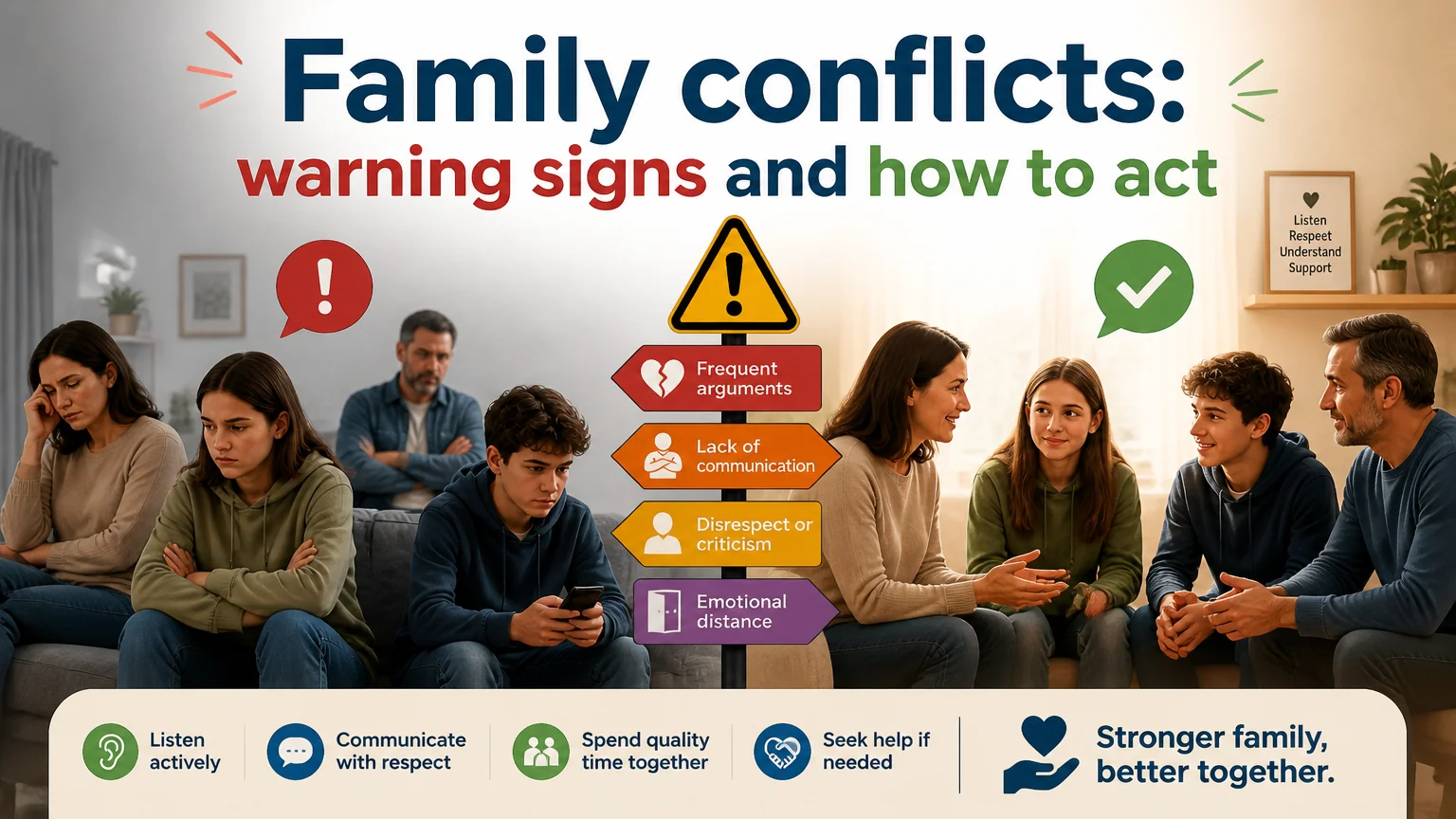
Family conflicts are inevitable, especially when life is complicated by losses, financial problems, abrupt changes, or difficult decisions. The key is not to avoid them at all costs, but to learn to manage them with respect, clarity, and healthy boundaries. Below you will find a practical, step-by-step guide to understand conflict, speak without hurting, agree on sustainable solutions, and care for relationships over time.
Understanding conflict to defuse tension
Why it appears and what fuels it
Conflict often arises when there are unspoken expectations, rigid roles, accumulated stress, or different interpretations of the same event. In difficult situations, external pressure amplifies disagreements: the mind seeks certainty, the body is on alert, and empathy drops. Identifying these dynamics helps separate the problem from the person.
Signs that the conflict is escalating
- Conversations that repeat without changes and with increasing intensity.
- Personal put-downs, sarcasm, or prolonged silences.
- “All or nothing”: inflexible positions and polarized thinking.
- Internal alliances (two against one) or triangulations with third parties.
- Emotional fatigue after each interaction and avoidance of the topic.
If you notice these signs, it’s time to change the way you talk before trying to reach agreements.
Personal preparation: regulate first, talk later
Ground your emotions and expectations
Entering an intense conversation with your body activated raises the likelihood of a fight. Before speaking:
- Breathe deeply for two minutes and slow your body’s pace.
- Write down what you feel and what you need; separate wants from demands.
- Clarify your minimum goal (e.g., “to understand their point”) and your ideal goal.
- Decide on a healthy boundary if the conversation goes off track (pause, reschedule, change the format).
Mind the timing and the setting
- Choose a time with no rush or hunger, with sufficient privacy.
- Avoid starting discussions late at night or in the middle of other tasks.
- Agree on an estimated duration to prevent exhaustion.
Communication that lowers defenses
Basic principles
- Speak in the first person: describe your experience without assuming others’ intentions.
- Validate what you heard before responding: show that you understood.
- Take pauses when emotion rises; a timely break prevents escalation.
- Ask more than you assert: curiosity opens doors.
Useful phrases for tense moments
- “I want to better understand your point. What’s most important to you here?”
- “When X happens, I feel Y and I need Z. Can we look for an alternative?”
- “What I’m hearing is that you’re concerned about A because of B. Is that right?”
- “I need a 10-minute break so we can talk better. I’ll come back and we can continue.”
- “I don’t agree, but I appreciate you saying it so clearly.”
The family meeting step by step
Before: align the framework
- Define the topic and goal in a concrete sentence.
- Agree on rules: no interruptions, no insults, equitable speaking times.
- Designate someone to keep time or take notes, if possible.
During: a supportive structure
- Opening round: each person shares their view in two or three minutes.
- Facilitator’s summary: confirm common ground and discrepancies.
- Option ideation: generate alternatives without evaluating for a few minutes.
- Evaluation: assess the feasibility, costs, and benefits of each option.
- Decision: choose one or two concrete, measurable actions.
After: follow-up
- Record agreements in writing: who does what, when, and how it will be measured.
- Set a short review date to make adjustments without blame.
Clear boundaries and agreements
How to write agreements that are kept
- Specific: “Call every Tuesday at 7:00 p.m.” instead of “communicate more.”
- Realistic: consider available time, money, and energy.
- Reciprocal: each party takes on something; avoid one-sided pacts.
- Reviewable: include an evaluation date and success criteria.
Healthy consequences
Consequences are not punishments; they are coherent responses if the agreement is not met. For example, if there is constant yelling, the consequence can be to stop the conversation and resume it with mediation. The key is to announce them beforehand and apply them calmly.
When to seek outside help
Mediation and community support
- Ideal when there is stalemate, repeated misunderstandings, or an unequal distribution of power in the conversation.
- A neutral third party helps frame, translate, and balance speaking time.
Individual or family therapy
- Useful if there are old wounds, deep resentment, or repeating patterns.
- Allows you to work on emotions, family history, and communication skills.
If there is physical violence, threats, or coercive control, prioritize safety and seek specialized resources immediately.
When there are children or adolescents
What to say and what not to say
- Offer simple, honest information, appropriate to their age.
- Avoid using them as messengers or as an adult’s ally against another.
- Reaffirm that they are not responsible for the conflict or for solving it.
- Maintain stable routines: schedules, schoolwork, playtime, and rest.
Signs of stress to watch for
- Sharp changes in sleep or appetite.
- Regressions (bed-wetting, new fears), irritability, or isolation.
- Drop in school performance or frequent somatic complaints.
Common cases in difficult times
Economic crisis
- Basic financial transparency: income, fixed expenses, and priorities.
- Shared budgeting and tasks to reduce costs without blame.
- Small wins: review weekly progress to sustain motivation.
Illness or grief
- Care and rest schedule to avoid overloading a single person.
- Farewell or commemoration rituals that validate different emotions.
- Space for silence: not everything is resolved by talking all the time.
Separation or household reconfiguration
- Written cohabitation and visitation plan, with a focus on what’s predictable.
- Agreements about communication in front of third parties and at school events.
- Limits on criticizing the other parent in front of the children.
Caring for older adults
- Distribution of tasks according to skills: finances, transportation, companionship.
- Medical and legal review to plan complex decisions.
- Rotation of duties and scheduled breaks for caregivers.
Practical 30-day plan
- Week 1: strategic pause. Map the problem, write down needs and boundaries. Brief conversations to listen, without deciding yet.
- Week 2: first formal meeting. Define the goal, rules, and one small pilot action.
- Week 3: review the pilot action. Adjust what doesn’t work; agree on a second action.
- Week 4: consolidation. Document agreements, set care rituals, and schedule the next monthly review.
Common mistakes and how to avoid them
- Wanting to win the argument: replace it with seeking a good-enough agreement.
- Judging intentions: describe observable behaviors and their impact.
- Speaking in the heat of the moment: pause, regulate, and return when the intensity drops.
- Vague agreements: translate everything into actions, responsible parties, and dates.
- Not measuring progress: without follow-up, what was agreed upon gets diluted.
Regaining and maintaining trust
Rituals that bring you together
- 15-minute weekly check-in: what worked? what to adjust? what to appreciate?
- Enjoyment spaces with no conflict agenda (a meal, a walk, a movie).
- Small, consistent gestures: keep schedules, give notice of changes, acknowledge efforts.
Repairing when we fail
- Acknowledge the impact without justifying: “What I said hurt you. I’m sorry I did that.”
- Propose a concrete reparative action and follow through.
- Give it time: trust returns with repeated behaviors, not promises.
Quick guide for difficult conversations
Before
- Clear objective and a concrete request.
- One or two specific pieces of evidence, not an endless list.
- Pause plan if emotion rises.
During
- Listen, summarize, ask, and then propose.
- Speak in the first person and validate the other person.
- Look for at least one shared option.
After
- Write down what was agreed and how it will be measured.
- Set a review date.
- Acknowledge the effort of having had the conversation.
Overcoming conflict is not a straight line; there will be advances and setbacks. What matters is to sustain a clear intention, careful conversations, and revisable agreements. With structure, empathy, and healthy boundaries, even the most difficult situations can become opportunities to strengthen bonds and build a fairer, kinder way of being a family for everyone involved.
 For Onlinecourses55
|
2026-04-22
For Onlinecourses55
|
2026-04-22