For Onlinecourses55
|
2026-02-16
For Onlinecourses55
|
2026-02-16

How to resolve family conflicts with effective techniques - family conflict resolution
In any family, understanding conflicts can lead to better communication; enhance your skills with a valuable course designed to help families resolve disputes effectively and strengthen bonds.
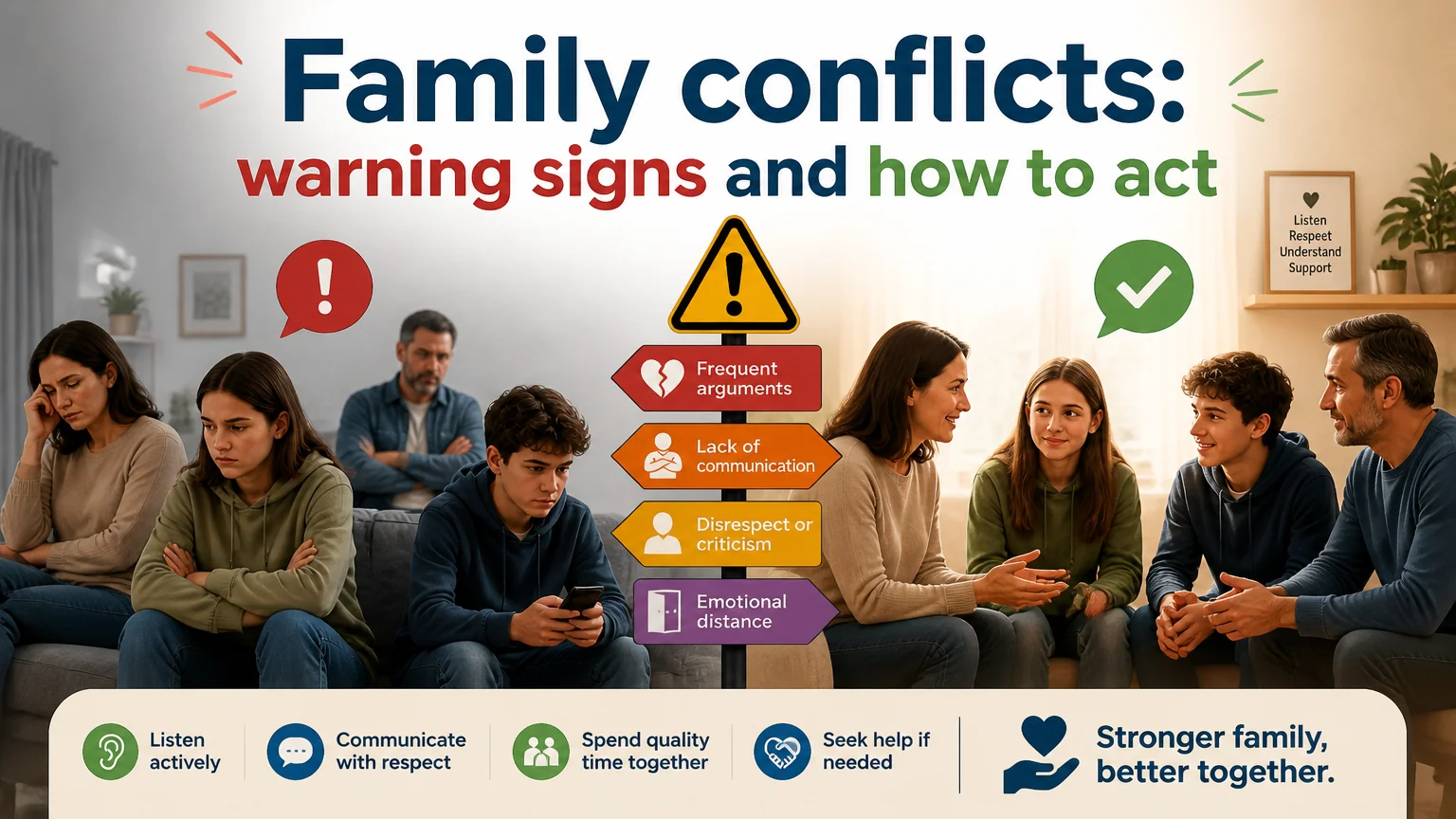
In every family, friction arises: misunderstandings, unspoken expectations, clashes of values, or misaligned routines. The goal isn’t to avoid conflict, but to turn it into an opportunity to understand each other better and strengthen bonds. Below you’ll find a clear roadmap, with practical techniques and everyday examples, to face difficult conversations without losing control or sacrificing respect.
Before speaking, it’s worth asking yourself: “What’s really at stake?” Many apparent arguments hide unmet needs: recognition, autonomy, safety, or affection. If the issue is the division of chores, perhaps what hurts is feeling that one person carries it all. If the reason is how money is used, there may be fear about the future or a lack of clarity about priorities.
A good practice is to briefly write down the concrete fact, what emotions arise, and what need lies behind it. For example: “Fact: you arrived late three times without notice. Emotion: frustration. Need: predictability and respect for family time.” This prior clarity prevents entering the conversation from a place of accusation and helps keep you grounded in the concrete.
Important conversations deserve a thoughtful frame. Choosing a time when no one is rushed, tired, or hungry greatly increases the chances of a good outcome. It’s also key to agree on a few basic rules: speak in turns, don’t interrupt, avoid put-downs, and keep the focus on solutions.
This ritual isn’t a formality: it signals to everyone that dialogue is valuable and deserves full attention.
Assertiveness combines honesty and respect. It allows you to express what you think and feel without attacking or lapsing into passivity. It’s grounded in truly listening, speaking from your own experience, and validating others’ emotions, even when you don’t share them.
Active listening means paying attention to content and tone, observing body language, and showing genuine interest. Avoid preparing your response while the other person is speaking; instead, take a breath and focus on understanding.
When someone feels heard, they lower their guard and become more receptive to exploring solutions.
“You always” or “you never” statements trigger automatic defensiveness. Switching to first-person messages lowers friction: “When X happens, I feel Y, and I need Z.” Example: “When plan changes are announced at the last minute, I feel overwhelmed and need more advance notice to organize.”
This format delineates fact, emotion, and need. It leaves out sweeping judgments about the other person’s character and focuses on modifiable behaviors.
Paraphrasing is reflecting back in your own words what you think you understood: “What worries you is that the budget isn’t enough and you fear the extra expense will leave us with no margin, is that right?” Validating doesn’t mean agreeing, but acknowledging the emotion: “I can see why this upsets you; it’s an uncertain situation.”
These two micro-techniques calm the atmosphere and prevent misunderstandings by correcting misinterpretations in time.
When there are many angles or accumulated tension, it helps to rely on simple, repeatable frameworks. They give structure to the conversation and prevent endless circling without decisions.
A sustainable agreement balances needs. To do that, establish objective criteria before choosing: available time, real budget, fairness, impact on the children, health, etc. Then evaluate each option against those criteria. For example, to divide household chores you might consider hours of paid work, personal preferences, and the complexity of each task, aiming for a distribution everyone perceives as fair.
If you get stuck, return to interests, not positions. Instead of “I want it done this way,” explore “what problem does this option solve for you?” That’s where creative solutions often appear.
Emotion isn’t the enemy; it’s information. But if it escalates too much, it hijacks the conversation. Warning signs: raised voices, constant interruptions, sarcasm, or rigid silence.
When you resume, recap where you were and what’s needed to move forward. Avoid reopening wounds that were already being addressed.
A good agreement answers four questions: what will be done, who will do it, when, and how it will be reviewed. The more concrete, the better. “Every Sunday afternoon we review the week’s calendar; if there are changes, they’re announced in the family chat 24 hours in advance.”
Follow-up isn’t distrust; it’s the maintenance of what was agreed. It allows you to celebrate progress and make timely corrections without blame.
If conversations become repetitive loops, old wounds are reactivated, or there is verbal or physical violence, it’s time for external support. A mediator or family therapist provides a safe framework, neutral tools, and perspective to get unstuck. Seeking help isn’t a failure; it’s a mature decision to protect the family.
Resolving conflicts as a family isn’t a one-off feat, but a habit you train. With preparation, listening, careful language, and verifiable agreements, arguments stop being a battle and become collaboration. It’s not about winning, but about understanding and designing a kinder everyday life together. Each well-handled conversation is another brick in shared trust.