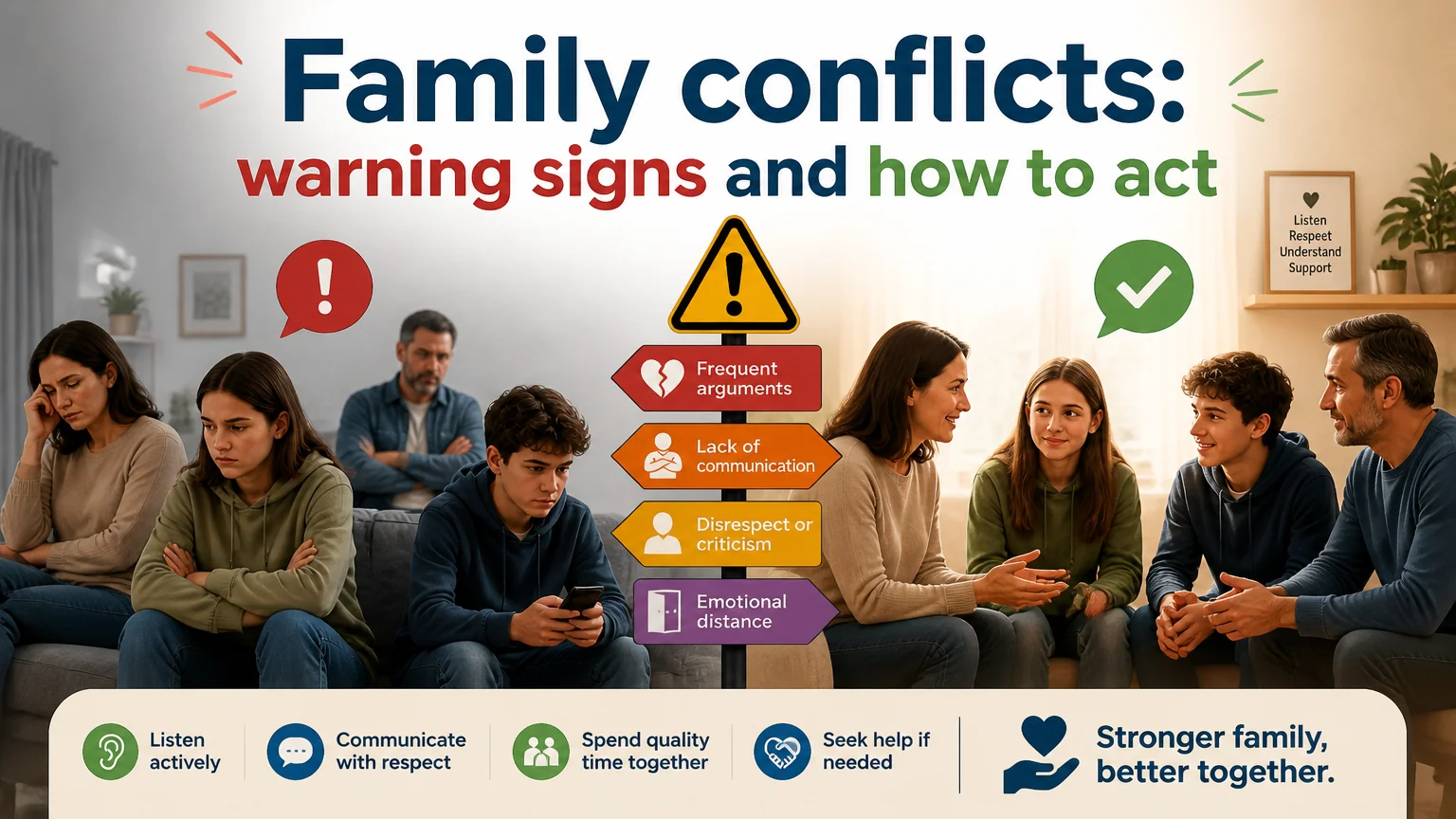
Understanding family conflict
Family conflicts don’t come out of nowhere. They usually arise from unspoken expectations, differing values, past stories that still hurt, and, above all, day-to-day pressure. When someone feels ignored, judged, or overburdened, they react defensively. Before looking for solutions, it’s helpful to understand which emotions are active: fear of losing control, need for respect, desire to feel seen. Shifting the focus from “who is right” to “what do we need” reduces tension and opens the door to useful, sustainable agreements.
Preparing before you talk
A calm conversation is won before it begins. If you arrive tired, hungry, or rushed, the discussion will easily spill over. Spend a few minutes organizing your ideas, deciding what outcome you consider acceptable, and how you will keep calm if provocations arise. Preparing doesn’t mean rehearsing a perfect speech, but ensuring that you can listen and express yourself without attacking. Choosing the right time and place is also part of success: privacy, enough time, and lack of distractions make the difference.
Quick techniques to self-regulate
- Breathe 4-4-6: inhale 4, hold 4, exhale 6. Repeat 5 times.
- Label the emotion: “I feel frustration” helps reduce its intensity.
- Agreed 10-minute pause: neither punishment nor escape, just a reset.
- Pre-note: write your main objective on a card and read it before speaking.
Conversations that de-escalate
The tone you start with often predicts the ending. A gentle, specific, respectful opening reduces resistance. Instead of bringing out the full list of grievances, address one topic at a time. Owning a share of responsibility is a shortcut to cooperation: it disarms defensiveness and shows maturity. Keep your voice steady and slow; if the volume rises, everyone’s emotional tension usually rises too.
Active listening and validation
- Summarize what you hear: “If I understand correctly, it bothered you that I didn’t let you know.”
- Validate the emotion, not necessarily the conclusion: “I understand that you felt left out.”
- Ask open-ended questions: “What would you need to feel calmer next time?”
- Avoid interrupting; take notes if you’re afraid you’ll forget your point.
First-person messages
- Useful template: “When X happens, I feel Y, and I need Z. Can we try A?”
- Example: “When the plan is changed without notice, I feel overwhelmed and need time to adjust. Can we give 2 hours’ notice?”
- Avoid “always” and “never”; they trigger defensiveness and are rarely true.
Basic rules for family meetings
- One topic at a time; if another comes up, note it for a future meeting.
- Timed speaking turns (e.g., 3 minutes) with no interruptions.
- Insults, sarcasm, and put-downs are forbidden; if they appear, pause immediately.
- Clear written agreements: who does what, when, and how it will be measured.
- Breaks if someone requests them; resume at an agreed time.
Solving problems step by step
- (1) Define the problem precisely: “Dinner is delayed 40 minutes three times a week.”
- (2) Clarify interests, not positions: “I want punctuality” may mean “I need to rest before bedtime.”
- (3) Brainstorm without judgment: at least 5 options, including creative ones.
- (4) Evaluate pros and cons together: impact, effort, fairness for everyone.
- (5) Choose a brief pilot test: 2 weeks and then a review.
- (6) Establish early signals for adjustment: what will tell us that we need to change?
Handling common sensitive topics
Money and inheritances
Money is rarely just money; it often represents security, recognition, and autonomy. Transparency prevents suspicion and resentment. Separating facts from interpretations helps keep the focus on concrete solutions and not on moral judgments.
- Create a budget visible to all involved.
- Agreements on loans: amounts, timelines, and what happens if they aren’t met.
- For inheritances: document wishes and avoid indirect messages in family meetings.
Parenting and boundaries
Parenting disagreements are normal. The key is deciding which rules are non-negotiable and where there is room for personal style. Minimum consistency among caregivers reduces confusion in children and teens.
- Define 3–5 core rules (sleep, screens, chores, respect).
- Agreements on logical, known, and proportional consequences.
- Monthly reviews to adjust according to age and school context.
Care for elders
Caring for older adults stirs guilt, exhaustion, and differences in judgment. Distributing tasks by strengths and availability, not by emotional bonds, is fairer and more sustainable. A flawed system that gets done is better than a perfect one no one can maintain.
- Task map: medications, appointments, shopping, companionship.
- Clear rotations and scheduled breaks for the primary caregiver.
- Warning signs of overload: irritability, insomnia, forgetfulness.
What to avoid
- Bringing out the historical archive of grievances; limit the conversation to the current fact.
- Mind reading: ask before assuming intentions.
- Ultimatums except for safety boundaries; they usually burn bridges.
- Conversing by messaging when there is a high emotional load; better by voice or in person.
If children or teens are present
Younger ones watch and learn how disagreement is managed. They don’t need to witness intense arguments or take sides. Protecting their well-being involves simply explaining that the adults are working to understand each other and that it isn’t their fault. More important than avoiding every conflict is showing how to repair afterward.
- Use neutral, brief language to reassure.
- Don’t ask them to judge or be messengers between adults.
- Reaffirm routines: sleep, meals, and school are not negotiable because of the dispute.
Mediation and external help
There are times when a neutral voice speeds up agreement and reduces emotional wear and tear. Family mediation, therapy, or even a trusted friend with credibility for everyone can make it easier to hear what we can’t manage to hear on our own. Seeking support is not failing; it is choosing efficiency and care for the bonds.
- Indicators: repeated arguments without progress, insults, stalemates, or legal issues.
- Prepare the mediator: objectives, boundaries, and non-negotiable topics.
- Commitment from all parties to follow guidelines and respect timelines.
Weekly action plan
Turning good intentions into habits requires a simple system. Better small, steady changes than big, fleeting promises. A weekly plan keeps everyone aligned and prevents tension from building up.
- Brief meeting every Sunday (20–30 minutes) to review agreements.
- Shared calendar: commitments, responsibilities, and special needs.
- One gesture of appreciation per person per week: explicit recognition of something the other did well.
- Family emotional traffic light: green (fine), yellow (tense), red (I need a break).
Follow-up and repair
Conflicts aren’t “cured” with one talk; they’re channeled with follow-up. If something went wrong, timely repair prevents scars. An effective apology speaks about facts, emotions, and learning, not excuses. Reviewing agreements allows adjustment before they blow up again.
- Useful apology: “I did X, I see it affected you in Y, and I will do Z to prevent it.”
- Record agreements in a visible place with a review date.
- Celebrate concrete progress: small victories sustain motivation.
Quick day-to-day tools
- A keyword to pause discussions when tension rises.
- “Parking lot” for topics: when a new issue appears, it’s noted for the next meeting.
- Scale from 1 to 10: each person rates the importance of the topic; start with the highest.
- Closing round: each person says in 30 seconds what they’re taking with them and what next step they’ll take.
Family harmony doesn’t mean the absence of disagreements, but the ability to turn them into agreements with the least possible wear and tear. With preparation, clear rules, and simple practices, difficult conversations become safer, more respectful, and more productive. The essential thing is to maintain curiosity about the other’s inner world, mind the tone, and measure success not by winning debates, but by protecting the bonds while moving forward on concrete solutions.