Transforming your family's communication starts with intentional practices. Discover practical strategies in this comprehensive course aimed at enhancing family interactions while maintaining clarity and respect.
Family communication doesn’t improve by accident: it’s trained. With small routines and clearer language it’s possible to reduce misunderstandings, lower tension, and increase connection among all members. The important thing is to move from good intentions to concrete practices, repeated consistently.
Below you will find a set of strategies applicable in homes with children, teenagers, couples, and extended families. They are simple tactics, with clear steps, that you can adapt to your reality. The goal is to build a climate of trust and collaboration without losing sight of boundaries and everyday organization.
Quick diagnosis to know where to start
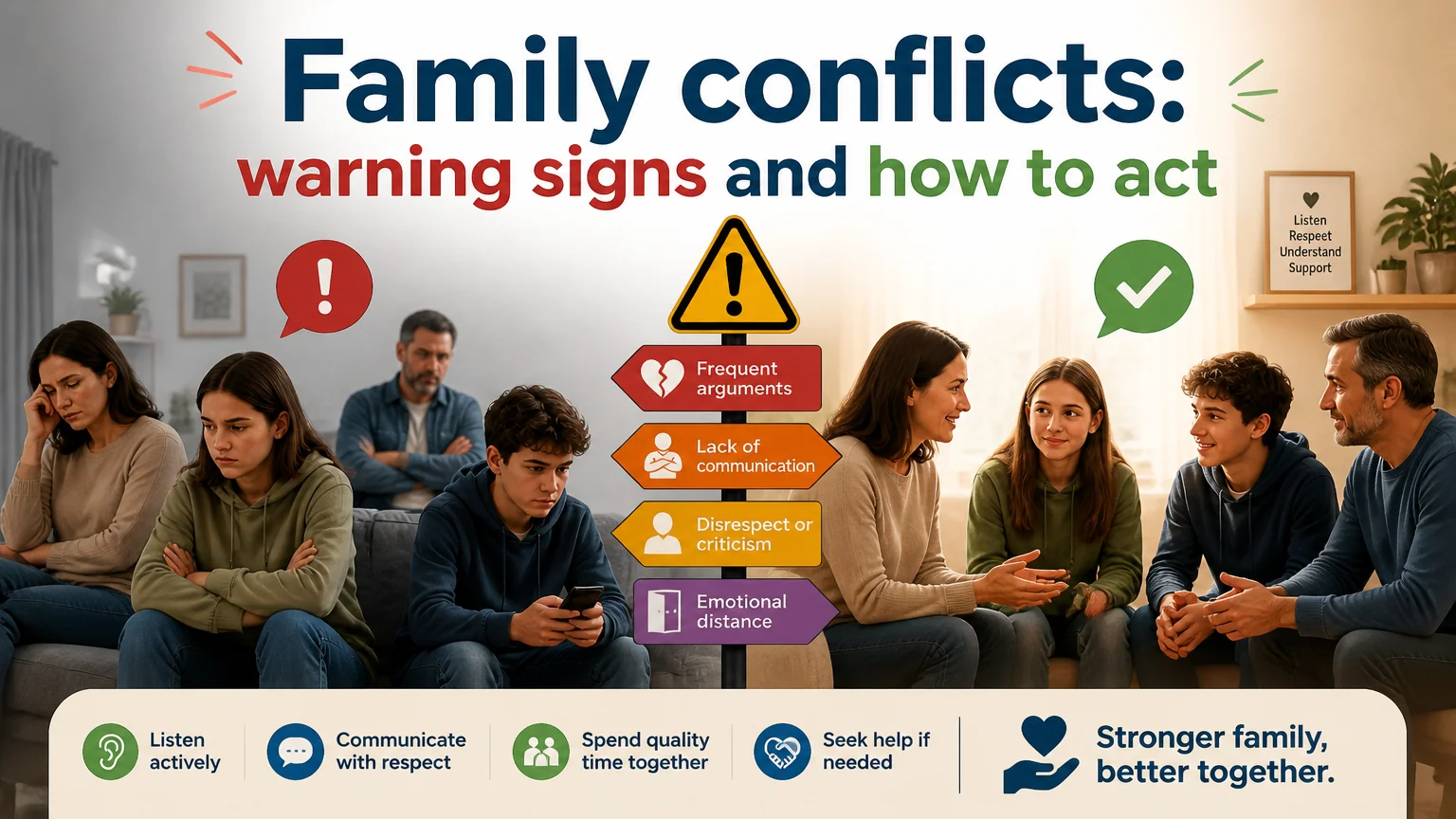
Common warning signs
- Arguments repeat with the same script and no new agreements.
- Someone avoids speaking for fear of “stirring up trouble.”
- There are constant interruptions and little listening.
- Important topics are addressed only when the conflict has already blown up.
Relationship map in 10 minutes
- List each member and note how they prefer to communicate (face to face, messages, time to think, etc.).
- Identify times of day with better and worse moods for talking.
- Define three priority topics for the month (for example: household chores, screen use, time together).
With this map, choose one or two areas to intervene first. Starting small increases the likelihood of sustaining the change.
Rituals that organize the conversation
25-minute weekly family meeting
- Fixed agenda: what worked, what didn’t, agreements for the week, recognition of someone.
- Rotating roles: facilitator, agreements scribe, timekeeper.
- Golden rule: complex personal issues aren’t resolved there; they’re only scheduled for a separate conversation.
Speaking turns and signals
- Talking object: whoever holds it speaks; the rest listen without interrupting.
- Pause signal: agree on a keyword to stop an escalation in tone and resume later.
Rituals provide structure and safety. Predictability reduces the need to shout to be heard.
Active listening and emotional validation
Practical steps
- Make eye contact and set the device aside.
- Reflect in your own words what you understood: “What worries you is…”.
- Validate the emotion without judging: “It’s understandable that you feel that way.”
- Ask before proposing solutions: “Do you want me to listen or for us to brainstorm ideas?”
Phrases that help
- “I want to make sure I understand you well—is this what you meant…?”
- “It makes sense that it bothered you; thank you for telling me.”
- “I can disagree and still respect what you feel.”
Validating isn’t the same as giving in. It’s recognizing the other person’s experience as real and worthy of consideration.
How to argue without hurting: from reproach to agreement
First-person messages
Use a simple formula: when X happens, I feel Y, I need Z, I propose W. This shifts the focus from attack to collaboration.
- “When the dishes are left unwashed, I feel overwhelmed; I need order to focus; I propose we take turns by day.”
Safety rules in conflict
- One issue per conversation. Mixing topics confuses and triggers defensiveness.
- No generalizations (“always,” “never”). Be specific and describe facts.
- 20-minute time-out if the tone rises. Return at an agreed time to close.
The goal isn’t to win the argument, but to gain clarity and a shared step toward the solution.
Visible agreements for tasks and boundaries
Responsibility board
- Task list by day and by person, with clear deadlines.
- Weekly review to adjust the load according to schedules and exams.
- Explicit recognition of effort, not just the result.
Protocols for critical moments
- Mornings: who prepares, who checks backpacks, what to do if someone is running late.
- Nights: screen time, wind-down ritual, quiet in the house after a certain hour.
Agreements drain the emotion from repetitive tasks. Less daily negotiation means more energy to connect.
Talking with children and teenagers
With little ones
- Simple, concrete language. Offer two valid options.
- Stories and role-plays to practice rules (“what would the superhero of patience do?”).
- Immediate positive reinforcement: name the behavior you want to see more of.
With teenagers
- Negotiation with reasons: explain the why of the rules and ask for their point of view.
- Progressive autonomy: more freedom linked to more verifiable responsibility.
- Bridges instead of lectures: “Help me understand how you see it” opens more than “because I said so.”
At both stages, consistency between what is said and what is done carries more weight than long speeches.
Couple and co-parenting: being on the same team
Daily mini-alignments
- Ten minutes at the end of the day to share key information and next-day decisions.
- Unified front: if a disagreement arises, note it to discuss later without undermining the other.
Monthly reviews
- Which boundaries work? Which generate unnecessary friction?
- Distribution of invisible loads (medical appointments, gifts, reminders): make them explicit and rotate them.
When the couple feels supported, the message to the children is clear and consistent.
Environment, nonverbal language, and technology
Small changes with big impact
- Eye contact, open posture, and a calm tone. The how says as much as the what.
- Reduce ambient noise in important conversations: no TV or phones.
- Screen rules: no use at the table or in the first 30 minutes after getting home.
The right environment facilitates listening and lowers reactivity. Setting the stage is part of communicating well.
30-day plan to establish habits
- Week 1: establish the weekly meeting and the pause signal. Practice first-person messages.
- Week 2: create the task board and two protocols (mornings and nights). Define a keyword to de-escalate.
- Week 3: practice active listening with reflection and validation, twice a day in micro-conversations.
- Week 4: review progress, adjust agreements, and celebrate concrete achievements.
Better to move forward slowly and surely than to try to change everything at once. Consistency wins.
Indicators to measure progress
- Fewer interruptions per conversation.
- More written agreements that are fulfilled without renegotiation.
- Shorter discussions with a clear closure.
- Increase in spontaneous gestures of appreciation.
Recording two or three metrics in a shared note helps keep on course and celebrate improvements.
Common mistakes that sabotage improvement
- Wanting immediate results and quitting at the first relapse.
- Using the family meeting for reproaches instead of coordination.
- Turning every conversation into a judgment about the person instead of talking about the behavior.
- Not adjusting agreements when schedules or needs change.
Stumbles are part of the process. The important thing is to return to the plan, adjust what’s necessary, and continue.
Closing and next steps
Apply today
- Define a pause signal and try it in the next tense conversation.
- Write the script for your first first-person message for a pending issue.
- Schedule the first 25-minute family meeting with rotating roles.
Effective communication isn’t a mysterious talent; it’s a set of observable habits. With clear boundaries, emotional validation, and simple rituals, any family can build a space where talking is safe, useful, and, over time, increasingly easy.
 For Onlinecourses55
|
2026-02-16
For Onlinecourses55
|
2026-02-16