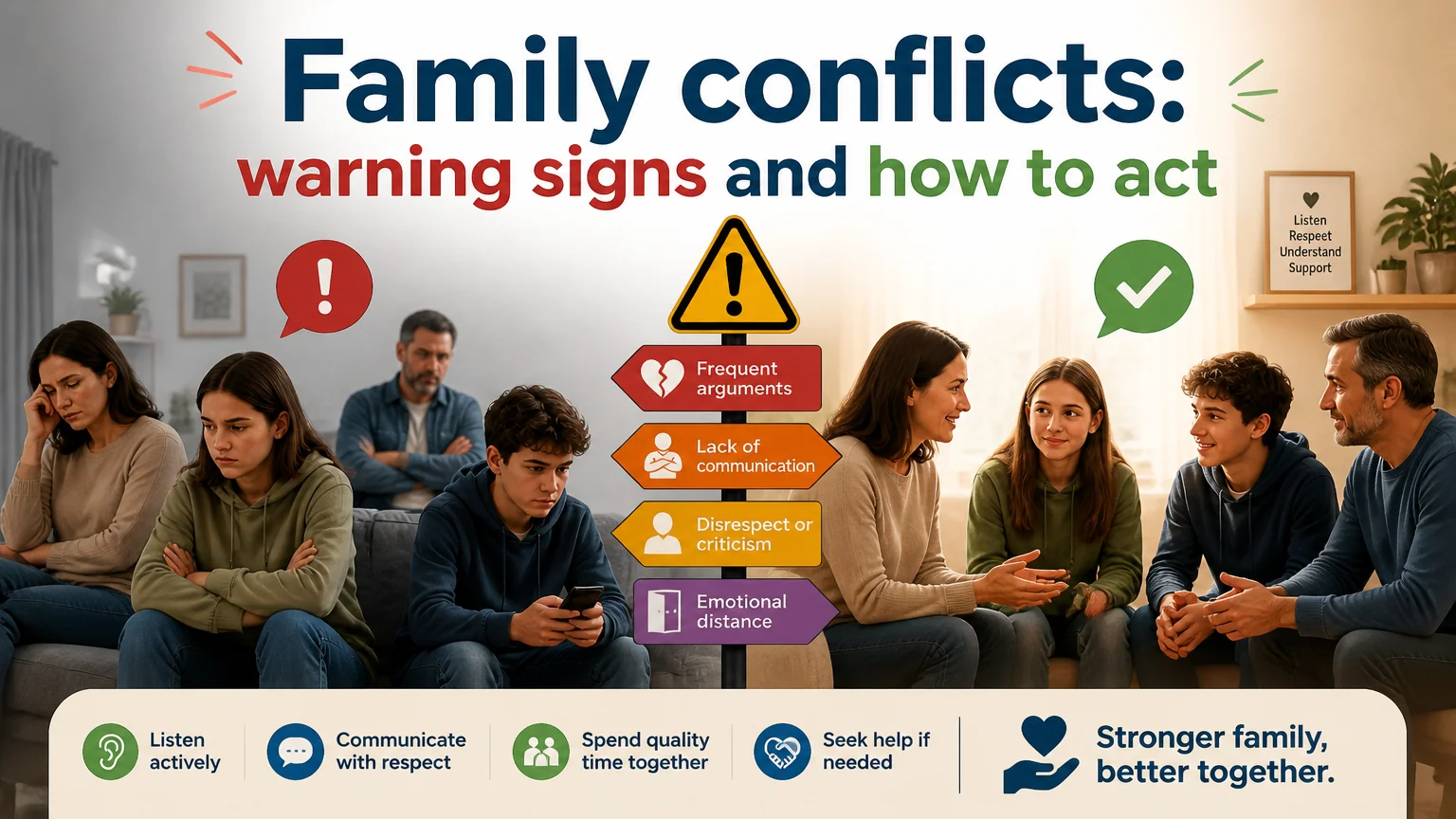
How to establish healthy boundaries to avoid family disputes - family conflict resolution
Establishing clear boundaries is key to reducing family tensions; learn how with a practical course focusing on respectful family dynamics and conflict resolution that offers valuable insights.
Why boundaries change family dynamics
In many homes, conflicts don’t arise from malice but from the lack of clear agreements. A healthy boundary is not a barrier to punish, but a visible line that protects the emotional well-being, time, space, and values of each member. When those lines become explicit and consistent, arguments lose fuel, expectations get organized, and coexistence gains in respect and predictability.
What a healthy boundary is and what it isn’t
A healthy boundary is a clear statement of what you need and how you will act to take care of yourself when that need isn’t respected. It’s not a threat, nor an attempt to control the other person. It’s expressed calmly, upheld consistently, and accompanied by logical, proportionate consequences.
- That is: “I need 24 hours’ notice for visits; otherwise, I won’t open the door.”
- It is not: “If you do that again, you’ll regret it.”
Signs that boundaries are needed
- You build up resentment after saying “yes” when you wanted to say “no.”
- You feel exhausted from being “always available.”
- There are invasions of privacy: checking the phone, entering without knocking, giving opinions without permission.
- Circular arguments repeat with the same topics.
- You struggle to enjoy family time because you anticipate conflicts.
- Important decisions are made without you, yet they affect your life.
Key principles to make them work
- Clarity: no hints, no assumptions.
- Firm kindness: respectful tone, resolute stance.
- Consistency: what you say is reflected in what you do.
- Proportionality: related and fair consequences.
- Reciprocity: boundaries apply to all parties, not unilateral privileges.
- Flexibility: they are reviewed when circumstances change.
Prepare before you speak
- Define your need: time, space, money, information, rest, privacy.
- Write the boundary in a simple sentence: “From now on…”
- Anticipate objections and craft brief responses.
- Choose the time and place: calmly and without unnecessary audience.
- Decide on consequences that depend on you, not on the other person changing.
How to communicate with clarity and empathy
The way you say it matters as much as the content. Speak in the first person, validate emotions, and specify observable behaviors. Avoid diagnoses (“you’re intrusive”) and opt for descriptions (“you came in without knocking”).
- Useful format: “When [behavior], I feel [emotion]. I need [need]. From now on [boundary] and if it isn’t respected [consequence].”
- Example: “When you arrive without notice, I feel overwhelmed. I need to organize my time. From now on, give 24 hours’ notice; otherwise, I won’t be receiving the visit.”
- Closing question: “Is that clear? Is there anything you need to ask?”
Boundaries by type of relationship
With parents and in-laws
- Visits: “It works for us to see each other on Sunday afternoons; other days we prefer to plan in advance.”
- Parenting: “We appreciate the advice; we make the decisions about schedules and screens.”
- Money: “Thank you for the offer; if we accept help, we’ll do it with a plan and without conditions.”
With siblings and extended family
- Favors: “I can help once a month; if something extra comes up, I’ll let you know if it’s possible for me.”
- Jokes and comparisons: “I don’t take part in jokes about my partner/children; let’s change the subject.”
- Gatherings: “We’ll attend for two hours; then we’ll leave without pressure.”
With your partner
- Personal time: “I need 2 nights a week for my activities; you can choose yours as well.”
- Digital privacy: “I don’t share passwords; if something worries you, we’ll talk about it.”
- Finances: “Expenses over X are decided together.”
With children and teenagers
- Routines: “Screens after homework and until 8:00 p.m.”
- Respect: “I don’t tolerate shouting; if it happens, we pause the conversation and resume it later.”
- Gradual autonomy: “You can choose your clothes, but there’s a dress code for formal events.”
What to do in the face of difficult reactions
- Minimization: “It’s not such a big deal.” Response: “It may seem small, and even so it’s important to me.”
- Guilt: “You make me feel bad.” Response: “I’m sorry you feel that way; my intention is to care for the relationship and my well-being.”
- Insistence: repeat, don’t justify: “I’ve already answered; the decision stands.”
- Escalation: take a breather: “I’m pausing this conversation; we’ll resume it tomorrow at 6:00 p.m.”
Consequences that uphold the boundary
Without consequences, the boundary becomes a suggestion. This isn’t about punishment, but about behavioral adjustments to protect you.
- If there are non-urgent nighttime calls: silence the phone at a certain hour.
- If someone crosses a line at a gathering: step away for a while or end the visit early.
- If a logistical agreement isn’t respected: don’t take on the task next time.
- If your information is shared without permission: stop sharing it with that person.
Common myths and mistakes
- Selfishness: Taking care of yourself isn’t neglecting others; it’s the basis for caring better.
- “If they loved me, they would guess”: People don’t read minds; agreements are discussed.
- “Setting boundaries is saying no to everything”: It’s also saying yes with clear conditions and timing.
- “If I give in once, I’ve lost”: Flexibility with notice doesn’t nullify the rule; it shows judgment.
- Overexplaining: A brief reason is enough; overjustification opens endless negotiations.
Useful phrases for different moments
- Opening: “I want to talk about something that helps us get along better.”
- Boundary: “It’s important to me that [behavior]. From now on I will [action].”
- Validation: “I understand that the change makes you uncomfortable.”
- Repetition: “We’ve discussed it and the decision stands.”
- Closing: “Thank you for listening; let’s review how it’s going in two weeks.”
Practical plan to start this week
- Day 1: Choose a priority area and write your need in one sentence.
- Day 2: Design the boundary and the logical consequence. Practice it out loud.
- Day 3: Schedule the conversation for a calm moment.
- Day 4: Communicate it using the first-person format.
- Day 5: Apply the first consequence kindly.
- Day 6: Observe improvements and resistance; note adjustments.
- Day 7: Review the agreement with the other party and celebrate small gains.
How to maintain them over time
- Brief, consistent reminders: “I’m sharing this again so we’re aligned.”
- Periodic reviews: “Is it still working? What should we fine-tune?”
- Positive reinforcement: acknowledge when the agreement is respected.
- Self-care: sleep, digital boundaries, breaks; upholding a boundary requires energy.
When to seek external help
If there are constant escalations, sensitive topics (money, inheritances, parenting), or entrenched patterns, a neutral third party can facilitate agreements. Family mediation, systemic therapy, or communication workshops offer tools and a safe space to reframe expectations and agree on new rules for living together.
Final message
Saying what you need with respect is an act of self-love and also a gift to the relationship. At first it may feel uncomfortable, but with clarity, consistency, and empathy, agreements become a habit. Start with a small boundary, hold your decisions calmly, and allow time to do its part. Everyday peace doesn’t arrive by chance: it’s built with brave conversations and clear rules.
 For Onlinecourses55
|
2026-07-06
For Onlinecourses55
|
2026-07-06