For Onlinecourses55
|
2025-12-02
For Onlinecourses55
|
2025-12-02

The bullying triangle: bullies, victims and the key role of bystanders - school bullying
Delving into the nuances of the dynamic relationships involved in peer harassment is essential. Our in-depth course allows you to learn about the psychological profiles affecting school interactions and offers tools to establish a supportive community where every child can thrive.
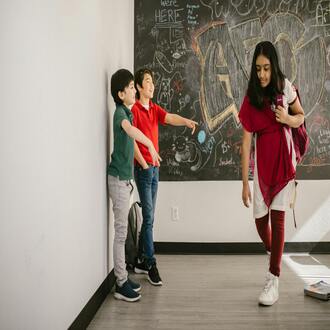
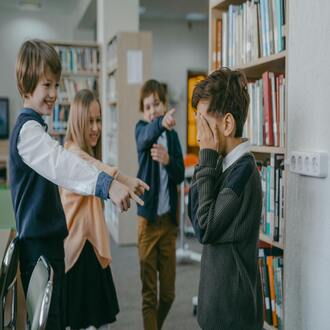
School bullying is never a two-person phenomenon. To understand the dynamics of bullying, we must look beyond the binary relationship between the bully and the bullied. Experts in school coexistence speak of the "Bullying Triangle", a complex social structure where each actor plays a determining role. In this article we analyze the psychological profiles of the three vertices: the aggressor, the victim and, the larger and decisive group, the bystanders.
Contrary to the stereotype, the aggressor is not always a student with academic problems or marginalised. Often, they are social leaders with the ability to manipulate the group. There are several subtypes that we study in the course:
The Dominant Aggressor (Leader): They usually have a strong, impulsive personality with little empathy. They need to reaffirm their power by subjugating others. They do not feel guilt for their actions and tend to justify the violence ("they deserved it", "it's a joke"). Often, they have an inflated self-esteem (narcissism) and low tolerance for frustration.
The Anxious or Reactive Aggressor: This is a more complex profile. Sometimes they act violently because they misinterpret social situations as threatening. They may have underlying emotional problems or come from a violent family environment.
The Follower Aggressor (Accomplice): They do not initiate the bullying, but follow the leader to gain social acceptance or out of fear of becoming a victim. Without these followers who laugh at the jokes and support him, the leader would lose his power.
Common characteristics to address: Lack of empathy (inability to put oneself in another's place), impulsivity, difficulty complying with rules and a positive view of violence as a tool for resolving conflicts.
Any boy or girl can be a victim of school bullying. There is no "trait" that justifies the aggression, but there are vulnerability factors that aggressors exploit.
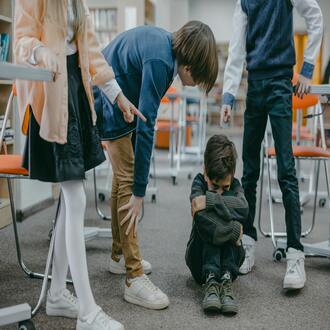
Passive Victim: This is the most common profile. They tend to be quiet, insecure students with few friends or a weak social network. Faced with aggression, they react with crying or withdrawal, which reinforces the aggressor (who obtains the feeling of power they seek). They suffer in silence for fear of reprisals or out of shame ("nobody will believe me").
Provocative Victim: A small percentage of victims combine anxiety with aggressive reactions. They may be hyperactive students or have social difficulties that irritate the group, which the aggressor uses as an excuse to justify the attack. It is vital to distinguish cause and effect here.
The Learned Helplessness Syndrome: After prolonged bullying, the victim comes to believe that no matter what they do, nothing will change. They stop defending themselves and asking for help. This passivity is not weakness; it is severe psychological damage that requires therapeutic intervention and teacher support.
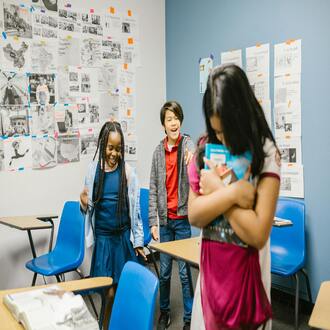
Here lies the key to prevention. 80% of students are neither aggressors nor victims; they are bystanders. Their behavior determines whether the bullying stops or continues.
The Reinforcement Role: If bystanders laugh, record with their phones or simply watch with interest, they are reinforcing the aggressor. Bullying is a theatrical act; it needs an audience. If the audience disappears, the performance ends.
The Law of Silence: Many students do not intervene out of fear ("if I say something, they'll go after me") or diffusion of responsibility ("someone else will do something"). Breaking this law of silence is the main objective of prevention programs like the KiVa method.
The Defenders: These are the students who dare to intervene, comfort the victim or seek a teacher. Promoting this role is vital. In our course we teach how to empower the group to transform classroom culture from "tattletales" to "caregivers".
Intervention cannot focus only on punishing the aggressor and protecting the victim (although that is necessary). It must work with the class group:
Understanding this triangle is fundamental for any School Coexistence Plan. If we only treat individual symptoms without correcting the group dynamic, bullying will resurface with new protagonists.
Search
Popular searches