For Onlinecourses55
|
2026-10-19
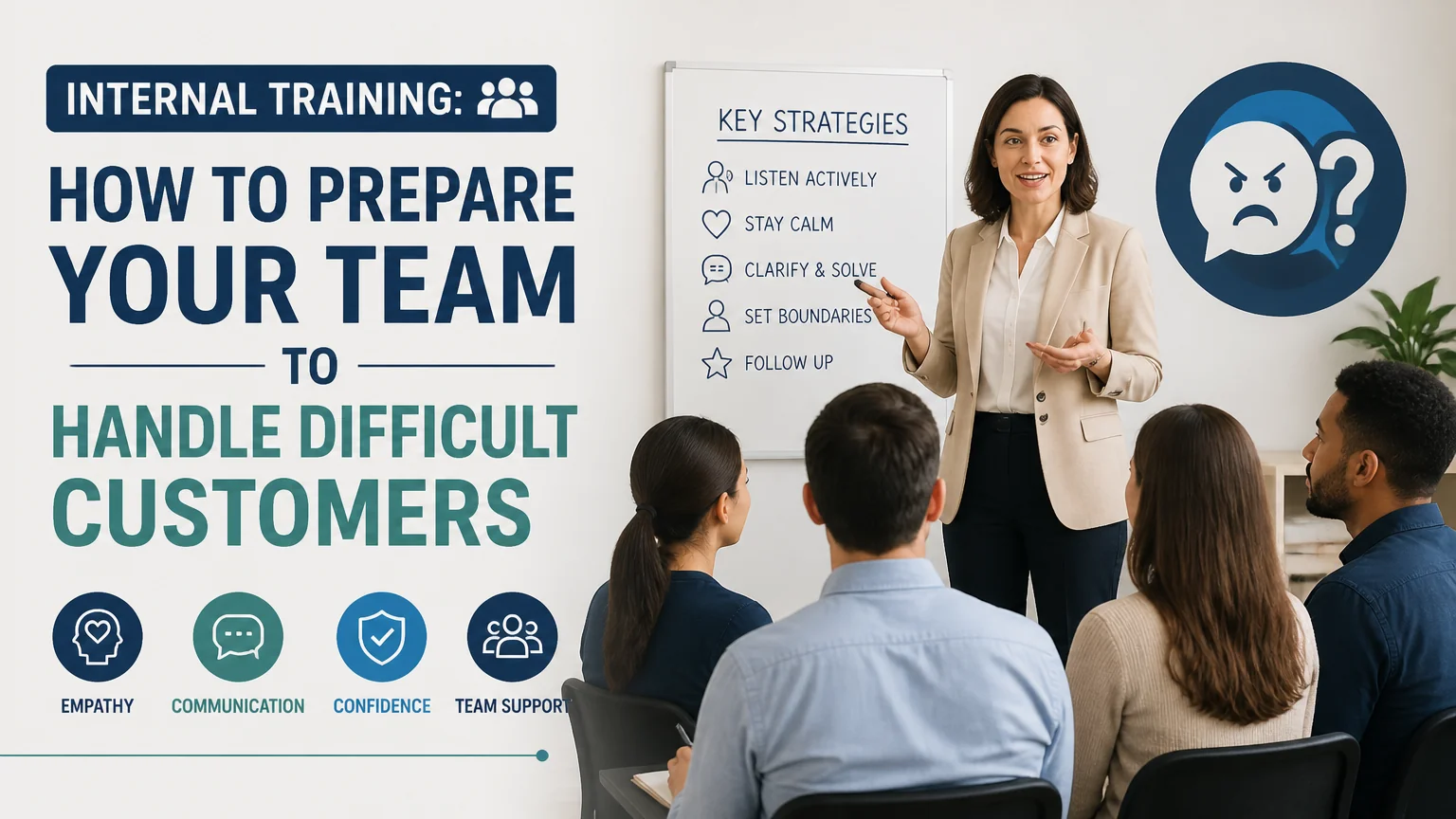
Internal training: how to prepare your team to handle difficult customers - handling difficult customers
Improve your team's ability to handle customer complaints through our strategic training tailored for customer service professionals, fostering a culture of empathy and understanding.
Preparing a team to handle difficult customers isn’t just about teaching responses or protocols; it’s about building skills, confidence, and a culture that can navigate tense situations without jeopardizing the customer relationship. A good internal training plan combines practical theory, simulated exercises, performance measurement, and ongoing follow-up. Below you’ll find a practical, structured approach to designing and implementing a training program that improves your team’s ability to manage conflicts, reduce escalations, and turn negative experiences into opportunities.
Investing in internal training has clear benefits: it reduces staff turnover, improves customer satisfaction, and shortens average resolution time. Furthermore, when staff understand the reasons behind policies and have the tools to apply them with empathy, the likelihood of escalations decreases. Training also protects the company’s reputation and can turn dissatisfied customers into advocates if managed correctly.
A trained team conveys confidence and consistency. Customers perceive professionalism and are more likely to accept solutions when they are served with clarity and respect. Training helps standardize responses, but also allows for personalization when the situation calls for it.
Employees who receive training support feel more valued, work with less stress, and make better decisions in critical moments. This reduces burnout and creates a healthier work environment.
Not all difficult customers are the same. Before designing the training, it’s a good idea to categorize the behaviors the team faces most frequently: angry, confused, demanding, repetitive, or customers with chronic issues. Understanding these categories allows the training to focus on specific tactics for each case.
They require de-escalation and emotional validation techniques. The goal is to reduce tension and restore effective communication.
They need clear explanations, patience, and step-by-step guidance. Avoiding jargon and confirming understanding is essential.
Require attention to boundaries and procedures; training should teach how to enforce policies without creating confrontation.
Training should focus on communication and problem-solving skills. Among the most important are active listening, empathy, emotional management, assertiveness, and creativity in offering solutions. These skills are best developed through practice and feedback rather than theory alone.
Listening is not just hearing. It involves rephrasing what the client says, acknowledging their emotions, and demonstrating understanding. Validation reduces defensiveness and facilitates collaboration toward a solution.
Use short sentences, outline concrete steps, and avoid making promises you cannot keep. Assertiveness allows you to maintain respectful boundaries and protect the team from abuse.
Teach techniques to reduce tension: a calm tone, pauses, offering limited options, and using the client’s name when appropriate. It is also advisable to provide training in managing one’s own stress to avoid impulsive reactions.
The best training combines several methods: in-person sessions, role-playing, analysis of real-life cases, microlearning, and individual coaching. Alternating formats helps maintain interest and cater to different learning styles.
Practicing real-life situations with colleagues allows participants to rehearse responses, receive immediate feedback, and correct unproductive habits. Scenarios should include variations: difficult clients, internal errors, and policy limitations.
Shadowing and reviewing calls or messages with structured feedback help identify strengths and areas for improvement. Using an evaluation guide prevents subjective criticism and promotes constructive learning.
Short documents, opening and closing scripts, response templates, and brief videos help review concepts quickly. Micro-learning modules facilitate repetition and continuous reinforcement.
A solid program has progressive modules: fundamentals, specific techniques, handling complex cases, and supervised practice. Include clear evaluation criteria and measurable objectives to certify competence before allowing autonomous handling of critical situations.
Training doesn’t end when a session concludes. Measuring its impact using metrics such as NPS, resolution time, number of escalations, and customer feedback is crucial. It’s also important to gather the team’s feedback on the training’s usefulness and their additional needs.
Defining metrics before starting allows you to compare results. Some useful metrics: reduction in escalated calls, decrease in average handling time, increase in first-contact resolutions, and post-interaction satisfaction ratings.
Review content quarterly to incorporate lessons from new cases. Training must evolve with products, policies, and emerging customer behaviors.
Training is most effective when supported by an organizational culture that values customer service. Leaders and supervisors should model behaviors, offer support in difficult situations, and recognize best practices.
Supervisors should be available to provide guidance, make decisions in complex cases, and participate in feedback sessions. Their involvement legitimizes the training and facilitates its application in day-to-day work.
Establish resources for the team handling high-stress interactions: breaks, decompression time, access to coaching, and clear rules on when to escalate an issue to protect the employee.
Preparing the team to handle difficult customers requires consistency and a training program designed for everyday reality. With a plan that combines soft skills, guided practice, and institutional support, it is possible to transform conflictive situations into opportunities to demonstrate value and strengthen relationships. Implement clear steps, evaluate results, and keep learning alive so that training produces real and sustainable change.
Search
Popular searches