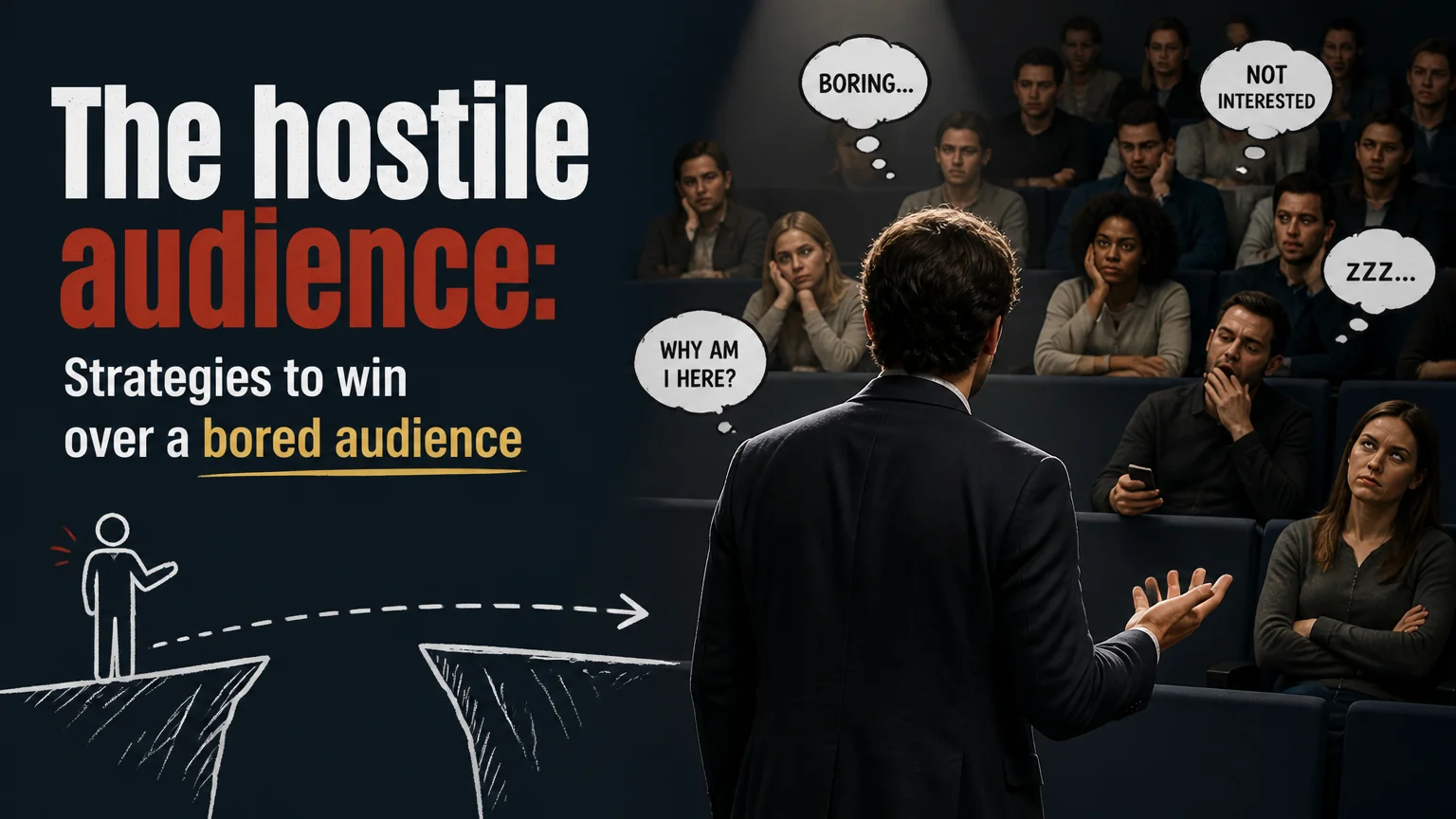
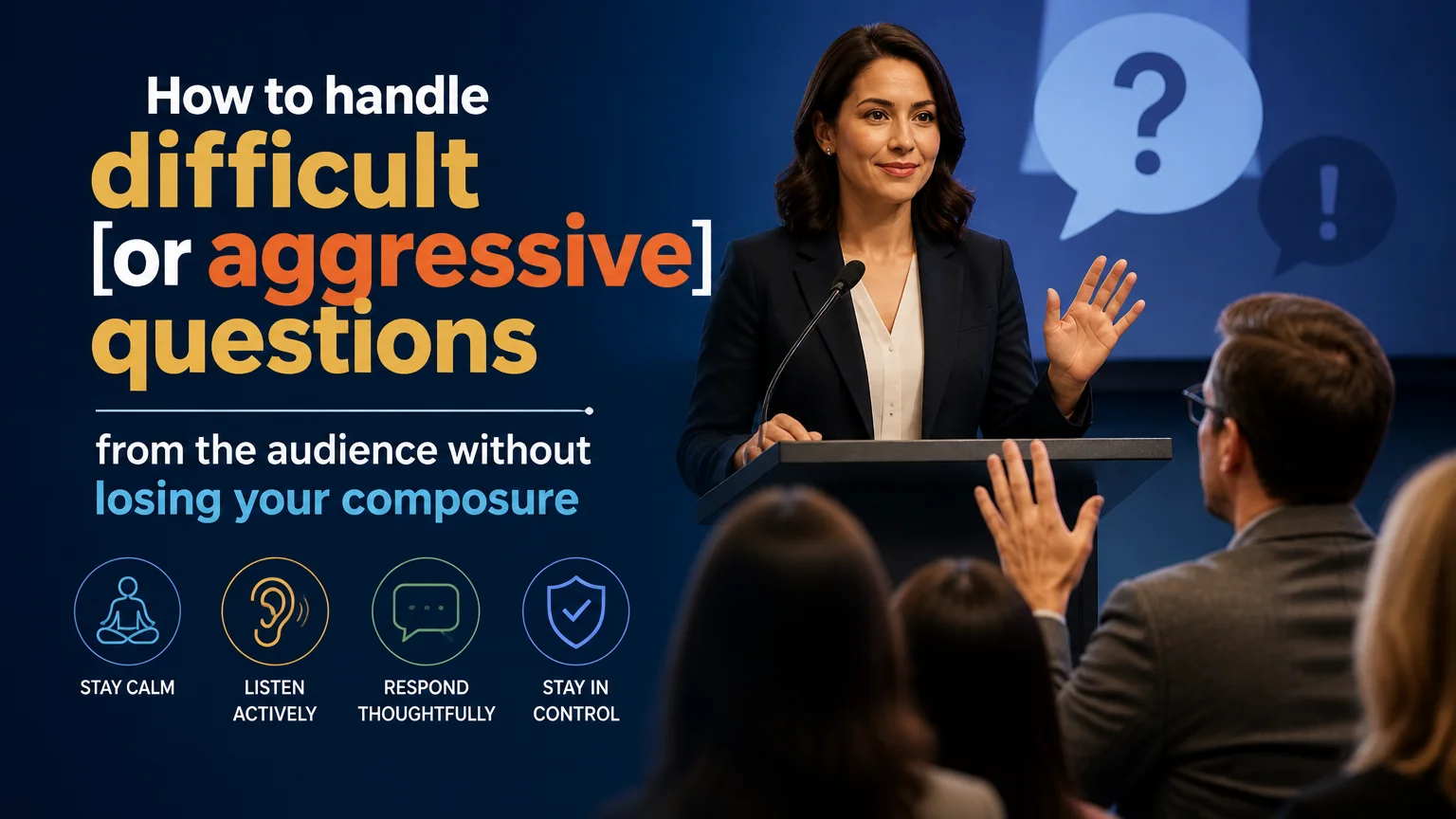
The hostile audience: strategies to win over a bored audience - overcoming stage fright
A strategic approach to understanding audience behavior can help you prepare engaging presentations while avoiding common pitfalls.
Why an Audience Becomes Hostile or Bored
There is no such thing as a difficult audience, only difficult circumstances. When people tune out or show resistance, there are usually specific reasons: misaligned expectations, fatigue, background noise, negative past experiences, or an unclear opening. Understanding the cause shifts your approach from confrontation to collaboration.
Early Signs
- Glances at phones, crossed arms, sighs, or quiet side conversations.
- Loaded questions asked in a challenging tone, or excessive silence when invited to participate.
- Closed-off postures, wandering eyes, or sarcastic laughter.
Common Causes
- The audience cannot see what is in it for them.
- Too much theory without enough practical examples.
- A long session without breaks or changes of pace.
- Overly technical language or overwhelming visuals.
- Emotional baggage: they may have had a bad experience before or sat through another boring session.
Strategic Preparation Focused on Immediate Value
Before taking the stage, design your content around immediate usefulness. When the audience sees value early on, hostility decreases and curiosity increases.
- Define the group’s profile and priorities: roles, time pressures, and the KPIs that matter to them.
- Write a clear promise: “In 20 minutes, you’ll understand a key concept and be able to apply a practical technique.”
- Map out objections: list three common concerns and how you’ll address them with data or stories.
- Structure the session in 7–10-minute blocks with brief interactions.
- Include examples from their world, not generic ones.
- Prepare a backup plan for a quick activity in case you notice the audience tuning out.
The First 90 Seconds: Set the Tone
Openings That Work
- A short story with tension and a practical resolution.
- A surprising fact that directly affects the audience’s work.
- A yes-or-no show-of-hands question: “Who has experienced this at work this week? Hands up.”
- A concrete promise: “In 10 minutes, you’ll have a script for responding to tough objections.”
Avoid
- Long self-introductions.
- Inside jokes or references that exclude people.
- Reading slides aloud.
Micro-Techniques for Re-Engaging the Audience During Your Talk
- Break the pattern: move from the podium to the whiteboard, turn off the slide, and ask a direct question.
- Quick vote: “If this happens to you often, raise your hand. If not, give me a thumbs-down.”
- 30-second challenge: “Write down the biggest objection you hear. Compare it with the person next to you.”
- WIFM bridge: “What this means for you today is…”
- State the obvious: “I see some puzzled faces; let’s pause and I’ll explain this with a real example.”
- Powerful pause: stay silent for 3–5 seconds to recapture attention.
- Practical mini-story: a 60–90-second case with context, conflict, and a measurable outcome.
- Change the channel: switch from audio to visuals, or from visuals to a demo with an object or whiteboard.
Body Language, Voice, and Movement
- Keep an open posture, plant your feet, and move with purpose; avoid pacing nervously.
- Make eye contact in a triangle: left, center, right.
- Vary your voice: raise it for important points, lower it for confidential remarks, and use pauses.
- Use your hands to illustrate ideas such as sequences, sizes, or directions; avoid covering your torso.
- Move closer to areas where people are getting distracted; proximity reduces side conversations.
Turn Hostility into Participation
Validate Without Giving In
- “What you’re saying makes sense; many people here may feel the same way. Let me show you two pieces of data, then we’ll come back to your point.”
- “I hear you. If we look at the impact on your day-to-day work, here’s what changes.”
Handling Interruptions and Objections
- Three-step rule: acknowledge, frame, move on. “I understand the concern; to keep things moving, I’ll address it in three minutes after this example.”
- Neutral rephrasing: “If I understand correctly, your point is about this issue. Is that right?”
- Offer a choice: “Would you rather see the practical case now, or wrap up this section and go straight to examples?”
- Set firm, courteous limits with anyone who dominates the conversation: “I appreciate your enthusiasm; I need to hear from more people. We can continue at the end if you’d like.”
Measured Humor and Vulnerability
- Use gentle self-deprecating humor, never at the audience’s expense.
- Use callbacks: revisit an earlier anecdote to get a smile without forcing it.
- Share one of your own mistakes and the practical lesson in 30–40 seconds; it builds empathy and lowers defenses.
Visual Aids That Don’t Bore
- One idea per slide, large type, and high contrast.
- Charts with the takeaway highlighted: “This matters because…”
- Remove redundant bullet points; replace them with an image plus a striking sentence.
- Use short demos or a whiteboard to think things through in real time.
A 10-Minute Rescue Plan for a Cold Room
- Minute 1: pause, breathe, and acknowledge the mood: “I sense some fatigue; I’ll make this very useful and practical.”
- Minute 2: renew your promise: “In eight minutes, you’ll leave with a script you can use today.”
- Minutes 3–4: share a brief case with a number and a real outcome.
- Minute 5: run a yes-or-no show-of-hands activity and ask someone at random by name, if you know it.
- Minutes 6–7: do a 90-second exercise in pairs, then share two responses with the group.
- Minutes 8–9: summarize three key ideas and provide a quick template.
- Minute 10: ask for a micro-commitment: “What will your first step be tomorrow? Write it down.”
Ready-to-Use Scripts
- Direct opening: “In the next 10 minutes, you’ll save an hour of work each week if you apply this step.”
- When people are skeptical: “If I were in your shoes, I’d have doubts too. That’s why I brought this example from your industry.”
- To cut off a digression: “Great point. To stay on track, I’ll set it aside and return to it in the final section.”
- To recalibrate expectations: “This won’t solve everything, but it will address 80% of the most common cases.”
A Closing That Turns Skeptics into Allies
- Three-point recap: “You’re leaving with 1) a technique to capture attention, 2) a script for handling objections, and 3) an activity to re-engage the audience.”
- Specific call to action: “Try the yes-or-no vote at your next meeting and tell me how it goes.”
- Offer next steps: “Would you like the checklist by email, or would you prefer a five-minute demo now?”
Pre-Stage Checklist
- A clear one-sentence promise and a tangible benefit.
- An objection map with a brief response and an example.
- Two prepared activities lasting 60–90 seconds.
- A 90-second story with a number and an outcome.
- Clean slides and a backup plan that doesn’t rely on slides.
- Notes with validating phrases and boundary-setting language.
- Water, a visible clock, and a reference point on stage.
Mistakes That Make People Bored
- Starting with “who I am” instead of “what you’ll gain.”
- Speaking without pauses or changes of pace.
- Covering too many points without enough practical depth.
- Ignoring signs of disengagement because you’re sticking to the script.
- Confusing rapport with losing authority or allowing unlimited interruptions.
Final Thought
Winning over a difficult audience isn’t about delivering perfect speeches; it’s about making small decisions: promise concrete value, demonstrate it quickly, listen without giving up control, and create brief opportunities to participate. When people feel their time is being used well and they are being treated with respect, hostility turns into attention and, with a couple of quick wins, into genuine engagement.
 For Onlinecourses55
|
2026-11-02