
The Human Being as a Social Being and Socialization
Learn why humans are social, how socialization instills norms, values, and beliefs, and how family and community shape identity and lifelong development.
Watch Video For Onlinecourses55
|
2026-11-10
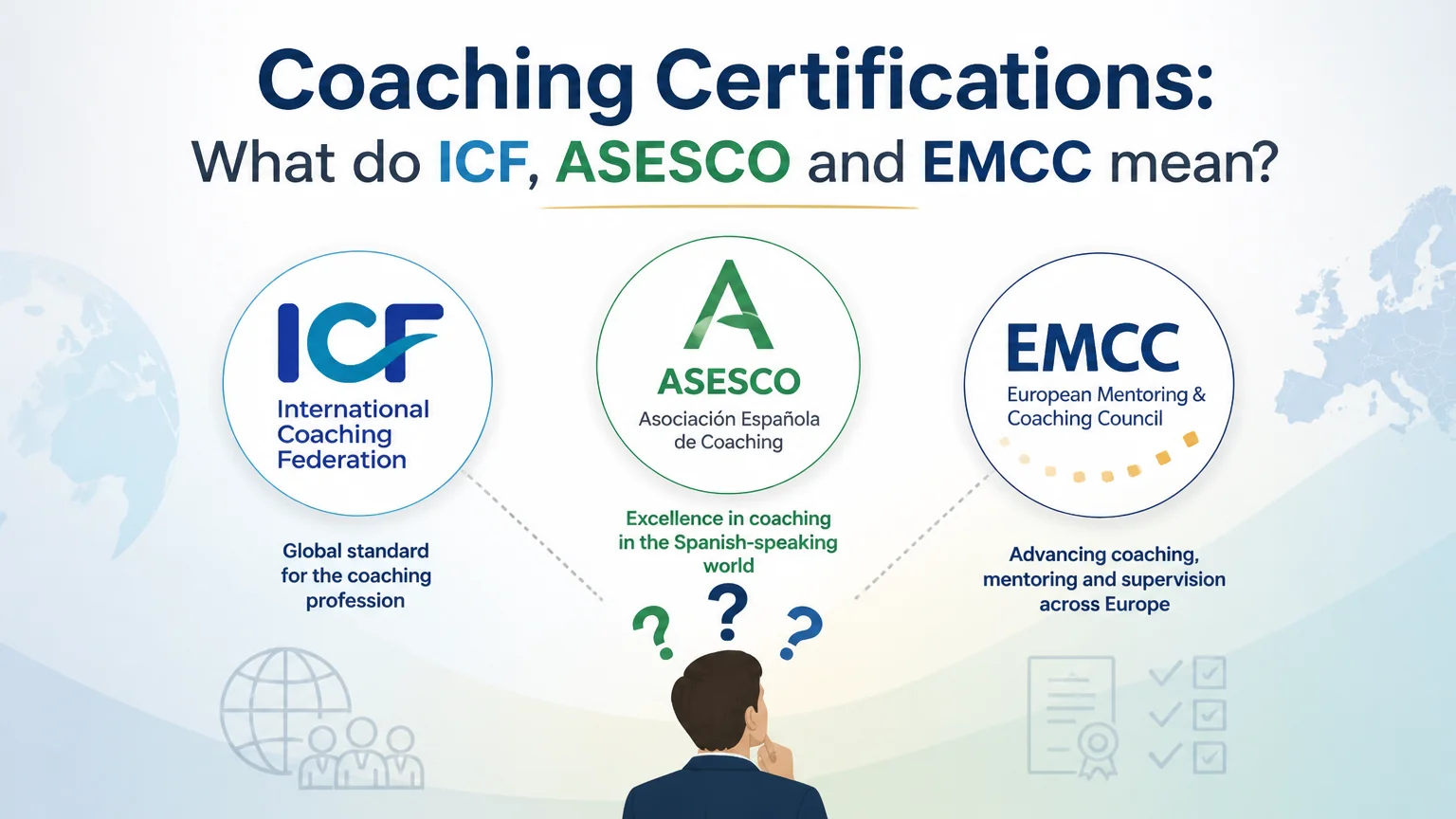
Coaching certifications: what do icf, asesco and emcc mean?
Navigating the world of coaching certifications is essential, and you can find valuable insights about this journey in a comprehensive coaching course, which will help you establish professional credibility.
Choosing a coaching certification isn't just about having a stamp on your résumé. It affects how you train, the ethical standards you follow, the quality of your sessions and how the market perceives you. Three acronyms often appear when you research the topic: ICF, EMCC and ASESCO. Each represents an organization with different history, scope and criteria, but with a common goal: to ensure good practice and professional credibility. Understanding what's behind each one helps you decide which path best fits your goals, your audience and your budget.
ICF stands for International Coaching Federation. It is the most widely referenced global benchmark for competence, ethics and coach accreditation. Its strength lies in the clarity of its competency framework, a robust accreditation process and the international visibility of its credential.
Individual accreditation is structured in three levels that reflect experience and mastery:
To obtain a credential three pillars are evaluated: specific coaching training (measured in hours with a recognized provider), practical experience (number of coaching hours with clients) and competency evaluation (theoretical exam and, at higher levels, review of recorded sessions). In addition, mentor coaching with an accredited professional is required and adherence to the code of ethics is expected.
If you target international corporations, global consultancies or want geographic mobility, ICF recognition usually opens doors.
EMCC stands for European Mentoring and Coaching Council. It was born in Europe and today has an international presence. Its proposal is broad: it integrates coaching, mentoring and supervision under a single quality framework, and promotes a reflective practice closely linked to continuous professional development.
EMCC grants individual accreditation (EIA) with four levels ranging from foundation to mastery:
For the EIA, EMCC reviews your training, your client experience, your professional reflection (portfolio) and evidence of regular supervision. In addition, it accredits training programs with a specific seal (EQA), which facilitates the path for those who take those programs.
If you work in Europe, in academic settings or in organizations that integrate coaching and mentoring, EMCC often fits very well.
ASESCO is the Spanish Association of Coaching. It has been a relevant player in the professionalization of coaching in Spain and, by extension, in the Spanish-speaking ecosystem. Its differential value lies in the local context: market knowledge, a Spanish-speaking community and dissemination of good practices adapted to cultural reality.
ASESCO offers individual accreditations with progressive levels based on your specific training, your hours of practice and your professional development. It evaluates the quality of the coaching training completed, requests evidence of client experience and requires adherence to its code of ethics. It also recognizes programs from schools that meet its standards, facilitating an organized pathway for those who train in Spain or Latin America.
If your focus is the Spanish or Latin American market and you want to join a local network, ASESCO provides visibility and community.
The ICF credential is usually the most requested by multinationals and consultancies with presence in several countries. It helps you standardize your offering and speak the same competency language across different markets.
EMCC may fit better due to its emphasis on supervision, reflective practice and the recognition of mentoring. It is especially valued in environments that integrate leadership development, academies and the European public sector.
ASESCO offers proximity, community and recognition in Spanish. It can be an excellent gateway to build local reputation, create partnerships and access events and directories in the Spanish-speaking field.
A good criterion to decide is to ask yourself where you want your credential to carry the most weight in the next three to five years. If you envision working with global clients, prioritize ICF. If you see yourself in Europe and value supervision as a backbone, EMCC fits. If your business will be mainly in Spanish and you seek a local network, ASESCO offers a solid base. It's also valid to combine: train with a school accredited by one of them and, later, add another accreditation to broaden your reach.
ICF, EMCC and ASESCO represent serious and complementary standards for practicing coaching with rigor. The right choice is not "which is better in the abstract," but "which best supports your offering, your clients and your professional development." By understanding what each values —observable competencies, reflective practice, supervision, training and ethics— you can build a training pathway that gives you confidence, credibility and sustainable results for you and your clients.
Do you prefer learning by watching and listening? Expand your knowledge with these free videos related to this topic.
Learn why humans are social, how socialization instills norms, values, and beliefs, and how family and community shape identity and lifelong development.
Watch VideoDiscover why society changes, how identity is shaped by choices, and how to build the flexibility to learn, unlearn, and relearn amid social transformation.
Watch VideoExplore two responses to an identity crisis and learn to choose the reflective path, turning uncertainty into meaningful personal growth and self-understanding.
Watch VideoSearch
Popular searches