For Onlinecourses55
|
2026-11-04
Customer service recruitment: tests to assess emotional intelligence - customer service emotional intelligence
To find candidates who truly excel in customer engagement, consider integrating assessments for emotional awareness, which you can enhance by exploring this training focused on emotional management skills that directly impact satisfaction and team dynamics.
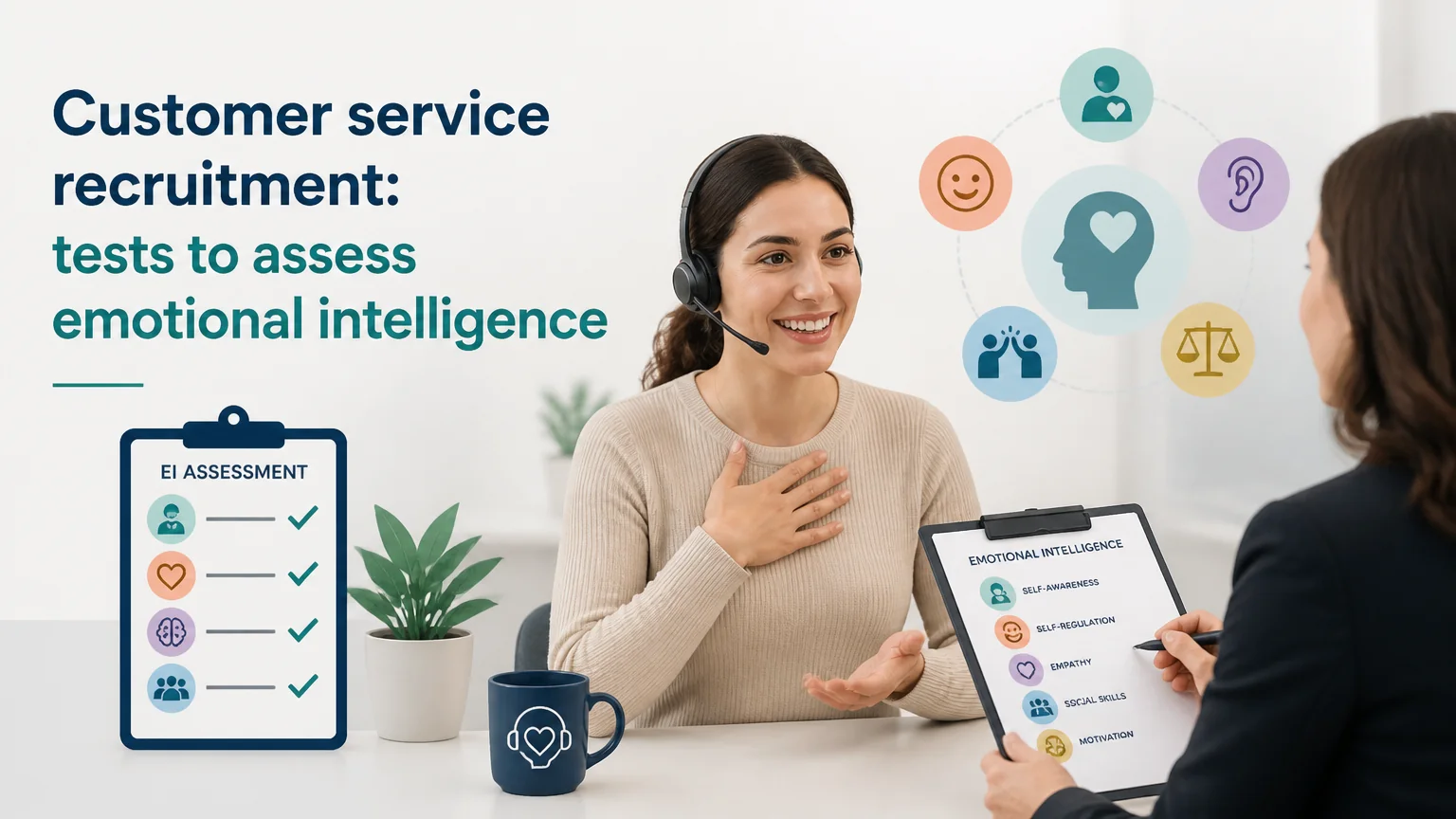
Selecting customer service staff requires more than just evaluating technical knowledge: it involves measuring the ability to manage one’s own and others’ emotions in high-pressure situations. Assessing emotional intelligence in candidates allows you to predict their ability to remain calm, empathize with customers, and resolve conflicts without compromising service quality. Below are practical approaches and specific tests that can be integrated into a selection process to identify candidates with high emotional potential.
Emotional intelligence directly influences customer satisfaction and team efficiency. Employees with strong emotional management skills engage in assertive conversations, repair damaged relationships, and reduce internal stress. Additionally, these professionals learn more quickly from feedback and adapt better to changes in policies or products. For these reasons, incorporating tests that measure emotional competencies helps reduce turnover and improves quality metrics.
There is no single test that fully measures emotional intelligence. Combining different methodologies provides a more accurate picture of the candidate’s behavior in a real-world context. The most useful tests and how to implement them are described below.
These are quick tools that assess traits such as empathy and self-control. They can be administered online prior to in-person stages. It is important to choose validated questionnaires and use the results as input, not as the sole basis for decision-making. These instruments identify trends and serve to filter candidates who require more in-depth evaluations.
Situational judgment tests present real-life customer service scenarios and ask the candidate to choose or prioritize responses. They allow you to observe decision-making under pressure and the priority the candidate gives to the customer experience over internal policies. They are especially useful for measuring emotional judgment and the ability to balance operational objectives with human needs.
Simulations recreate calls, chats, or in-person interactions with fictional customers who act out complaints, urgent situations, or confusion. Language, tone, active listening skills, and problem-solving ability are evaluated. It is recommended to record these and score them using a clear rubric: problem identification, emotional management, proposed solution, and effective resolution.
Behavioral questions ask for specific examples from the past. For example: "Tell me about a time when you handled an angry customer." Responses reveal patterns of behavior and learning. Using the STAR technique (Situation, Task, Action, Result) helps standardize information gathering and compare candidates objectively.
Short tests that show facial expressions, voice tones, or conversation snippets and ask candidates to identify the emotional state. These tests measure emotional reading ability, which is key to anticipating needs and tailoring responses. They should be used in conjunction with other tests to reduce cultural or communication biases.
An effective process combines several stages distributed across time and format. Suggested workflow:
It is essential that each stage have clear evaluation criteria and that evaluators receive prior calibration to reduce variability among interviewers.
Scenario: Simulate a call where the customer demands a refund for an error that is not the provider’s fault. Evaluation: Time taken to calm the customer, use of verbal empathy, proposal of an alternative solution, and closing with confirmation of actions. Weighting: 30% empathy, 30% resolution, 20% clarity of communication, 20% follow-up.
Scenario: Present a conversation excerpt with key details and ask for a summary and next steps. Observation: Ability to identify relevant information, paraphrase, and propose concrete steps. This test measures attention and precision in communication, which are crucial in both written and oral channels.
Task: Perform simultaneous tasks—handling chat, phone calls, and email—with incomplete information. Evaluation: Prioritization, frustration management, courtesy, and accuracy in responses. This assesses self-control and organization under pressure.
Results must be interpreted with context and cultural diversity in mind. Some tests may favor extroverted profiles or individuals skilled at crafting socially desirable responses. To mitigate biases, combine objective measures (observed behavior) with self-reports and use a diverse pool of evaluators. Additionally, documenting decisions helps justify selections and improve the process over time.
Selection does not end with hiring. Findings from the assessment should inform onboarding and training plans. For example, if several new hires struggle to modulate their tone, design workshops on emotional management and provide live feedback. A cycle of assessment, training, and re-evaluation ensures that emotional intelligence becomes a developable competency within the organization.
Designing a set of tests that combine self-reporting, real-life scenarios, and direct observation allows you to select individuals capable of maintaining warm and efficient customer service. Prioritizing specific competencies, using clear rubrics, and calibrating evaluators reduces error and bias. Ultimately, investing in a rigorous process leads to improvements in retention, customer loyalty, and workplace culture—results that justify the effort of assessing emotional intelligence from the selection stage onward.
Search
Popular searches