
The role of the counselor and the therapeutic alliance
Build a safe, professional helping relationship grounded in confidentiality, neutrality, empathy, acceptance, and authenticity to help clients find solutions.
Watch Video For Onlinecourses55
|
2026-11-08
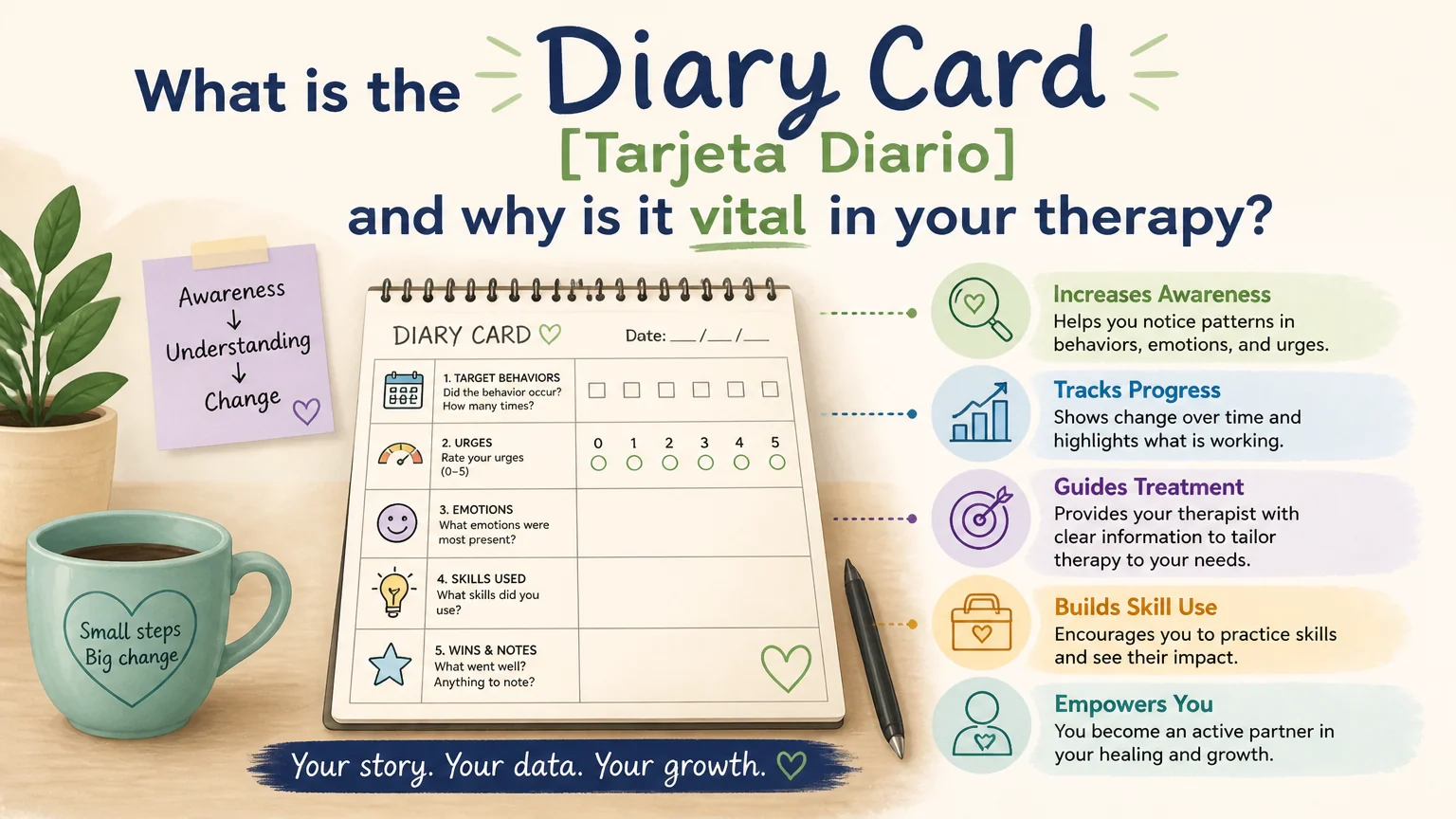
What is the diary card [tarjeta diario] and why is it vital in your therapy?
Start mapping your emotional journey with the comprehensive training on using diary cards effectively to enhance therapeutic progress.
If you have ever left a session with the feeling “I understood it, but I don't know how to apply it in my day-to-day,” you need a tool that connects therapy to your real life. The Diary Card acts as that bridge: it helps you observe what you feel, do and need, and translate it into concrete actions with your therapeutic skills. It is a brief, everyday, structured record that allows you to see in black and white what sometimes feels chaotic in the mind.
Its purpose is twofold: on the one hand, to give you clarity about your emotions, urges, behaviors and skills; on the other, to make it easier for your therapist and you to work with real data, not just vague memories. Day by day, you create a map of patterns: what triggers you, what calms you, when urges appear, which skills work for you and in what situations. With that information, treatment becomes more precise and effective.
Brief records of emotion intensity (anxiety, sadness, anger, shame, guilt, joy) and general well-being. They usually use a simple scale (for example, 0–5 or 0–10).
Note urges to engage in behaviors you want to reduce (self-harm, substance use, binge eating, avoiding responsibilities, impulsive arguments) and whether they occurred or not. Prioritize being honest, not perfect.
Mark the skills you practiced that day and how they worked for you. Common categories include mindfulness, distress tolerance, emotional regulation and interpersonal effectiveness. You can also add personal skills that help you.
Hours of sleep, medication taken, stressful or positive events, exercise and social support. These data help explain variations and plan better strategies.
Most people find 0–5 useful, where 0 is none and 5 is the maximum. For urges, 0–3 is sufficient. Keep the same scale to compare easily between days. Remember: consistency is more important than millimetric precision.
Imagine an afternoon with work stress and a brief argument via messages. You fill it out like this:
This snapshot of a day provides concrete material for your next session: you can see the trigger, the peak of the urge, the skill applied and the outcome.
The best format is the one you'll use daily. It can be a printed sheet, an app, a note on your phone or a spreadsheet. Keep the basic structure: emotions, urges, behaviors, skills, contextual factors and learning.
The usual recommendation is to complete it daily during the first weeks of active treatment. As you consolidate skills and stability, it can move to a flexible frequency (for example, five days a week) or become a “maintenance” tool: used intensively during stressful periods and reduced when things improve. The important thing is to keep the basic habit of observation and adjustment.
The power of this tool is not in the sheet itself, but in the habit it creates: observe, understand and act with intention. By turning your days into useful information, you stop navigating blindly and start making small but strategic decisions that, added together, change the course of your process. Start simple, stay consistent and let the data from your own life guide you to the next step.
Do you prefer learning by watching and listening? Expand your knowledge with these free videos related to this topic.
Build a safe, professional helping relationship grounded in confidentiality, neutrality, empathy, acceptance, and authenticity to help clients find solutions.
Watch VideoLearn when to choose counseling or psychotherapy, comparing duration, intervention depth, and referral criteria based on symptom severity and personal goals.
Watch VideoCompare humanistic, cognitive, and behavioral views of clients, thought, and learning, and strategies to foster growth, change beliefs, and modify behavior.
Watch VideoSearch
Popular searches