For Onlinecourses55
|
2026-09-07
For Onlinecourses55
|
2026-09-07

Overcoming depression with act: moving while carrying the weight - therapy acceptance commitment
Learn to embrace your feelings without being overwhelmed by them, and build a life guided by your values through this essential program on acceptance and commitment techniques that supports your emotional journey.
When sadness settles in, everything seems slower, thicker, and harder to move. The mind fills with painful stories and the body feels as if it were wearing lead shoes. Acceptance and Commitment Therapy (ACT) proposes something counterintuitive and deeply human: instead of fighting relentlessly against what you feel, learn to make room for it and move toward what matters to you, step by step, even with that burden in tow.
ACT doesn't aim to eliminate uncomfortable emotions or thoughts, but to change your relationship with them so they don't govern you. In depression, many people get caught in loops of rumination, avoidance, and paralysis. ACT offers practical skills to:
Depression is not laziness or lack of will. It is, in part, a state where energy drops, enjoyment is reduced, and the mind insists on stories of failure, guilt, or worthlessness. That heaviness appears in the body, in your schedule, and in the way you think. Understanding this without judging yourself creates margin to choose more useful responses.
Instead of trying to "take away" the heaviness at all costs, ACT invites you to relate to it like a backpack. You can't make it disappear by magic, but you can adjust the straps, rest when you need to, and keep walking toward a place that matters to you.
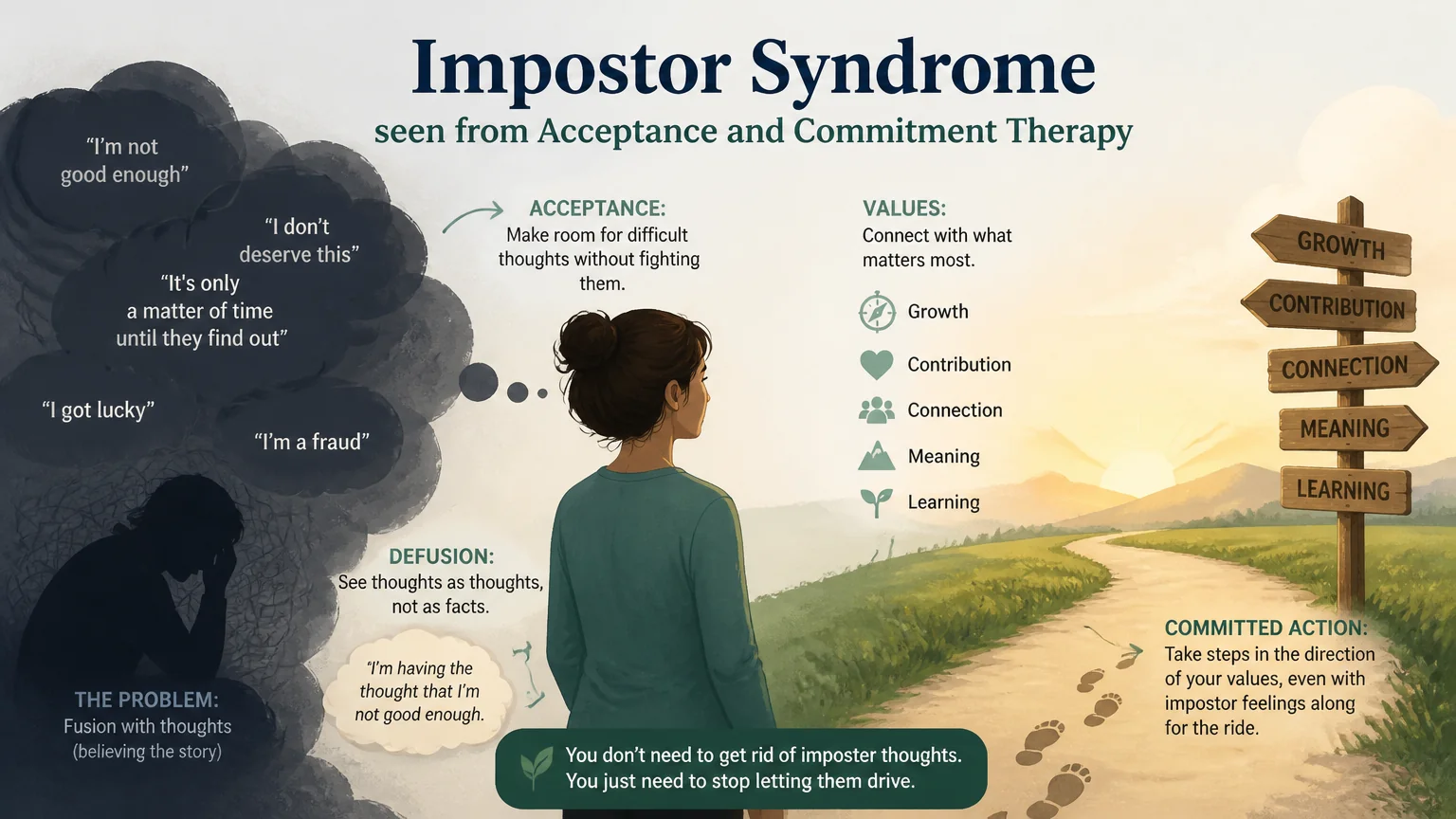
Acceptance is not resignation; it's stopping the waste of energy fighting your internal experience. It involves noticing sadness, apathy, or fatigue and allowing their presence in the body with kindness. As the struggle decreases, a little more space to act often appears.
The depressed mind speaks loudly: "you're worth nothing," "it's pointless," "no one loves you." Defusion is observing those phrases as sounds or words, not as absolute truths. You can respond: "my mind is telling me the story that I can't," and still choose a small, valuable action.
Rumination pushes you to the past and worry to the future. Presence trains attention to return to the body, to the breath, and to the environment. This anchoring reduces entanglement with thoughts and makes it easier to choose the next step.
You are not your sadness or your thoughts. You are the space that can observe them. From that broader place, it is possible to hold discomfort without losing yourself in it and to remember where you want to head.
Values are chosen directions: caring, learning, creating, supporting, playing, contributing. They are not goals to check off, but ways of living. When mood is low, reconnecting with values brings clarity when deciding "what small gesture aligns with what matters to me today?"
Valuable action doesn't wait for mood to improve. It is designed in sustainable micro-steps. By acting, even a little, you rebuild energy, meaning, and self-esteem based on deeds, not just thoughts.
Motivation usually comes after starting, not before. Reduce the goal until it feels almost ridiculous. If ten minutes is too much, try one. If one is too much, try thirty seconds.
Perfection is a common trap. Change "all or nothing" to "something is better than nothing." Add small actions that, repeated, make a real difference.
The criterion is not feeling good, but living better. If today you did something valuable despite the sadness, it worked. The emotion may take time to follow, but life can become broader from now on.
There will be worse days. They are not failure; they are part of the process. Have a minimum plan for those moments and resume the pace when you can, without self-punishment.
If symptoms last several weeks, affect important areas of your life, or signals appear such as intense hopelessness, total isolation, severe sleep or appetite changes, or thoughts of harming yourself, it's time to consult a mental health professional. Asking for support is an act of courage and, combined with ACT practices, can accelerate change.
Some people feel relief within a few weeks when practicing daily. Others need more time. The key is repeating micro-valuable actions and continuous training in acceptance, defusion, and presence.
Yes. Medication can help stabilize mood or energy, making practice easier. Always consult a professional to adjust treatments.
Acceptance is not a skill you either have or don't; it's a practice. Start by allowing 5% of the sensation for a few seconds and try again. The idea is to slowly broaden your capacity to hold what appears.
You don't need to feel light to start moving. It's enough to choose one small step today in the direction of what matters to you. As you walk, carry the tools with you: breathe, observe, name, choose, and act. With patience and consistency, that path opens clarity, even on cloudy days.
Search
Popular searches

![Addictions and act: the urge surfing technique [urge surfing]](/images/postDuplicados/onlinecourses55-addictions-and-act-the-urge-surfing-technique-urge-surfing.webp)