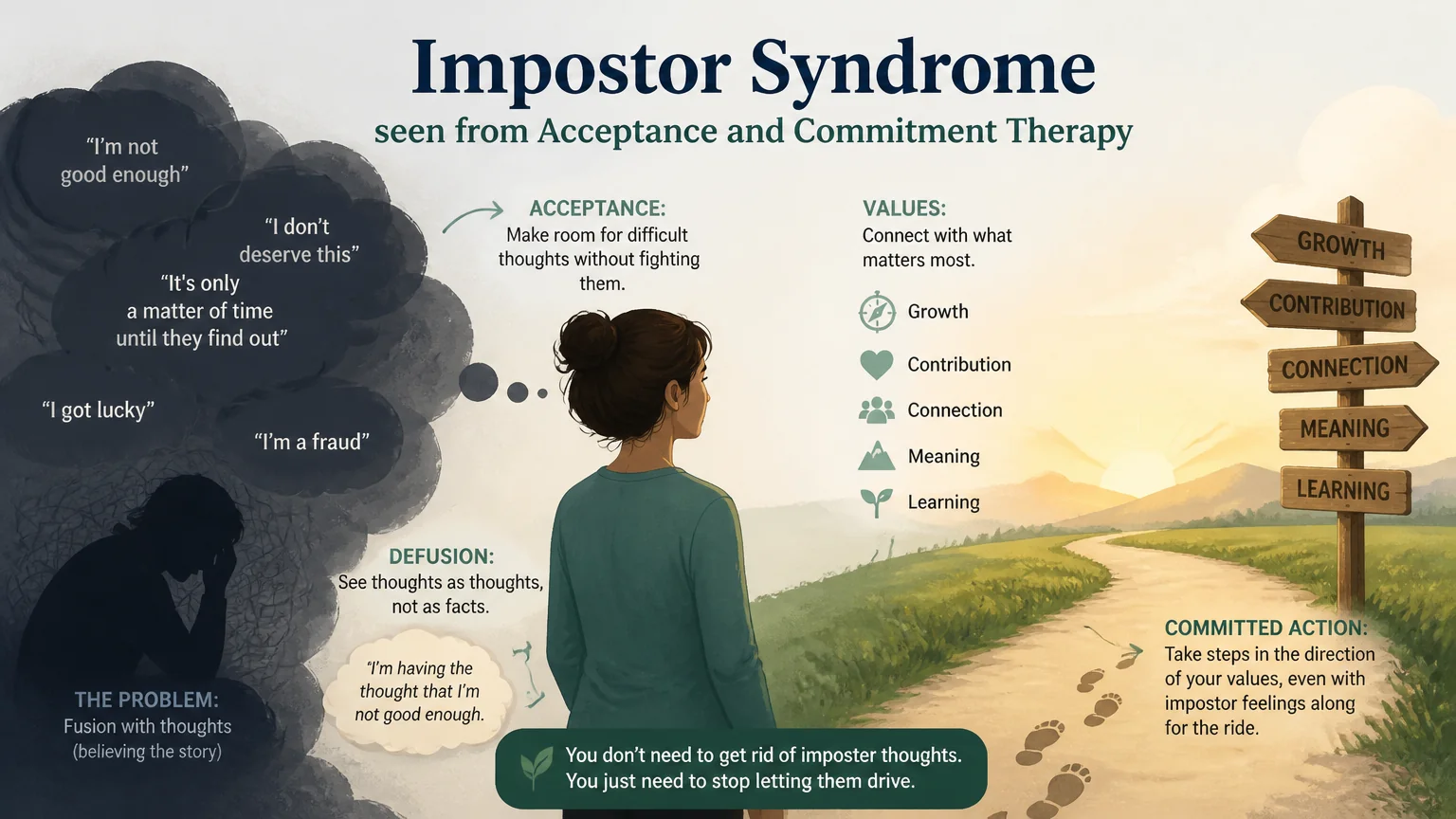
Feeling like a fraud despite evidence of your accomplishments can be exhausting. From the perspective of Acceptance and Commitment Therapy (ACT), it's not about "defeating" those thoughts, but about relating to them in a way that allows you to live according to your values, even when the mind says "you're not enough." Below you'll find a practical guide to understanding this phenomenon and working with it from ACT.
What it is and how it manifests
It is characterized by difficulty internalizing successes, a persistent fear of "being discovered," and a tendency to attribute achievements to luck or external factors. It is not a clinical diagnosis, but a pattern of thoughts and behaviors that can appear in highly competent people.
Common signs
- Constant doubts about your ability, even with positive feedback.
- Perfectionism: delaying tasks or not submitting them until they are "perfect".
- Minimizing achievements and maximizing mistakes.
- Comparing yourself to others and feeling that "everyone knows more than I do".
- Avoiding opportunities for fear of not being up to the task.
Impact on daily life
- Chronic stress and emotional exhaustion.
- Creative block and procrastination.
- Difficulty making decisions and asking for help.
- Tense relationships due to needing approval or isolating yourself.
Why it appears from the ACT perspective
ACT points out that the problem is not having difficult thoughts, but getting stuck in them and in unsuccessful attempts to control them.
Cognitive fusion
It occurs when we treat thoughts as literal truths: "If I think I'm a fraud, then I am." Fusion makes the words of the mind dictate our actions and narrow our life.
Experiential avoidance
To avoid feeling anxiety or shame, we avoid speaking in meetings, applying for positions, or showing our work. In the short term it reduces discomfort; in the long term it feeds the pattern, because it confirms the story of "I'm not capable."
What ACT aims for: psychological flexibility
The goal is to increase psychological flexibility: the ability to be with what arises (thoughts, emotions, sensations) and choose actions aligned with your values. ACT works with six interrelated processes:
- Defusion: taking distance from thoughts.
- Acceptance: making space for difficult emotions.
- Contact with the present moment: anchoring attention in the here and now.
- Self-as-context: noticing that you are more than the contents of your mind.
- Values: clarifying what truly matters to you.
- Committed action: moving in the direction of those values.
Defusion practices for "the impostor mind"
They do not aim to eliminate thoughts, but to change your relationship with them so they lose power over your behavior.
Label the thought
- Phrase it like this: "I am having the thought that I am not up to the task." Repeat slowly three times. Notice how its impact changes.
Give your mind a voice
- Say the thought in the voice of a broadcaster, robot, or whisper. The goal is to see it as words, not as truths.
Leaves on the river
- Imagine each thought as a leaf floating down a river. Watch them come and go without pushing them or holding onto them.
Thank your mind
- When "You are not enough" appears, respond: "Thanks, mind, for trying to protect me." Return to the valuable task.
Acceptance and regulation of discomfort
Acceptance is not giving up; it is stopping the internal struggle so you can act with freedom. Practice the following when anxiety or shame arises:
- Locate the sensation: "I feel a knot in my stomach".
- Breathe with the sensation: gentle inhales and long exhales.
- Open space: imagine expanding your torso so the emotion can be there without pushing it away.
- Name it kindly: "Here is the fear; I can move forward anyway".
Self as context and self-compassion
You are not your thoughts, emotions, or roles. You are the space where all of that appears. Cultivating this perspective reduces the control of the "impostor story".
Brief exercise
- Say silently: "I am noticing thought X, emotion Y, and sensation Z".
- Then add: "And I'm also here, breathing, choosing".
- Acknowledge yourself with warmth: "This is hard, and I will take care of myself while I do what matters".
Clarify values that guide your actions
Values are directions, not goals to check off. When what guides you is "avoiding feeling exposed," you move away from what matters. When what guides you is "learning, contributing, growing," fear can come with you without deciding for you.
Questions to explore
- What kind of professional do I want to be, beyond measurable results.
- What qualities do I want to embody when things go wrong.
- What would a day aligned with my curiosity and service look like.
Common value areas
- Learning and growth.
- Contribution and service.
- Collaboration and honesty.
- Creativity and play.
- Self-care and balance.
Committed action: a 30-day plan
Small steps, repeated, are worth more than big plans left for later.
- Day 1-7: define two minimal daily actions aligned with a value (for example, "share a 200-word draft with a colleague").
- Day 8-14: add a gradually challenging exposure (e.g., speak for 2 minutes in the meeting). Evaluate with curiosity, not judgment.
- Day 15-21: request specific feedback about the task, not about your worth as a person. Prepare with defusion before and after.
- Day 22-30: carry out a weekly "brave" action (apply for an opportunity, present an idea). Celebrate the act, not just the outcome.
Working with perfectionism
The demand for "zero errors" is fuel for the impostor mind. From ACT, we practice "good enough" so we can learn as we go.
Practical experiments
- Submit an 80% version and ask for concrete feedback.
- Set time limits: "45 minutes and it's sent".
- Define clear "good for now" criteria and stick to them.
- Differentiate identity and behavior: "I made a mistake" is not "I am a mistake".
Relationships, comparison, and asking for help
Social comparison feeds narratives of insufficiency. Redirect that energy toward connection and learning.
- Helpful comparison: "What can I learn from this person" instead of "What am I missing".
- Find a practice partner: share weekly goals and celebrations.
- Ask for specific help: "Can you review the clarity of these three paragraphs?".
- Practice acknowledging your own and others' merits without a "but": "I did a good job", "Your contribution was key".
Indicators for seeking professional support
If anxiety, depression, or avoidance are seriously limiting your life, a therapeutic process can be of great help. Warning signs:
- Persistent difficulty sleeping, concentrating, or meeting responsibilities.
- Marked social isolation or frequent panic attacks.
- Problematic substance use to manage distress.
- Thoughts of self-harm or intense hopelessness. In that case, seek immediate help from emergency services or support lines in your country.
Integration: a different way of relating to your mind
The mind will keep producing stories; that is its function. The difference is made by your response: notice, open space, and return to valuable action. Each time you label a thought, breathe with the emotion, and take a step toward your values, you weaken the avoidance cycle and strengthen your freedom.
A brief ritual for day-to-day life
- Before a challenging task: 3 breaths, label a thought, connect with a value.
- During: focus on the next useful action, 10-20 minutes of focused work.
- After: acknowledge the brave act and extract a concrete learning.
It's not about always feeling safe, but about building a life that matters, even when doubts appear. In service of what matters to you, fear can ride in the back seat while you drive.
 For Onlinecourses55
|
2026-10-22