

The Relational Dialectical Model: A Conceptual Overview
Learn how people and environments affect each other, and assess physical and sociocultural context plus five inner dimensions that shape behavior and distress.
Watch Video For Onlinecourses55
|
2026-11-22
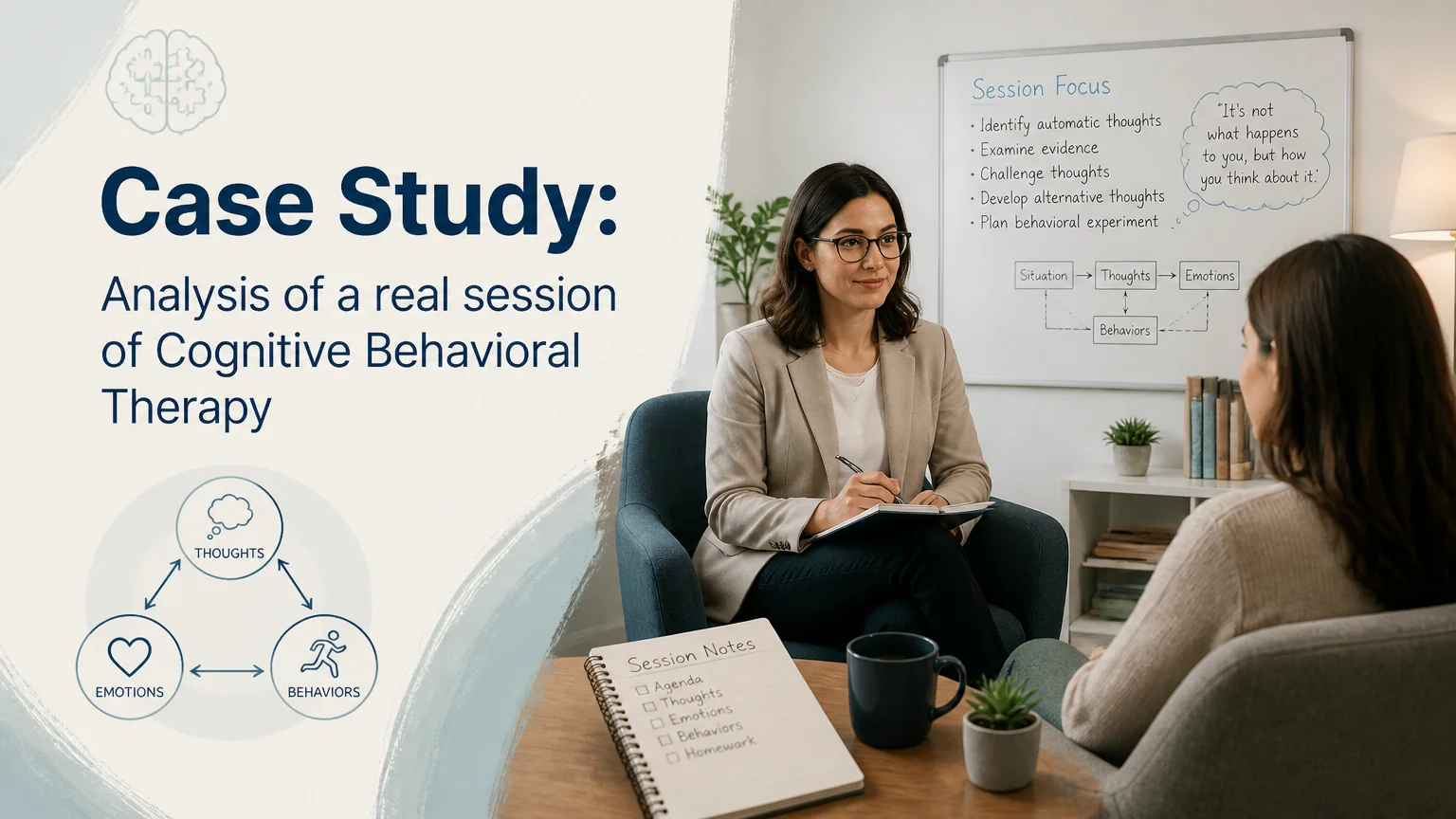
Case study: analysis of a real session of cognitive behavioral therapy
In facing anticipatory anxiety at work, you can benefit greatly from structured techniques. A course focusing on cognitive restructuring strategies will empower you to understand and challenge the thoughts that contribute to your anxiety, helping you approach your responsibilities with confidence.
This session works with an adult who reports anticipatory anxiety at work, especially before meetings with leadership. They arrive with a feeling of a “knot in the stomach”, catastrophic thoughts about making mistakes and a tendency to avoid speaking. The session focuses on clarifying goals, identifying automatic thoughts, collaboratively challenging them and rehearsing alternative behaviors that reduce avoidance.
32-year-old professional, with a good performance history, perfectionistic and self-critical. They report that their anxiety increased in the last three months after taking on new responsibilities. There is no history of panic attacks, but there are persistent worries and muscle tension.
It opens by asking about current state, relevant events since the last meeting and anxiety level from 0 to 10. The client scores 7/10 thinking about tomorrow’s meeting. A brief agenda is agreed: review what happened last week, work on anticipation of the meeting and finish with practical tasks.
This quick formulation offers a shared guide to intervene both cognitively and behaviorally within the same session.
From the exploration two central thoughts emerge: “I need to sound perfect to be respected” and “A mistake exposes that I don’t deserve the position”. A rigid performance rule and an overestimation of the probability of catastrophe are detected.
The client is invited to examine the “perfection” standard and its usefulness: “What evidence do you have that people you respect never make mistakes? How do you react when someone makes a minor slip?” The client acknowledges that they tend to value overall competence and willingness to correct more than the absolute absence of errors.
From this balance, a credible alternative thought is constructed: “I want to do well, but I don’t need to be perfect; if I draw a blank, I can check notes or ask for a moment to regroup.” The emotion drops to 5/10 when repeating this statement and rehearsing it with calm breathing.
An experiment is designed to test the belief that “a slip ruins the meeting”. In a role-play, the client simulates presenting and intentionally “makes a mistake” on a minor detail; then practices a neutral correction: “Correction: the percentage was 18%, not 15%.” It is observed that anxiety rises to 6/10 when erring and falls to 4/10 after the correction, which suggests that handling the error reduces perceived threat.
Micro-exposures are agreed: maintain eye contact, speak during the first two points without yielding the floor, and use a support card with three key ideas. These behaviors compete with avoidance and reinforce safety learning based on experience.
It is emphasized that tasks should be specific, measurable and realistic to sustain motivation and facilitate analysis in the next session.
At closure, anticipatory anxiety decreases from 7/10 to 4/10. The client reports a greater sense of control from having concrete responses to error and an action plan. Observable indicators are identified to evaluate progress: duration of speaking without yielding the floor, number of neutral corrections if slips occur, and anxiety level pre- and post-meeting.
It is proposed to review the records, analyze results of the behavioral experiment and adjust the exposure hierarchy. Core beliefs about competence and personal worth will also be considered if the performance standard remains rigid.
The client’s organizational context is validated and cultural expectations about performance and professional image are considered. Autonomy to decide how far to take exposures is reinforced and transparency about the objectives of each task is encouraged. The approach remains collaborative, with informed consent for the exercises.
Between 45 and 60 minutes, depending on case complexity and the time needed to integrate a cognitive and a behavioral intervention.
Exposure is graded and consensual. Work is done first to strengthen resources, clarify goals and design small steps the person feels manageable, without forcing.
Self-reports (0-10 scale), observation of specific behaviors (participating, keeping the turn, correcting calmly) and feedback from the environment when relevant and voluntary are combined.
They are conceptualized as learning opportunities: review what worked, what didn’t and how to adjust the plan. The goal is not absence of anxiety, but increased effectiveness in facing it.
When changes in automatic thoughts and behaviors do not hold or rigid patterns repeat across multiple contexts. In that case, more focused interventions are planned.
The session illustrates how, by aligning a concrete goal with practical cognitive-behavioral techniques, it is possible to reduce anticipatory anxiety and increase confidence based on personal evidence. The focus on small experiments, clear measurement and active collaboration favors sustainable progress between sessions.
Do you prefer learning by watching and listening? Expand your knowledge with these free videos related to this topic.
Learn how people and environments affect each other, and assess physical and sociocultural context plus five inner dimensions that shape behavior and distress.
Watch VideoLearn to distinguish self-definition from self-evaluation, manage your self-image, and see how self-efficacy and self-esteem shape behavior and well-being.
Watch VideoLearn how emotions prepare the body, explore key universal emotions, and see how Lazarus's primary and secondary appraisals shape emotional responses.
Watch VideoSearch
Popular searches