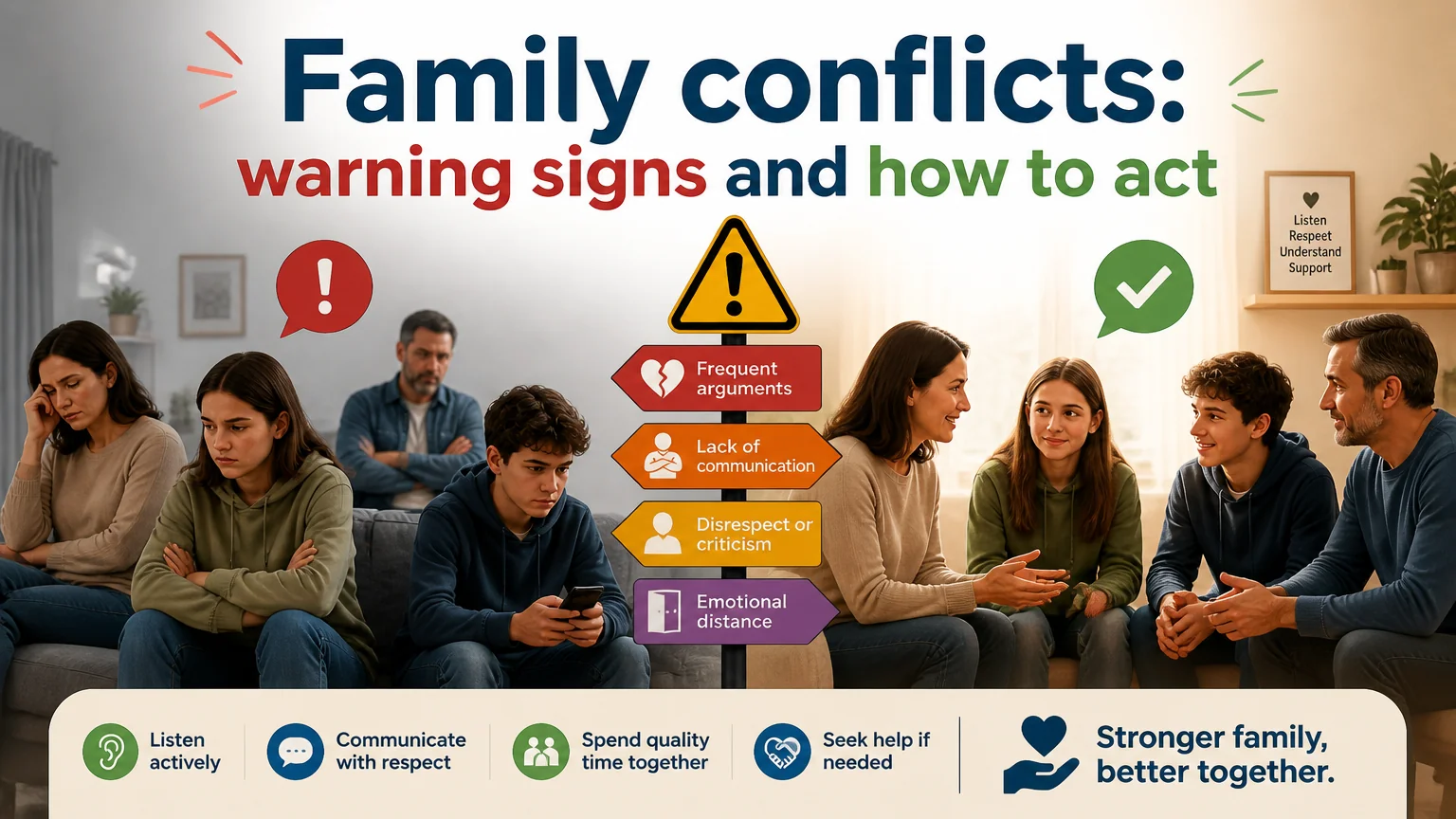
Living together brings inevitable friction, but also opportunities to grow as a family. With the right tools it is possible to lower the tension, better understand each member, and build agreements that are kept. Below you will find a practical set of approaches, techniques, and concrete steps to address everyday disagreements and more complex conflicts with calm and clarity.
Understanding the type of conflict before intervening
Naming the problem well prevents “fighting just to fight” and allows you to choose the right strategy. Ask yourself: what is really at stake? Values, chores, time, money, roles, boundaries, unspoken expectations, or past hurts?
- Differences in values: different ways of seeing education, discipline, tidiness, or screen use.
- Division of tasks and burdens: a sense of unfairness, lack of recognition, or imbalance.
- Poor communication: interruptions, sarcasm, yelling, or silences that escalate the tension.
- Unresolved history: old issues that resurface in every argument.
- Limited resources: time, money, and energy that make it harder to give in or negotiate.
Once the focus is identified, choose one specific conversation instead of trying to solve “everything” at once.
Assertive communication that lowers defenses
Active listening with verification
Listening isn’t waiting for your turn, but ensuring you understood the essence of the other person’s message. Use a brief cycle: listen, paraphrase, validate, and confirm.
- Paraphrase: “What I understand is that you feel overwhelmed by making dinner every day.”
- Reflect emotion: “That sounds like frustration and fatigue.”
- Clarifying question: “What weighs on you the most, planning or cooking?”
- Summary and check-in: “So, if we alternate menus and simplify, does that help?”
First-person messages
Describe your experience without blaming or generalizing. Swap “You never help” for “When I come home and see the kitchen messy, I feel overwhelmed and need concrete support.”
- Observation without judgment: “Three late payments arrived on Saturday.”
- Emotion: “I’m worried we’ll lose control.”
- Need: “I want clarity about expenses.”
- Concrete request: “Shall we schedule 20 minutes on Wednesdays to review finances?”
Validation without necessarily agreeing
To validate is to acknowledge the other person’s logic or emotion, not to give in. “I can see why it bothers you to come home and find noise; I feel the same with visual clutter.”
Emotional regulation to argue without exploding
Agreed pause and family signal
Before things escalate, agree on a word or gesture to pause. The pause lasts between 10 and 30 minutes and is used to calm down, not to punish.
Brief breathing techniques
Box breathing (4-4-4-4) or 4-7-8 helps lower activation. Three well-executed cycles already make a difference.
Minimum viable self-care
Without sleep, food, or rest, anyone argues worse. Define micro-habits: water in sight, short naps on critical days, and 10 minutes of movement.
Dialogue structures that organize the conversation
Traffic light technique
- Red: immediate stop if there is yelling, insults, or put-downs.
- Yellow: a turn for active listening, questions, and validation.
- Green: brainstorming and specific agreements.
Protected time and place
Complex conflicts require context. Agreeing to “today at 8:30 p.m., 30 minutes, no screens” improves the quality of the dialogue.
Brainstorming and a simple decision matrix
- Generate options without judging for 5 minutes.
- Evaluate each option by impact and effort.
- Choose a “good enough” solution to try for 2 weeks.
Agreements and boundaries that are actually kept
SMART agreements
Specific, measurable, achievable, relevant, and time-bound. “Monday to Friday, everyone washes their own dishes before 9:00 p.m.; on Saturday we review.”
Brief and recurring family meeting
- Duration: 20–30 minutes, same day and time.
- Agenda: wins, what didn’t work, one change per week.
- Closing ritual: something pleasant that strengthens the bond.
Agreed and proportional consequences
No emotional punishments. If a task isn’t done, related leisure time is redistributed, or an outing is postponed until it’s back on track.
At-home mediation step by step
- Preparation: define the topic (one at a time) and the desired outcome.
- Rules: no interrupting, no insults, right to a pause.
- Statements: each party speaks for 3–4 minutes using first-person messages.
- Mapping interests: list the needs behind the positions.
- Options: generate at least three solutions that consider both perspectives.
- Agreement: specify who does what, when, and how it will be measured; schedule a review.
When there are children and teenagers
Limited choices
Offering two acceptable options reduces power struggles: “Do you prefer to do homework before or after your snack?”
Visible routines and clear roles
- Boards with schedules and age-appropriate responsibilities.
- Signals for activity changes (timer, short music).
- Immediate positive reinforcement for following routines.
Conflicts over screens
Define device-free zones and times, content rules, and maximum time limits. Agree on specific and predictable consequences for noncompliance.
Practical tools and external support
- Shared calendar for shifts, appointments, and reminders.
- Collaborative to-do lists with priority and owner.
- Shared notes for family meeting agendas and agreements.
Seek professional support if there is violence, intimidation, problematic substance use, severe depressive symptoms, extreme isolation, or if conflicts do not diminish despite your efforts.
Useful phrases and scripts in tense moments
- “I want to understand you better. What’s most important to you in this?”
- “What I’m hearing is that you feel…, is that right?”
- “I need a 15-minute break so we can talk without hurting each other.”
- “It would be a big help to me if…; in return, I can…”
- “Let’s try this option for two weeks and review it on Sunday.”
- “I appreciate that today…; thank you for that effort.”
Common mistakes that worsen the atmosphere
- Generalizing with “always” or “never.”
- Interpreting intent instead of describing impact.
- Using sarcasm or humiliation as a release valve.
- Debating complex matters when someone is exhausted or hungry.
- Opening five topics at once; better one per conversation.
- Bringing up the past punitively instead of learning from it.
- Negotiating in front of the children about couple issues that require privacy.
7-day action plan to start now
- Day 1: Identify the main conflict and write the desired outcome in one sentence.
- Day 2: Agree on conversation rules and a pause signal; practice it once without a conflict.
- Day 3: Practice active listening with a neutral topic (5 minutes per person).
- Day 4: Define a set space and time for important conversations.
- Day 5: Brainstorm solutions; choose a “good enough” one.
- Day 6: Turn the solution into a SMART agreement with simple metrics.
- Day 7: Brief review meeting; acknowledge progress and adjust one detail.
How to sustain changes over time
What gets measured improves: record agreement compliance with simple marks and celebrate small wins. Keep meetings short and consistent, reduce the intensity of big conversations, and increase the frequency of micro-adjustments. Remember that the goal isn’t to win arguments, but to strengthen trust and cooperation.
Final idea
Conflict is not a sign of failure, but an invitation to know each other better and to organize more fairly. With clear language, protected time, verifiable agreements, and emotional care, any family can turn tensions into learning and build a kinder, more sustainable coexistence.
 For Onlinecourses55
|
2026-09-04