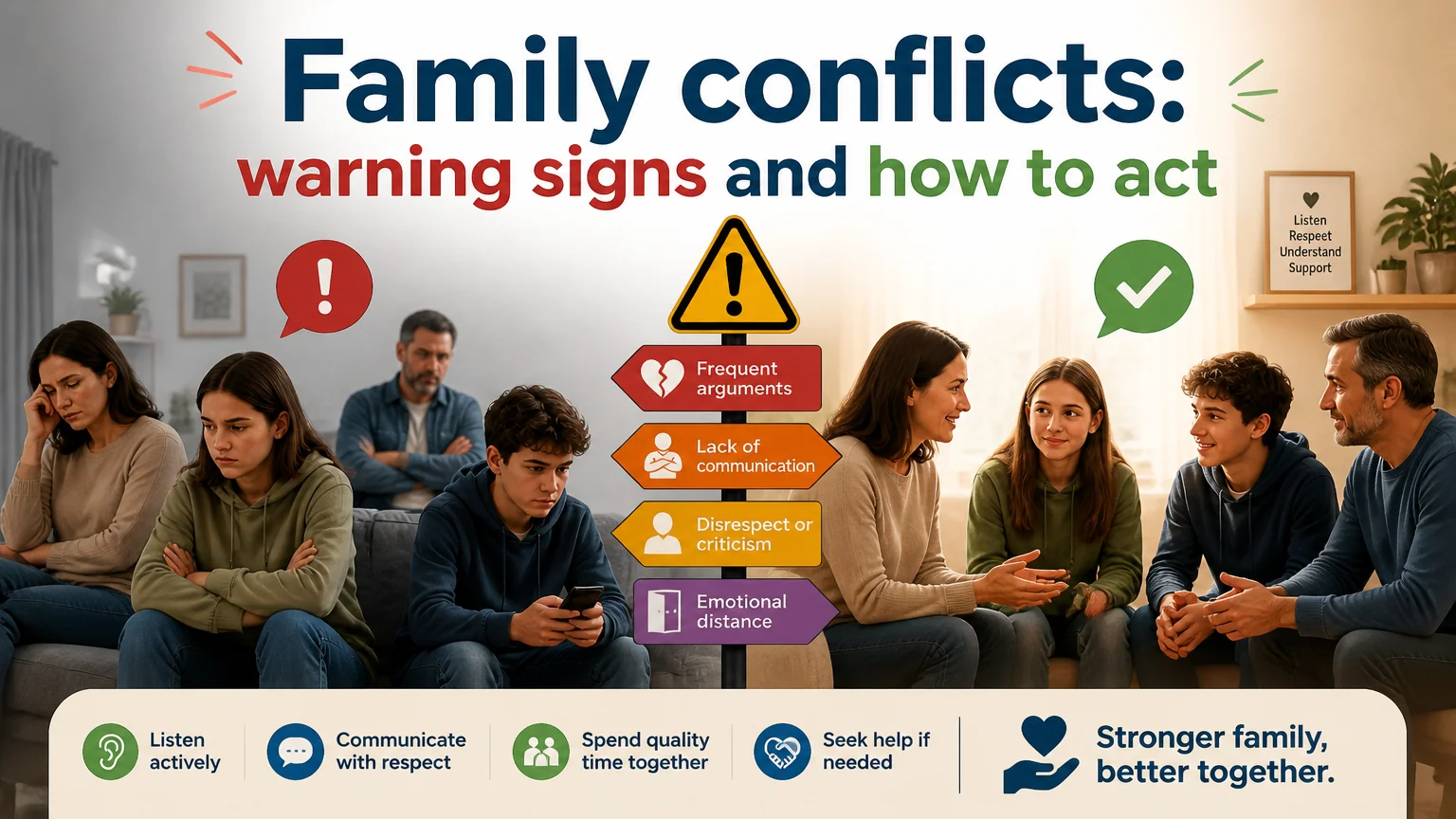
Family conflicts: warning signs and how to act - family conflict resolution
Understanding how to handle familial tensions positively can be enlightening; dive into a transformative course geared towards improving family dynamics and resolution strategies that can reshape your household for the better.
Understanding family conflict
Conflicts in the family are not, in themselves, a problem. They are a natural part of living together among people with different histories, needs, and paces. The challenge is not “to never argue,” but to learn to recognize when a difference of opinion becomes harmful, and how to channel it so that the relationship emerges stronger. A poorly managed conflict tends to repeat with greater intensity, builds up resentments, and affects the emotional health of those who live under the same roof. In contrast, when addressed with respect, clear boundaries, and active listening, it can open doors to fairer agreements and healthier dynamics. Understanding what we are talking about, what signs to watch for, and what steps to take is the first step toward transforming tensions into opportunities for individual and collective growth.
Warning signs not to ignore
In everyday life together
- Arguments that repeat over and over about the same topics, with no changes or concrete agreements.
- Prolonged silences, evasion, or the “silent treatment” as a habitual way to punish or control the other person.
- Put-downs, mockery, or sarcasm that humiliate and undermine trust, even if presented as “jokes.”
- Outbursts of anger, slamming doors, breaking objects, or shouting that create fear in the home.
- Important decisions made without consulting the people affected, generating a sense of invisibility or abuse of power.
- Using money, favors, or personal information to manipulate, demand, or blackmail.
In children and adolescents
- Sudden mood changes, drop in school performance, irritability, or sudden isolation.
- Fear of making mistakes, hypervigilance, or a need to “keep the peace” at any cost.
- Regressions (bed-wetting, nighttime fears) or frequent somatization (headaches or stomachaches without a clear medical cause).
- Risky behaviors: early substance use, running away from home, violence with peers or siblings.
- Difficulty sleeping, recurring nightmares, or a marked loss of appetite.
In couples and adults
- Loss of emotional intimacy: concerns, achievements, or vulnerabilities are no longer shared.
- Control of time, clothing, friendships, or social media under the pretext of “caring.”
- Rigid inequalities in household and caregiving tasks that generate chronic fatigue and resentment.
- Disagreements about money that include hiding expenses, debts, or income.
- Using children as messengers or allies in the dispute, placing them in the middle of the conflict.
Common causes and risk factors
Conflicts usually have multiple roots. Sometimes they stem from patterns learned in childhood that are repeated without question; in other cases, from life changes that disrupt routine (birth, bereavement, moving, unemployment). Economic stress, lack of quality time, unaddressed mental health problems, and unrealistic expectations about each member’s roles also play a part. The absence of clear boundaries, difficulty expressing needs without attack or defense, and ambiguous or passive-aggressive communication act as fuel. Recognizing these factors is not about finding culprits, but about broadening the map to intervene more precisely and compassionately.
How to act: practical steps to de-escalate and repair
- Intentional pause: when tension rises, agree on a “time-out” of 20 to 40 minutes to lower physiological activation before continuing.
- Name without blaming: describe observable behaviors and effects (“when the plan is changed without notice, I feel excluded”), avoiding global labels (“always,” “never,” “you’re irresponsible”).
- Interest in the need behind the behavior: ask “what do you need?” instead of assuming motives.
- One goal per conversation: stick to one topic and a concrete objective. Mixing multiple issues increases confusion.
- Clear offers and requests: propose specific, measurable, and realistic actions, with deadlines and those responsible.
- Repair the harm: if there were shouts, put-downs, or indifference, offer sincere apologies, validate the impact, and agree on how to prevent a repeat.
- Record agreements: write down commitments in a visible place and review their follow-through weekly.
Communication that reduces tensions
- Active listening: summarize what the other person said before responding to verify understanding and reduce misunderstandings.
- First-person messages: “I need/I feel” instead of “you make me/you all never.”
- Emotional validation: acknowledge the other person’s emotion even if you don’t share their point of view.
- Proportion rule: for every criticism, offer at least three sincere acknowledgments over the week.
- Tone and pace: lower the volume, avoid interruptions, allow silences to think.
Communication is not only what is said, but when, how, and for how long. Choosing low-demand moments, agreeing on signals to stop if tension rises, and establishing “reconnection rituals” (a walk, a mate, a screen-free dinner) helps sustain the bond while differences are resolved.
Agreements and boundaries that protect
- Non-negotiable boundaries: physical violence, threats, humiliation, and control are red lines. Protecting safety is the priority.
- Division of tasks: list all household and caregiving chores, assign them fairly and on a rotating basis, and review them monthly.
- Transparent finances: a shared budget, visible expenses, and rules for extraordinary purchases.
- Technology and screens: schedules, device-free spaces, and agreed-upon consequences for noncompliance.
- Privacy and personal time: each member needs their own spaces to rest and recharge.
Strategies according to the type of conflict
- Finances: prioritize needs, create an emergency fund, and set caps on individual spending.
- Parenting and limits with children: agree on 3 to 5 clear rules, consistent consequences, and daily positive reinforcement.
- Extended family: agree on kind boundaries (“we can’t today, see you on Sunday”) and present a united front.
- Inheritance and property decisions: document agreements in writing and, if complex, mediate with a neutral professional.
- Life changes (moving, arrival of a baby): schedule responsibilities, anticipate scenarios, and maintain weekly check-ins.
When to seek professional help
- When the conflict escalates to physical or sexual violence, or threats; it is urgent to seek protection and specialized support.
- If there is problematic substance use, depression, severe anxiety, or self-harming thoughts.
- When arguments take up a large part of the day, affect work/study or sleep, and you can’t get out of the loop.
- If a person is afraid to speak or feels constantly watched or controlled.
- When previous attempts at agreement fail or there are power asymmetries that make dialogue unfair.
Early intervention shortens processes, reduces harm, and offers practical tools. Asking for help is an act of care, not of failure.
Prevention and strengthening of the bond
- Deliberate quality time: at least 15 to 20 minutes a day of screen-free connection with each significant person.
- Family rituals: shared meals, games, celebrations, and farewells that mark belonging.
- Emotional education: name what you feel, teach how to ask, thank, and repair.
- Take care of the basics: enough sleep, regular meals, daily movement; the body influences mood and patience.
- Quarterly review: assess what works, what hurts, and what can be adjusted, celebrating achievements and correcting course.
30-day action plan
- Days 1-7: identify the 3 most frequent sources of conflict; agree on pause signals and a weekly space for conversation.
- Days 8-14: map out tasks and times; redistribute responsibilities and establish one communication rule (listening without interruptions).
- Days 15-21: implement a visible budget, set technology limits, and schedule moments of connection.
- Days 22-30: review progress, adjust agreements, and plan external supports if something remains stuck.
Sustainable changes happen step by step. Paying attention to warning signs, acting with firmness and care, and committing to explicit agreements transforms the home into a safer and kinder place for everyone. It’s not about avoiding conflict, but about learning to move through it with respect, responsibility, and hope.
 For Onlinecourses55
|
2026-10-04
For Onlinecourses55
|
2026-10-04