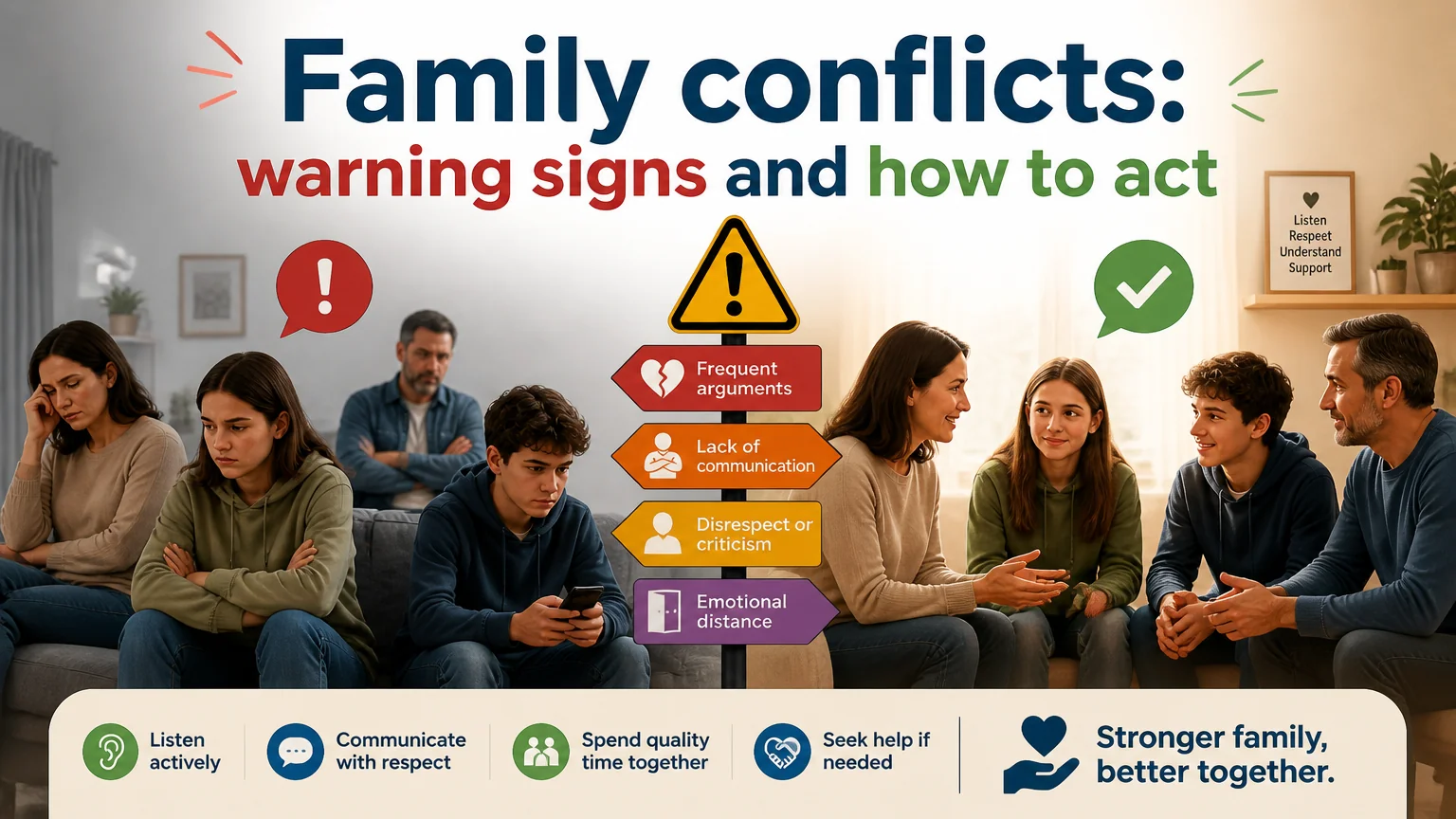
In the family context, conflicts are inevitable; what makes the difference is how the accompanying emotions are managed. When anger, frustration, or sadness arise, we tend to react automatically. Cultivating awareness, self-regulating, and communicating clearly turns painful arguments into opportunities for understanding. Below is a practical guide to navigate disagreements with greater calm and effectiveness.
Why emotions intensify family conflicts
In families, histories, loyalties, and expectations intertwine. That’s why a misinterpreted phrase can touch deep chords: the desire to be seen, respected, or loved. When the brain perceives a threat, it activates fight, flight, or freeze responses. This pushes us to interrupt, justify, blame, or shut down the conversation. Understanding this mechanism helps us personalize reactivity less and make more conscious decisions.
Self-awareness: the first step to de-escalate
Early signs of overwhelm
- Physical: jaw tension, warmth in the chest, rapid breathing.
- Cognitive: “all or nothing,” assumptions, an urgent need to be right.
- Behavioral: raising your voice, interrupting, withdrawing abruptly.
Naming what you feel (“I notice I’m defensive,” “I am sad”) reduces intensity and activates brain areas involved in self-control.
Simple emotional mapping
- Identify the primary emotion: fear, sadness, anger, shame.
- Explore the need underneath: safety, recognition, autonomy, connection.
- Define a realistic goal: to be heard, to agree on a boundary, to plan a change.
Before speaking: emotional preparation
Physiological pause
- Breathe 4-6: exhale longer than you inhale for 2–3 minutes.
- Connect with the body: plant your feet, relax shoulders, unclench your jaw.
- Delay the conversation if you’re at “10/10” intensity; return with a set time and date.
Intention and boundaries
- Clear intention: “I want to understand and agree on next steps, not look for who’s to blame.”
- Healthy boundaries: “if voices rise, we’ll take a 15-minute pause.”
- Scope: define which topic you will discuss to avoid opening endless fronts.
During the conversation: techniques that regulate and bring you closer
Active listening and validation
- Paraphrase: “what concerns you is… is that right?”
- Validate the emotion, not necessarily the version of events: “I understand that it’s frustrating for you.”
- Ask open-ended questions: “what would be a sign of improvement for you?”
First-person messages
- Describe behavior and effect: “when the plan changes at the last minute, I feel overwhelmed.”
- Avoid global labels: “always,” “never,” “you are.”
- Ask for something concrete: “can we give each other 24 hours’ notice?”
Reframing and seeking interests
Behind opposing positions there are often compatible interests. Instead of “I want you to come every Sunday” versus “I don’t want to go,” explore the interest: family connection and autonomy. The agreement could be biweekly visits and brief video calls during the week.
After the conflict: repair and learning
Closing the cycle prevents resentments from piling up. Even if there wasn’t total consensus, repair strengthens the bond.
- Summarize agreements and next steps in writing to reduce misunderstandings.
- Acknowledge your part: “I got carried away and interrupted you; I’ll work on pausing.”
- Review the process: what worked, what to improve for next time.
Strategies by relationship
Partners
- Check the “emotional tank”: if it’s empty, everything sounds like criticism.
- Schedule difficult conversations outside moments of exhaustion.
- Balance “task time” (logistics) with “connection time” (affection and play).
Parents and children
- Co-created regulation: the adult models calm before demanding it.
- Limited choices: instead of open orders, two clear alternatives.
- Transition rituals: upon arriving home, 10 minutes of undivided attention reduce friction.
Siblings and extended family
- Common ground rules: speaking turns, time limits, consensus decisions when possible.
- Avoid triangulation: speak directly with the person involved.
- For inheritances or caregiving, define roles and written criteria to reduce ambiguities.
Practical tools to regulate emotions
- Box breathing: 4-4-4-4 counting inhale, hold, exhale, hold.
- 5-4-3-2-1 grounding: five things you see, four you feel, three you hear, two you smell, one you taste.
- Expressive writing: 10 minutes unfiltered; then underline needs and possible requests.
- Brief movement: walking 5–10 minutes lowers activation and improves clarity.
- Respectful humor: decompress without mockery or hurtful sarcasm.
- Shared pause signal: a keyword to stop escalations without shaming.
Common mistakes and how to avoid them
- Mind reading: ask instead of assuming.
- Keeping score of the past: focus on the current incident and a specific pattern, not the entire history.
- Character judgments: describe observable behaviors and effects.
- Debating at peak activation: postponing is maturity, not surrender.
- Constant ultimatums: reserve firm boundaries for what is essential and follow through.
Establishing agreements and healthy boundaries
- Time and place: define when and where sensitive topics will be discussed.
- Channel: some matters work better in writing to organize ideas.
- Basic rules: no insults, no interruptions, pauses when someone asks.
- Follow-up: date to review how the agreement is going and adjust it.
- No-go zones: topics that, for now, are best left out to protect the relationship.
When to seek professional support
If there is violence, threats, problematic substance use, constant disparagement, or a pattern that repeats despite genuine attempts to change, the intervention of a neutral third party can make a difference. It’s also helpful when there are difficulties expressing emotions without exploding, when the conflict affects minors, or when dialogue gets stuck in loops of blame and defensiveness.
7-day plan to get started
- Day 1: Notice your triggers; write down three early signs of activation.
- Day 2: Practice 4-6 breathing for 5 minutes, twice a day.
- Day 3: Write an “I-message” about a pending issue.
- Day 4: Rehearse validation: choose a situation and practice paraphrasing without counterarguing.
- Day 5: Clarify the intention and goal of a conversation you need to have.
- Day 6: Converse with rules: timing, no interruptions, final summary of agreements.
- Day 7: Review what you’ve learned and define a maintenance micro-habit (for example, a 2-minute pause before sensitive topics).
Closing
Managing emotions doesn’t mean suppressing them, but giving them a channel that cares for the bond while honoring each person’s needs. With small, consistent practices — pauses, listening, clarity, and boundaries — conflicts stop being quicksand and become fertile ground for trust. The family doesn’t become perfect, but it does become safer to disagree, repair, and grow.
 For Onlinecourses55
|
2026-11-03