For Onlinecourses55
|
2026-10-25
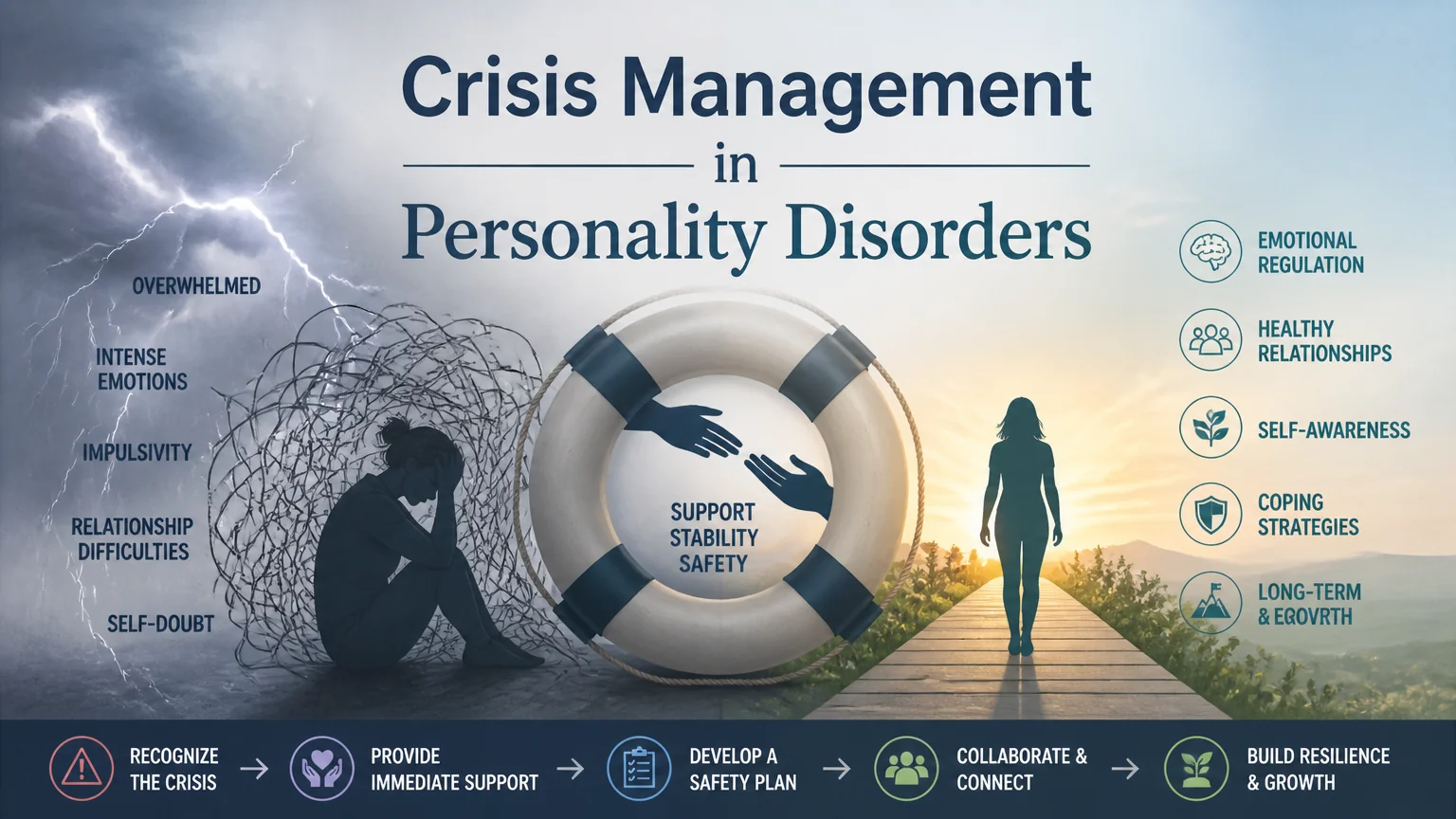
Crisis management in personality disorders - psychology disorder personality
Crisis management in personality disorders requires skill and preparedness. Our focused training program offers practical guidance for those in the mental health field looking to manage crises effectively and compassionately.
Managing a crisis related to personality disorders can feel overwhelming, both for the person experiencing it and for their environment. A crisis is usually a moment of intense emotional and behavioral dysregulation, during which impulsive reactions, interpersonal conflict, or feelings of emptiness and threat increase. Preparing beforehand, recognizing signs in time, and acting with simple, structured steps helps reduce harm and restore balance. Below you will find a practical and humane framework to understand what is happening, what to do in the moment, how to prevent relapses, and how to care for the relationship with yourself and others during and after the crisis.
In personality disorders, a crisis is not "drama" or a "tantrum"; it is a response to emotional overload or to a trigger perceived as threatening. It can arise after conflicts, losses, changes, criticism, or even from the accumulation of everyday stress. During the crisis, the brain's alarm system takes over: thinking becomes polarized, tolerance for frustration decreases, and the urge to act without considering consequences grows. Understanding this does not justify harm, but it does guide the intervention: safety first, regulation next, and reflection last.
Identifying early signs allows intervention before the crisis escalates. Some can be subtle and others very evident.
Recognizing personal patterns of triggers (for example, being late, changes of plans, tone of voice, prolonged silences) helps create a realistic plan and communicate needs before distress explodes.
These are skills to ride out the wave without making the problem bigger. They can include briefly immersing the face in cold water to activate the diving reflex, brief muscle tension and relaxation exercises, or distracting with concrete tasks for a limited time. The idea is not to avoid, but to gain time to regulate and choose better.
Paying attention to the present without judging: observing the emotion as a wave that rises and falls, noticing thoughts as "clouds" and returning to the breath or a bodily sensation. Small daily practices train the attention muscle and reduce automatic reactions.
Involves identifying emotions, understanding their function and adjusting the response. Small steps: check basic needs (sleep, nutrition, movement), reduce intoxicants (alcohol, excessive caffeine), and use active self-care (warm shower, walking, music that soothes without intensifying).
Learning to ask, say no and negotiate without sacrificing the relationship or self-esteem. Practicing clear phrases, describing facts without labels and proposing concrete solutions decreases the cycle of escalation and distance.
A written plan reduces improvisation. It can be brief and very practical. Ideally it is developed in a calm moment and shared with 1-2 trusted people.
How you say something matters as much as what you say. Speaking from your own experience instead of accusing reduces defensiveness. A useful format is to describe the situation, the emotion, the need and the request, briefly and specifically.
When the tide goes down, it's time to repair and extract lessons without destructive guilt. A mini review can include: what triggered it, what helped, what made it worse, and a small adjustment for next time. Repair does not erase what happened, but it rebuilds trust.
If crises are very frequent, there is a risk of self-harm, problematic substance use, violence or functional deterioration (work, study, relationships), it's time to add professional support. Approaches with the most evidence include skills-based interventions, mentalization-based therapies, transference-focused therapy and formats combined with family psychoeducation. Seeking help does not diminish personal effort; it enhances it. If there is immediate risk of harm, prioritize safety and contact emergency services or a trusted person who can accompany you.
Supporting someone is exhausting. Self-care is not selfish: it sustains you. Sleeping, moving, maintaining your own networks and having spaces to talk about what you experienced prevents burnout and reactivity. It also helps to agree, outside of crises, what you can and cannot offer, to avoid promises you later cannot keep. A healthy relationship means mutual care and clear boundaries.
Crises do not define people nor determine the future. With a simple plan, practiced skills and appropriate supports, intensity and frequency can decrease significantly. The key is to combine understanding (validation), direction (limits and concrete steps) and consistency (small repeated actions). It is not about perfection, but about improving a little each cycle. Each time you get through a crisis with less harm and more clarity, you are building evidence that change is possible.
Search
Popular searches