For Onlinecourses55
|
2026-11-04
Sports psychologist vs. coach: legal and practical differences - sports psychology
Knowing the distinct roles of sports professionals is essential; hence, learning about the interplay of coaching and psychological support can inform your decisions and enhance athlete welfare.
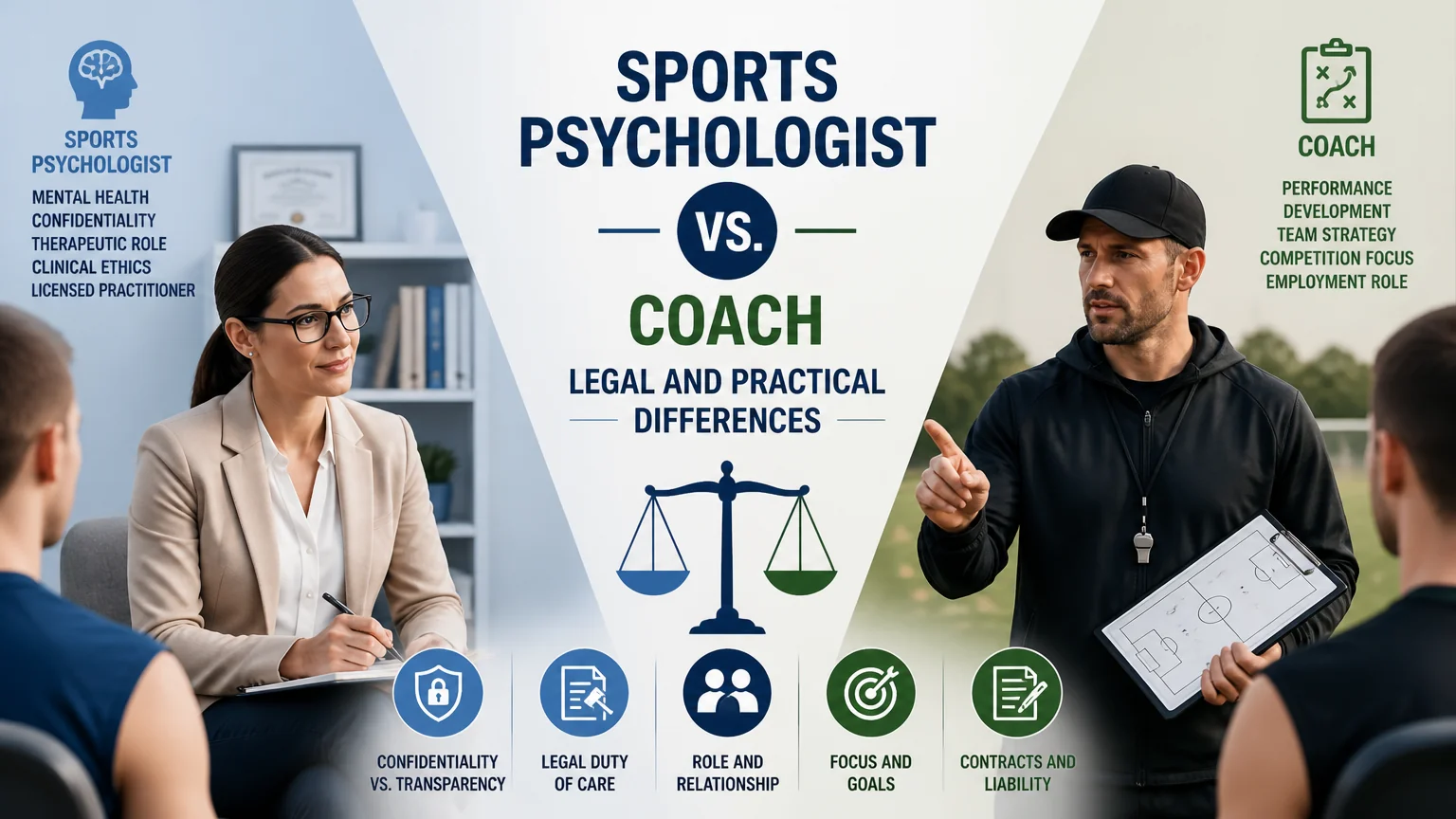
In high performance and grassroots sport it is common to hear the terms “psychologist” and “coach” as if they were interchangeable. They are similar in that both seek to improve the athlete's performance and well-being, but they are not the same. The difference matters for two reasons: on one hand, the legal framework that protects the athlete when mental health problems are addressed; on the other, the efficacy and safety of the intervention when the aim is to train skills, support habits or achieve specific performance goals. Understanding what each profile can do, what ethical limits they have and how they fit within a technical staff helps make informed decisions and avoid unnecessary risks.
The professional use of the title, the competencies and the responsibilities are not identical. In general terms, psychology is a regulated profession; coaching is not. This implies that the person practicing psychology must meet training, registration and insurance requirements, and is subject to a code of ethics and health protection rules. Coaching, on the other hand, is governed by private contracts and standards of professional associations, without specific legal authorization.
In Spain, practicing as a psychologist requires a university degree in Psychology and membership in the Official College of Psychology. If the intervention is health-related (diagnosis, prevention or treatment of mental health problems), specific authorization is required as a General Health Psychologist or as a Specialist Psychologist in Clinical Psychology. The professional may apply psychometric tests, carry out psychological assessments, diagnose and treat disorders, and is obliged to comply with the GDPR and the LOPDGDD in data handling. They must have civil liability insurance and respect the code of ethics (informed consent, confidentiality, competence and limits of practice).
Coaching, including sports coaching, is not a profession regulated by law. There are private certifications (for example, ICF or EMCC) that set standards of practice, supervision and training, but they do not grant health-related authorizations. A coach cannot diagnose or treat psychological disorders, should not administer tests restricted to psychologists and their responsibility falls within the contract, data protection regulations and commercial and consumer law.
In most Latin American countries the title of psychologist is also regulated: it requires a degree and, often, registration or professional licensing; clinical and health practice carries additional requirements. Coaching, meanwhile, lacks specific state regulation and operates with private certifications. Although details vary by country, the pattern is similar: the evaluation, diagnosis and treatment of mental health problems correspond to the psychologist; the facilitation of goals, habits and performance skills can be in the hands of a coach, provided they do not encroach on the clinical domain.
The psychologist addresses both performance and mental health. They can work with competitive anxiety, depression, injury processes, stress, sporting grief, addictions or eating disorders; and also with activation skills, concentration, emotional management, leadership or team cohesion. The coach focuses on concrete action goals and observable results: pre-competition routines, planning, communication, training habits, decision-making, accountability and progress tracking.
The psychologist uses evidence-based interventions: structured assessment, psychometrics when appropriate, psychoeducation, cognitive-behavioral therapy, acceptance and commitment therapy, mindfulness, crisis intervention, work with parents/coaches and return-to-play protocols after injury. The coach employs structured conversations, powerful questions, performance agreements, feedback, action plans, non-clinical visualizations and habit reviews. When symptoms exceed their scope (for example, panic attacks, suicidal ideation, eating disorders), they must refer to a health professional.
The psychologist is legally and ethically obliged to protect confidentiality, record the clinical history securely and request informed consent, including clauses on communication with the technical staff. The coach must also protect personal data and agree by contract what information is shared with the club or coach, but their framework is contractual, not health-related. In both cases, the GDPR applies in Europe to data processing.
The main grey area arises when mental health problems are confused with “performance blocks.” Persistent avoidance of competing, significant weight loss due to aesthetic pressure, problematic substance use or severe insomnia are not coaching matters: they require psychological assessment. Another risk is the use of psychological tests by non-psychologists; besides lacking validity, this may violate the athlete's rights. Finally, pressure for results can lead to breaches of confidentiality; this is prevented with clear agreements from the outset.
A serious professional explains their scope, details the process, requests informed consent, documents objectives and periodically reviews the plan. They also pursue continuous training and accept supervision for complex cases.
The psychologist usually works with informed consent, a framing document and, where appropriate, a contract with the club. They must have civil liability insurance and be registered. Fees reflect the complexity of the assessment, the sessions and coordination with other stakeholders. The coach works with a service contract that specifies scope, duration, success metrics, confidentiality and fees. Although not always mandatory, it is advisable that they have civil liability insurance and data protection policies. In both cases it is advisable to set in writing how conflicts, cancellations and ownership of working materials are resolved.
In summary, both profiles provide distinct and complementary value. Choosing well depends on identifying the nature of the challenge: clinical, performance or mixed. When the legal and ethical framework is respected, the athlete gains in safety and performance becomes sustainable.
Search
Popular searches