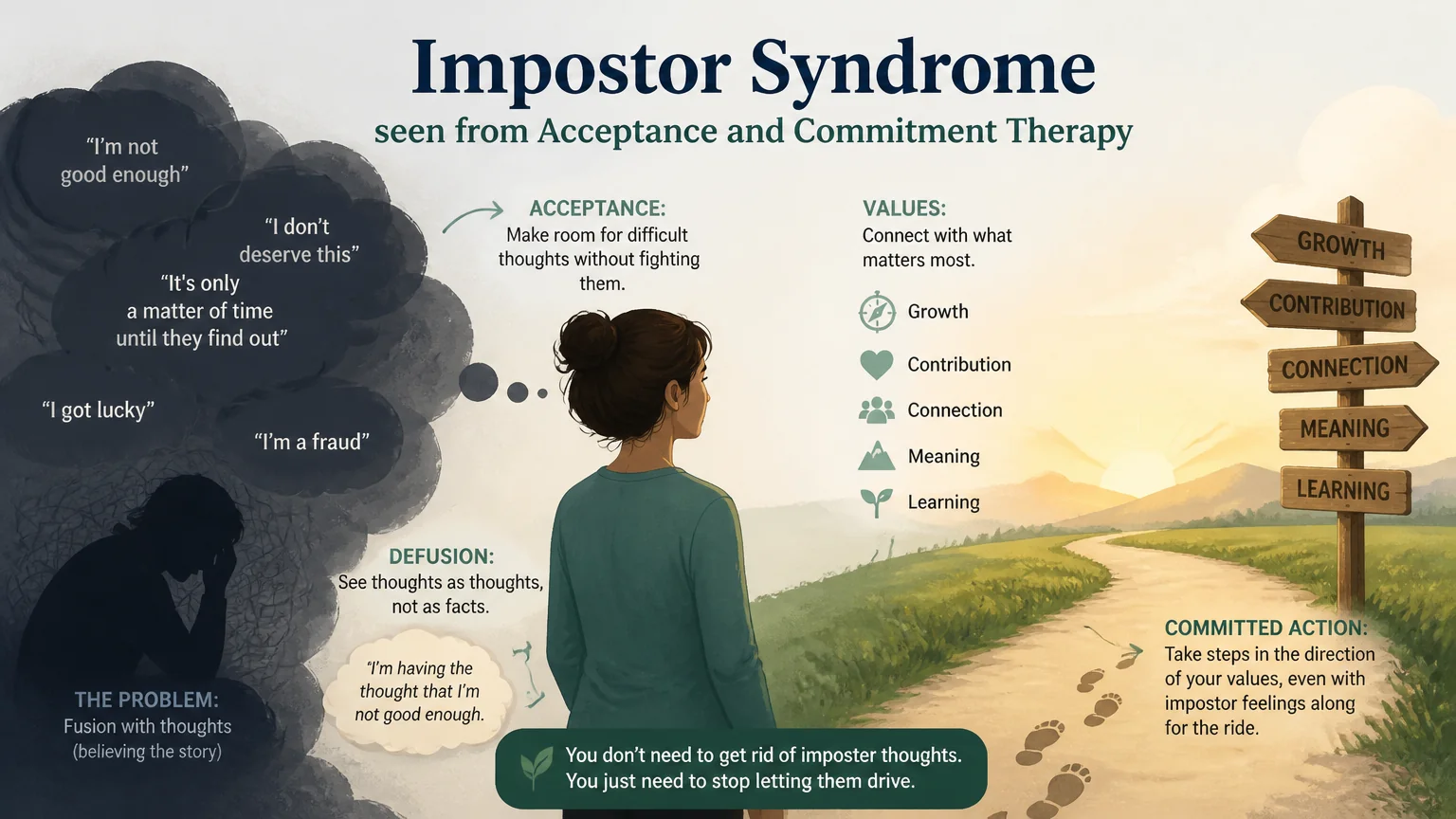

Framing and Definition of the Therapeutic Process Explained
Learn how Acceptance and Commitment Therapy shifts from changing thoughts to changing your relationship with them through acceptance and values-based action.
Watch Video For Onlinecourses55
|
2026-11-21

Creative despair: why hitting rock bottom is the start of change
Understand and recover from creative blocks using insights from Acceptance and Commitment Therapy that encourage exploration and new beginnings.
There are times when creativity seems to shut down completely. It’s not just a block: it’s a feeling of emptiness, a mix of exhaustion, shame, and the certainty that nothing you do will be good enough. That state is frightening, but it can also be a threshold. When something reaches its limit, the old way of doing and understanding things can no longer hold; from there, the only option is to reconfigure, let go of the weight, and start differently. That edge, as painful as it may be, shows you where you are and what no longer fits you.
Creative discouragement feels like losing your compass. Ideas don’t come, your drive disappears, and your standards rise higher than your motivation. It’s not a lack of talent: it’s often the clash between rigid expectations and a changing reality. Overwhelmed by self-imposed demands and comparisons, the brain activates protective mechanisms that shut down risk-taking. The result is paralysis disguised as “I have nothing to contribute.”
A block is a temporary standstill in a specific task. Creative emptiness is existential: it makes you question the meaning of what you do, your processes, and your identity. One can be resolved with techniques; the other requires an honest review of your assumptions, pace, and support. Understanding this prevents you from fighting with the wrong tool.
When you’ve tried “everything” without success, you’ve probably repeated variations of the same thing: more hours, more pressure, more recycled tricks. Overload dulls your sensitivity. What’s missing isn’t effort, but a change in approach: rediscover play, make the problem smaller, and align expectations with the resources you actually have.
Reaching your limit cuts through the noise. Suddenly, it becomes clear which practices were pretenses, which goals belonged to others, and which fears were dictating your decisions. That’s where a rarely mentioned quality comes into view: radical honesty. Without it, we just accumulate techniques; with it, any technique becomes relevant.
That phrase marks a threshold. It signals that your current strategy is exhausted and creates space to negotiate new rules. In practical terms, it lets you make decisions based on what you genuinely need: rest, companionship, structure, curiosity. It isn’t giving up; it’s stopping the insistence on what is breaking you.
Describe your state precisely: “I’m exhausted and afraid of becoming irrelevant” is more useful than “I feel bad.” Naming your feelings helps regulate them. Write three sentences: what you feel, what you fear, and what you need right now. Those three are enough to guide your immediate decisions.
Make an inventory of unwritten rules (“I must post every day,” “it has to be 100% original,” “if I rest, I’ll lose everything”). Question them one by one: Where do they come from? What do they prove? What do they cost? Keep only the ones that protect your well-being and learning.
Break your goal into ridiculously small units. If writing an article feels overwhelming, your goal for the day is just one paragraph or a list of raw ideas. This breakdown restores a sense of efficacy, a basic ingredient for reigniting desire.
Turn each attempt into a 20-minute experiment with a simple success criterion: “I tried one approach and learned something.” Play reduces the cost of mistakes and makes room for surprise. Document what you discover; creativity grows from recognized patterns, not isolated flashes of inspiration.
Don’t rely on willpower. Set minimum protected hours, judgment-free spaces, accountability partners, and specific reminders. A system supports you on good days and bad ones. The more automatic it is, the less friction you’ll face and the more consistent you’ll be.
Your limit isn’t a verdict; it’s a mirror. What you see there may hurt, but it also illuminates the path your work is asking you to take now. Change doesn’t always mean starting from scratch; sometimes it means refining your purpose, slowing down, asking for help, and learning to play again. When you accept that your measure is not perfection but intentional practice, your energy returns. Then the place that seemed like an ending becomes a foundation: a more honest, more human, and more personal platform from which to create what truly matters.
Do you prefer learning by watching and listening? Expand your knowledge with these free videos related to this topic.
Learn how Acceptance and Commitment Therapy shifts from changing thoughts to changing your relationship with them through acceptance and values-based action.
Watch VideoLearn how ACT is backed by science and institutions, using acceptance, defusion, and values to improve daily function in chronic pain and other disorders.
Watch VideoDistinguish clean pain from dirty pain and turn inner struggle into meaningful action to build a rich life without seeking to eliminate every symptom.
Watch VideoSearch
Popular searches